Temperature, RH and VPD as Contextual Measurements
Technician I uses environmental measurements as documented evidence, not as universal cultivation commands. Learners record temperature and relative humidity together, interpret vapor pressure deficit (VPD) as one description of atmospheric drying demand, distinguish room-air conditions from leaf-level conditions, and preserve the time, location, sensor and method context required for another qualified person to reconstruct the reading. VPD helps describe the gradient that can drive water loss from leaves, but actual transpiration also depends on stomatal conductance, leaf temperature, airflow/boundary-layer conditions and the ability of the root–xylem pathway to supply water.
Key vocabulary
Water vapor in air expressed relative to the saturation amount at the measured temperature.
The difference between saturation vapor pressure and actual vapor pressure under the measured conditions; it describes atmospheric drying demand.
A supplied intended value, range or operating limit used for comparison; it is not the same thing as an observed measurement.
The units, location, time, sensor identity or other information needed to interpret a recorded value correctly.
Temperature and RH belong together
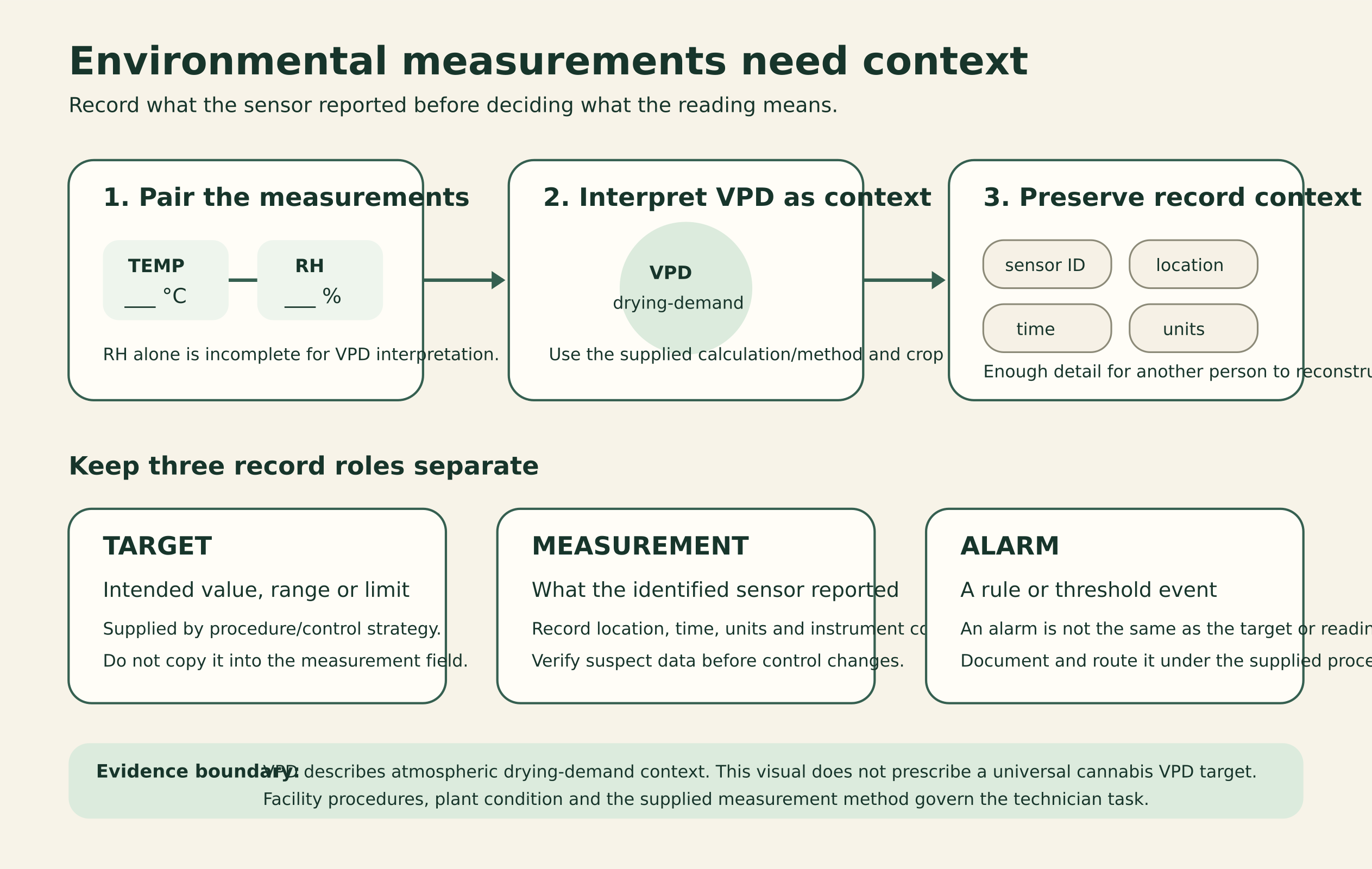
Relative humidity depends on temperature. A humidity percentage without the associated temperature is incomplete for VPD interpretation. Technician I records both values with the units and context required by the facility workflow rather than inferring drying demand from RH alone.
VPD is an interpretation tool, not a universal target law
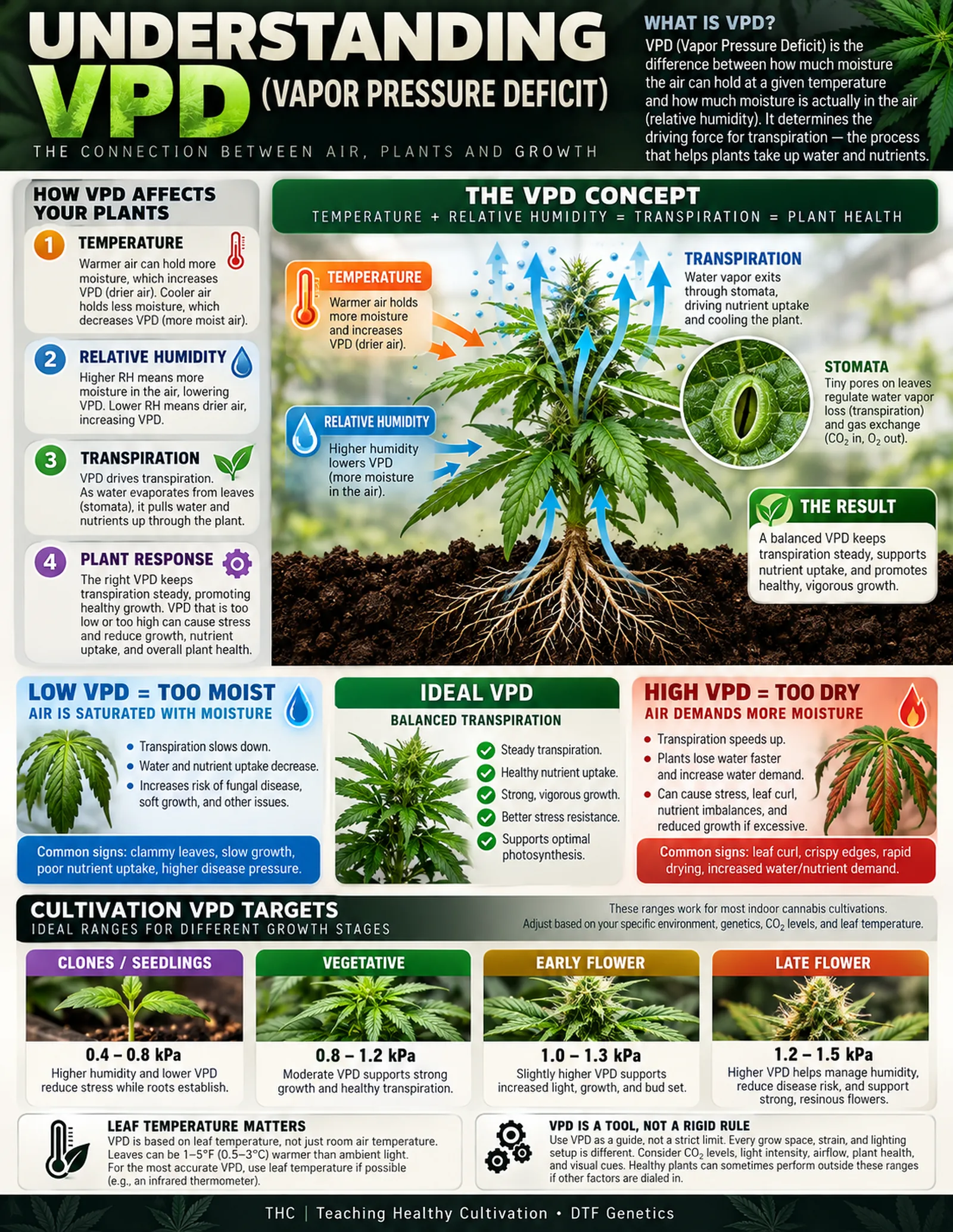
VPD combines temperature and humidity into a useful description of atmospheric drying demand. It should be interpreted with plant stage, crop condition, airflow, root-zone status and the method used to calculate it. Technician I compares readings with supplied targets but does not independently redesign environmental strategy to chase a chart value.
Observed value, target and alarm are different records
A target describes intended operation, a measured value describes what a sensor reported, and an alarm describes a rule or threshold event. A reconstructable record keeps those roles distinct and identifies the sensor, location and time so another person can tell what actually happened.
Air VPD and leaf-level conditions are related but not identical
Room-air temperature and RH can be used to describe atmospheric VPD, but the vapor-pressure gradient experienced by a leaf also depends on leaf temperature. Radiation load, airflow, transpiration and plant water status can make leaf temperature differ from the surrounding air. That is why a technician records where and how temperature/RH were measured and does not treat a room dashboard value as a direct measurement of every leaf surface.
VPD describes demand; plant hydraulics determine the response
Increasing VPD generally increases atmospheric demand for water vapor, but plant response is regulated rather than purely passive. Stomata can reduce conductance as demand rises, and transpiration can also become limited by hydraulic supply through the soil, roots, xylem and leaves. A VPD value therefore cannot, by itself, prove whether a plant is transpiring too much, too little or normally.
Airflow changes the leaf boundary layer and measurement meaning
Air movement alters the thin boundary layer of relatively still air next to the leaf surface. Changing that boundary layer can affect heat and water-vapor exchange even when the room sensor reports the same temperature and RH. Environmental records are strongest when airflow condition, sensor placement and crop location are preserved as context instead of being omitted from the interpretation.
Worked examples
- Two rooms both show 60% RH but have different temperatures. The technician records both variables and compares the resulting VPD context rather than assuming the rooms are equivalent.
- A dashboard target reads 25 °C while the current canopy-zone sensor reads 27 °C. The record stores 25 °C as the supplied target and 27 °C as the observation rather than replacing one with the other.
Common mistakes
- Recording RH without temperature when the task requires VPD context.
- Treating a copied VPD chart as a universal rule for every crop and facility.
- Recording the target value as though it were the actual sensor reading.
- Changing room controls before verifying the reading and the technician authority boundary.
- Assuming air temperature is always identical to leaf temperature when interpreting leaf-level vapor-pressure conditions.
- Treating VPD as a direct measurement of transpiration rather than a description of atmospheric demand that interacts with stomata and plant hydraulics.
- Recording RH without temperature when the task requires VPD context.
- Treating a copied VPD chart as a universal rule for every crop and facility.
- Recording the target value as though it were the actual sensor reading.
- Changing room controls before verifying the reading and the technician authority boundary.
Target versus measurement
Target
The intended value, range or limit supplied by the facility procedure or control strategy.
Measurement
The value actually reported at an identified sensor, location and time.
Downloadable practice: environmental measurement record
Use this printable worksheet to practice keeping supplied targets separate from observations, recording temperature/RH/VPD with sensor and time context, checking representativeness, documenting permitted verification, and preserving uncertainty and escalation status.
Same RH, different temperature
Setting: Room A and Room B both show 60% RH, but Room B is several degrees warmer.
Prompt: What is the strongest Technician I interpretation?
- The rooms must have the same VPD because RH matches
- Record each temperature and RH pair and interpret VPD using the supplied method
- Lower RH in both rooms until the percentages differ
- Ignore temperature because humidity controls drying demand alone
Check response
Answer: Record each temperature and RH pair and interpret VPD using the supplied method
VPD depends on temperature and humidity together, so matching RH percentages do not guarantee the same vapor-pressure relationship.
Practical application
Use the downloadable environmental measurement practice sheet with a supplied dashboard snapshot and room map. Record temperature, RH, calculated or displayed VPD, supplied targets, sensor/location/time context and alarm state; evaluate representativeness; document permitted verification and preserve any uncertainty or escalation need.
Lesson summary
Environmental measurements become useful when their variables, measurement plane and context are preserved. Technician I records temperature and RH together, treats VPD as atmospheric-demand context rather than a universal control law, recognizes that leaf temperature and airflow can change leaf-level conditions, separates target from observation, and escalates rather than turning one number into an unsupported diagnosis or control change.