Harvest Genealogy, Quantity Reconciliation and Discrepancy Control
Harvest is a transformation event: identified source plants or batches become new containers, lots, racks, weights and receiving records. Technician I learners preserve source-to-output genealogy, record what moved and where, reconcile counts and weights, and stop a traceability problem from spreading. A physical-versus-record mismatch remains visible until it is resolved through the controlled process; the technician never edits a number merely to make the records agree.
Key vocabulary
The documented relationship linking source plants or batches to the derived harvest lots, containers or postharvest records.
A traceability event in which source material becomes one or more new identified outputs, such as plants becoming harvest containers or lots.
The controlled comparison of physical quantity, identity, location and record information to determine whether they agree and to document any discrepancy.
A difference between expected, outgoing, incoming or physical counts or weights that requires explanation or controlled resolution before closure.
Harvest creates new traceable outputs
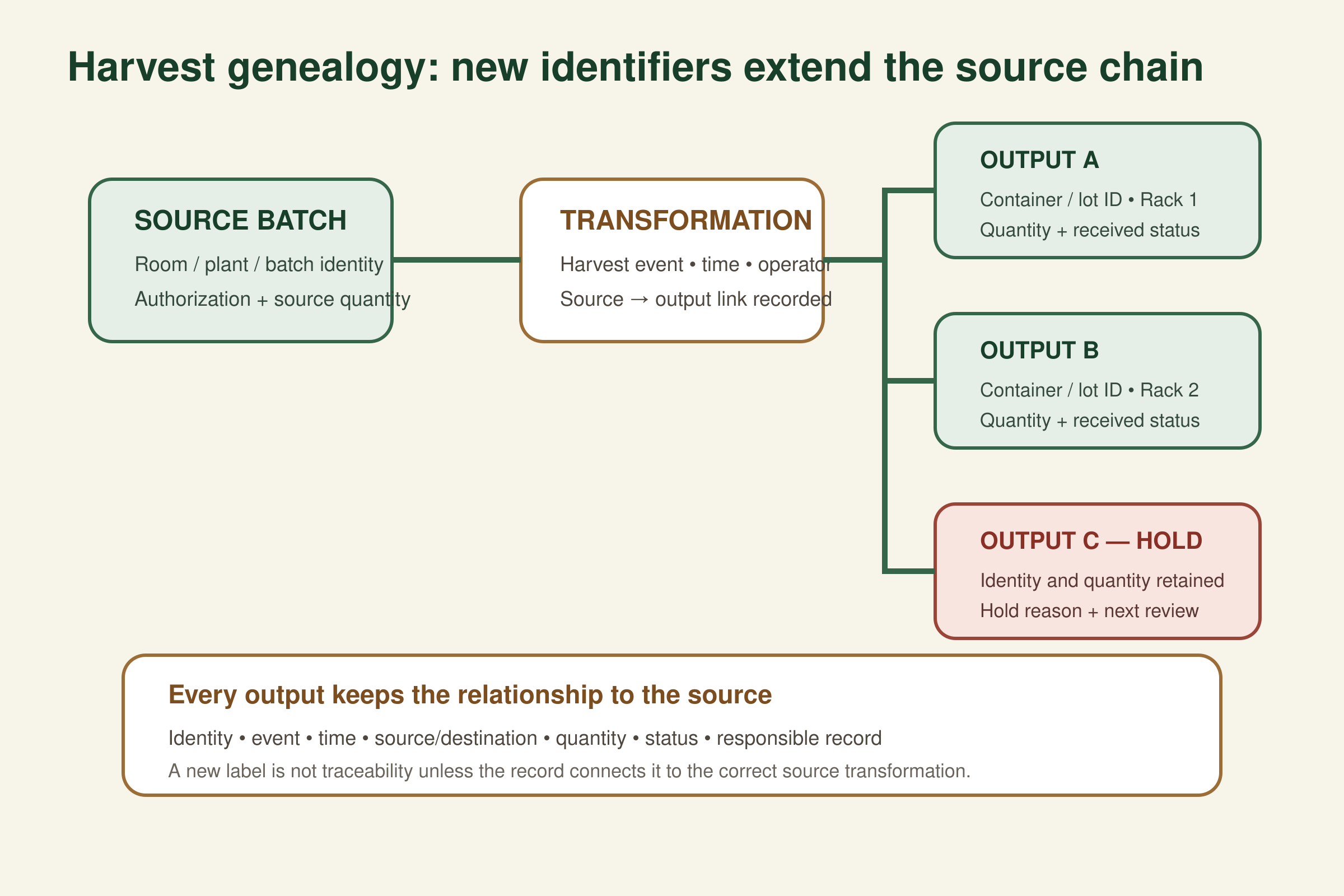
New container or lot identifiers should extend the source genealogy. Record the source identity, event, output identity, source and destination locations, time, quantity where required and responsible record so another person can reconstruct how the current postharvest identity came to exist.
Labels are necessary but not sufficient
A correct label becomes useful traceability only when the record connects it to the right source material and transition. Removing the old identifier before the new relationship is verified or relying on cultivar appearance can permanently break harvest genealogy.
Reconcile physical and recorded quantity
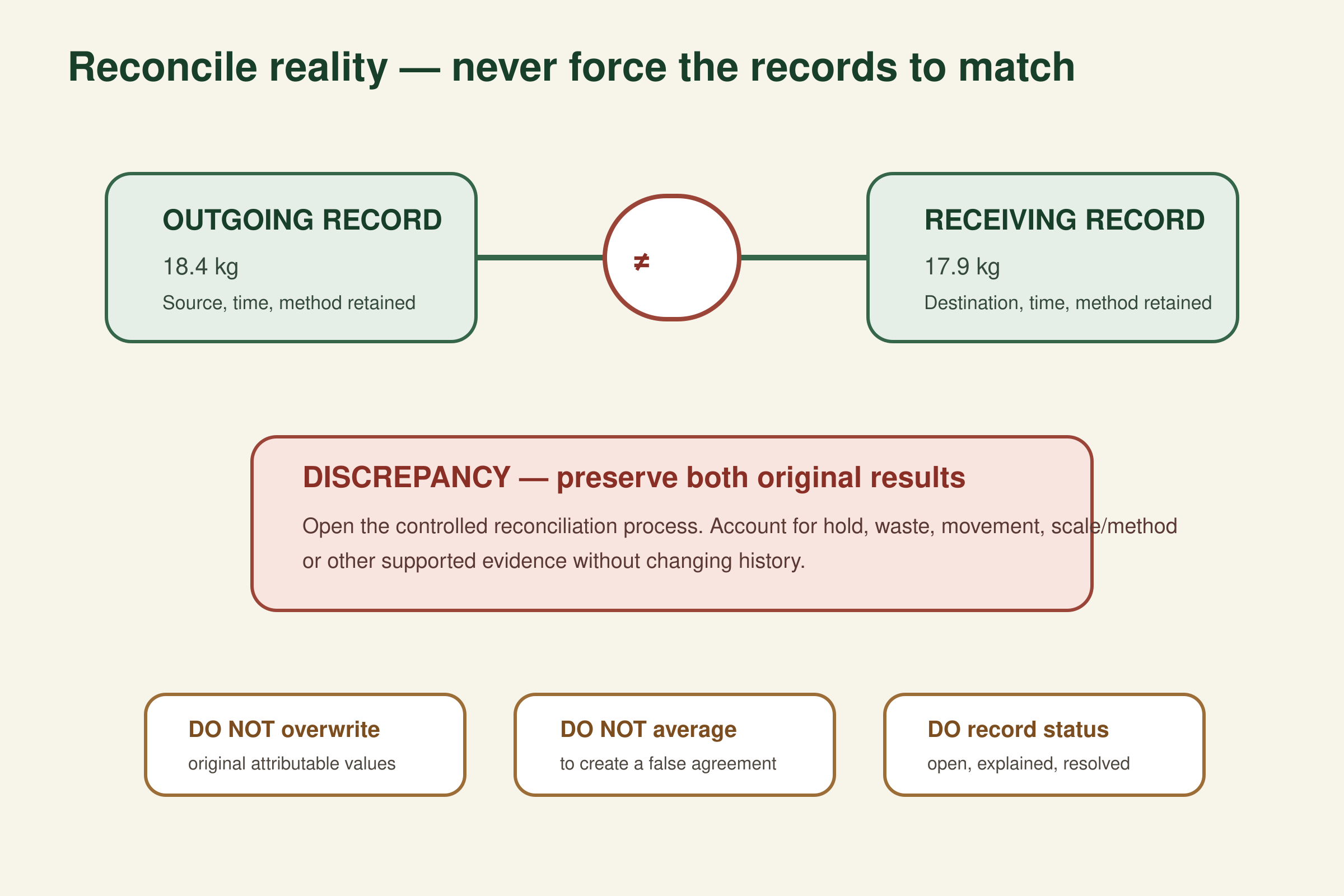
Compare outgoing and receiving counts or weights using the supplied method and units. If values differ, preserve both original results and investigate through the controlled discrepancy process rather than silently changing one record, averaging values or selecting the number that makes the handoff balance.
Waste or hold does not disappear from the chain
Material diverted to a hold, waste or other controlled status remains part of the material history as required by the local workflow. The stable principle is that removed or diverted quantity must not simply vanish from the source-to-output relationship.
Worked examples
- An outgoing harvest record shows 18.4 kg and receiving shows 17.9 kg. The technician preserves both entries and opens the supplied reconciliation process rather than overwriting the receiving result.
- One source batch is divided across two dry-room racks. Both rack identities retain the source relationship and their quantities/locations are recorded as separate outputs of the harvest event.
Common mistakes
- Applying a new label without linking it to source identity.
- Changing a receiving weight to make it match the outgoing value.
- Combining two lots before their identities and quantities are reconciled.
- Treating held or waste material as if it never belonged to the source batch.
Harvest transformation and reconciliation
Match the physical plants or batch to the current harvest authorization before transformation begins.
Prepare the required harvest container or lot identifiers before the source identity is removed or obscured.
Link source and output identities with location, time, quantity and responsible event record as required.
Verify that the identified output reached the intended dry-room rack, container or postharvest location.
Compare outgoing/receiving counts or weights and account for held, waste or other controlled status required by the workflow.
Preserve original values and open the controlled discrepancy process instead of forcing a false match.
Downloadable practice: harvest genealogy and reconciliation
Use this printable worksheet to map source material into identified outputs, record destinations and holds, compare outgoing and receiving quantities and preserve discrepancy evidence without forcing a match.
Outgoing and receiving weights differ
Setting: The outgoing harvest record shows 18.4 kg. The receiving scale record shows 17.9 kg, and both entries are attributable.
Prompt: What is the strongest action?
- Change the receiving record to 18.4 kg so the handoff can close
- Preserve both results and reconcile the discrepancy through the supplied process before closing the affected handoff
- Average the two weights
- Delete the outgoing weight because receiving is later
Check response
Answer: Preserve both results and reconcile the discrepancy through the supplied process before closing the affected handoff
Data integrity requires preserving original evidence. A discrepancy is a condition to resolve, not a reason to edit history until the numbers match.
Practical application
Reconstruct a harvest genealogy from source plants to three receiving containers, including one held container and a planted outgoing/receiving weight mismatch. Identify the first point where the physical and digital records diverge and complete the discrepancy record without changing original evidence.
Lesson summary
Harvest traceability is a chain of identities, transformations, locations and quantities. Technician I links outputs to sources, reconciles physical and recorded reality, and keeps discrepancies visible until the controlled process resolves them.