Routine Canopy Work, Plant Condition and Work-Order Boundaries
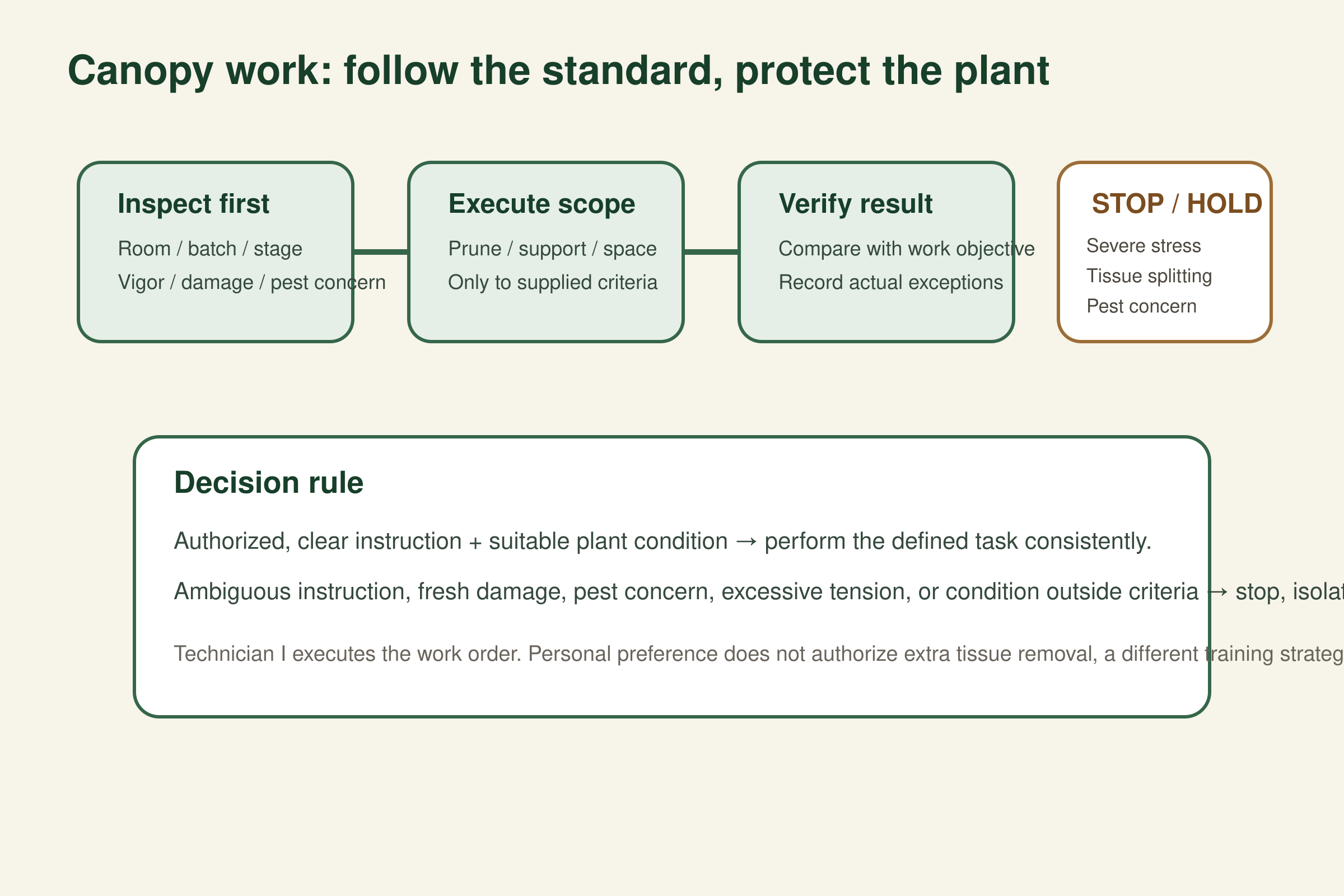
Routine canopy work is controlled plant handling, not an invitation to redesign plant architecture from personal preference. Learners practice confirming the room and work order, inspecting plant condition before beginning, performing only the authorized pruning, defoliation, support, spacing or training task, protecting sanitation between plants and areas, recognizing excessive damage or plant conditions that require a hold, and recording work honestly.
Key vocabulary
The spatial arrangement of stems, branches, leaves and reproductive sites in a plant canopy.
Canopy shaping that repositions or supports shoots without intentionally causing major tissue damage.
Training that intentionally removes, cuts or substantially damages tissue and therefore requires an appropriate recovery context.
The supplied task-specific definition of what plant work is required, acceptable and complete.
Anatomy and developmental stage determine what canopy work means
Roots, stems, nodes, internodes, leaves and meristems form one connected transport and growth system. Nodes mark repeated structural units, internodes define spacing, and apical or axillary meristems generate new shoot growth. The same cut or bend can produce different consequences in a small seedling, rapidly expanding vegetative plant, transition plant or flowering crop because resource allocation, tissue maturity and reproductive development are different. Canopy work should therefore be tied to the identified structure and developmental context rather than plant height alone.
Inspect before modifying the plant
Confirm plant or room identity, developmental context, vigor and any visible damage or pest/disease concern before beginning canopy work. A plant already showing a meaningful abnormality may require a hold or escalation rather than routine cutting or manipulation.
The work order controls scope
The technician performs the defined pruning, defoliation, support, spacing or training task to the supplied standard. Personal preference for topping, aggressive defoliation or another technique does not override the work order, plant condition or developmental stage.
Protect tissue and sanitation
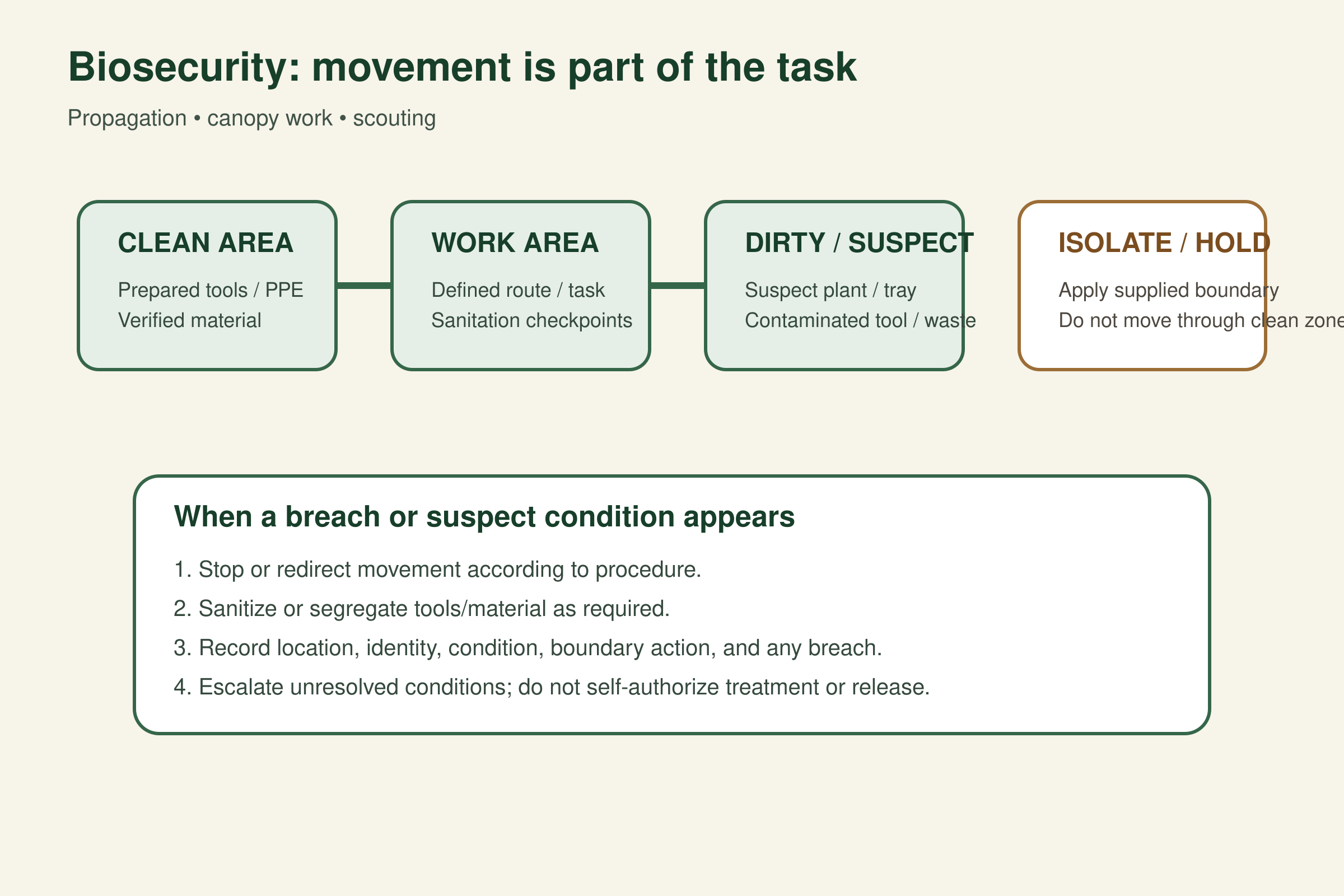
Use the supplied handling and sanitation method between plants or zones. Avoid unnecessary tissue damage, contaminated tool movement and support placement that cuts, constricts or abrades stems. When unintended damage occurs, document it rather than hiding it with additional pruning.
Evaluate completion against the standard
A canopy task is complete when the assigned plants were handled to the defined standard and exceptions were documented. Uniformity should be evaluated from the requested structural outcome and crop condition, not from making every plant visually identical regardless of biology.
Worked examples
- A work order calls for selective lower-canopy cleanup. A coworker suggests heavy whole-plant defoliation. The technician follows the work order and escalates any needed change rather than substituting a personal technique.
- A branch cracks during repositioning. The technician follows the supplied response, records the plant and damage, and avoids continuing to force the branch merely to match neighboring plants.
Common mistakes
- Applying a preferred training method even when it is not the assigned task.
- Removing additional tissue to make all plants look identical.
- Continuing routine canopy work through fresh pest signs without applying biosecurity/escalation controls.
- Hiding accidental plant damage rather than recording the exception.
Assigned canopy work versus independent redesign
Technician I task execution
Confirm identity and plant condition, follow the defined pruning/support/training standard, protect sanitation and document exceptions.
Out-of-scope redesign
Choose a different high-stress technique, remove substantially more tissue or change the production strategy without authorization.

Downloadable practice: canopy maintenance work order
Use this printable worksheet to practice room/work-order identity, plant-condition screening, authorized canopy action, stop conditions, sanitation/quarantine, before/after verification, exceptions and handoff.
Pest signs during pruning
Setting: A pruning crew discovers fresh feeding damage and suspicious insects on several plants in one work area.
Prompt: What should happen first?
- Continue through all rooms with the same tools
- Protect the supplied biosecurity boundary, stop or isolate work as required and escalate the finding
- Prune off the evidence and discard it without a record
- Move the suspect plants through clean rooms for comparison
Check response
Answer: Protect the supplied biosecurity boundary, stop or isolate work as required and escalate the finding
Canopy work must not become a contamination or pest-spread pathway. The observation and boundary response take priority over routine task completion.
Practical application
Execute a simulated canopy-maintenance work order containing a weak plant, a plant with fresh pest-like damage, a support placement risk and one accidental tissue injury. Use the downloadable canopy work-order practice sheet to document task scope, sanitation, quarantine/hold decisions, before/after verification, exceptions and handoff.
Lesson summary
Technician I canopy work links controlled instructions with plant condition. The technician confirms scope, handles tissue carefully, protects sanitation, stops when plant condition or authorization requires it, and documents actual completion instead of substituting personal technique.