Root-Zone Moisture, Dryback and EC Trend Context
Root-zone behavior changes over time and is coupled to the rest of the soil–plant–atmosphere continuum. Learners practice describing saturation, drainage, moisture loss, dryback and EC trends using repeated comparable observations rather than elapsed hours or one spot reading. The course keeps interpretation at Technician I scope: document what the root zone is doing, relate water supply to crop demand and environmental demand, and escalate meaningful deviations without prescribing an advanced crop-steering, nutrient or irrigation strategy.
Key vocabulary
The reduction in root-zone water content between irrigation events.
A practical moisture state after a saturated container has drained excess gravitational water.
Electrical conductivity measured from solution associated with the root environment using a defined sampling method.
A directional pattern in repeated measurements over time rather than one isolated value.
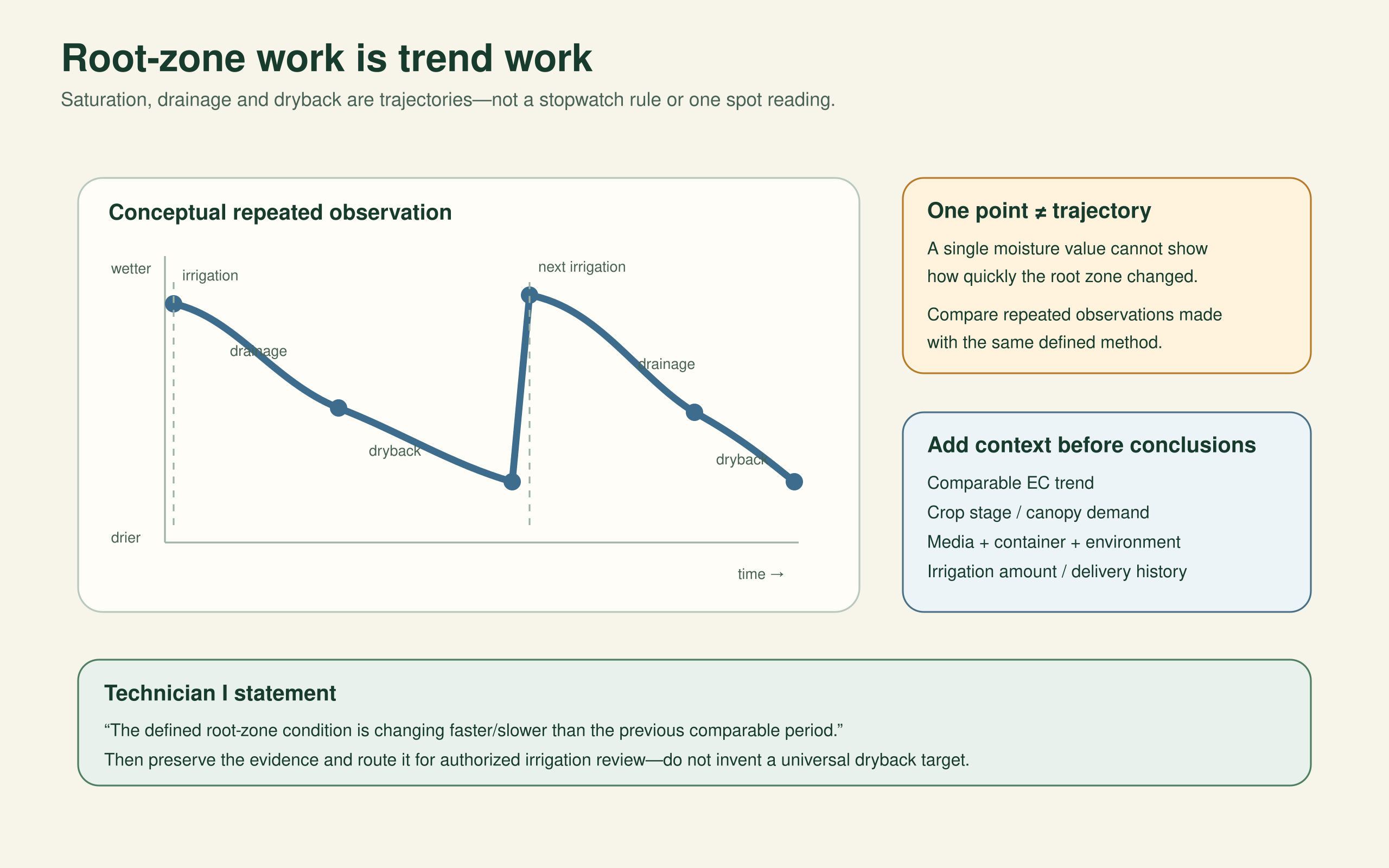
Dryback is a trajectory
One moisture reading or a fixed number of hours does not describe how quickly the root zone is changing. Repeated weight, sensor or other defined observations reveal the moisture trajectory between irrigations and allow comparison with previous crop behavior.
Crop demand and environment can change the curve
Canopy size, roots, light, temperature, humidity, media properties and container size can alter water use. A schedule that was adequate earlier may require review when measured dryback behavior changes; Technician I documents the shift and routes it through the authorized process.
Too wet and too dry are different observations
Prolonged saturation can restrict root-zone gas exchange, while excessive drying can limit water availability and concentrate dissolved ions. The acceptable operating range depends on the system and supplied strategy, so technicians describe the observed condition and trend rather than applying a universal moisture target.
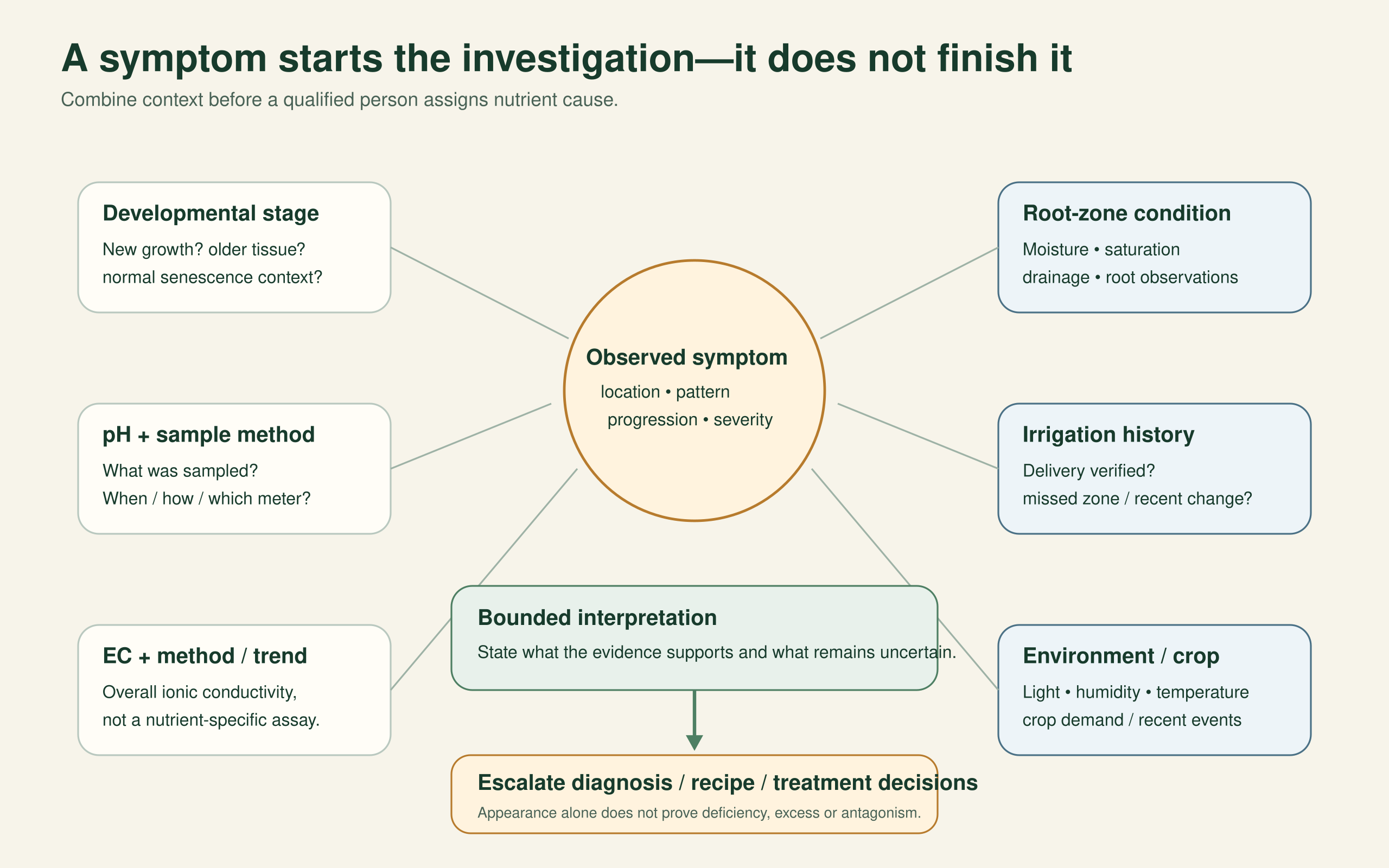
Nutrition evidence stays contextual
Deficiency-like or excess-like plant symptoms can overlap with pH, EC, water status, root health and developmental effects. Root-zone and plant observations should be combined before a qualified person assigns cause. Technician I does not solve every nutrition case by increasing or decreasing fertilizer concentration.
Root-zone supply and atmospheric demand are coupled
Water loss from leaves creates hydraulic demand that must be supplied through the soil or substrate, roots and xylem. Higher atmospheric drying demand can increase the pull on this pathway, while a drying root zone can reduce hydraulic supply. A technician therefore interprets moisture and EC trends alongside canopy and environmental context rather than treating the root zone as an isolated reservoir.
Persistent saturation changes more than water content
When pore space remains water-filled, oxygen diffusion to roots can become restricted relative to a well-aerated root zone. That can affect root function and change the meaning of crop symptoms, but saturation alone does not prove root disease. Record duration, extent, drainage behavior, crop response and comparable zones before escalation.
EC is a bulk conductivity measurement, not an ion-specific diagnosis
Electrical conductivity summarizes the ability of a solution to carry current and is influenced by the total dissolved ionic environment and the sampling method. It does not identify which individual nutrient ion is high or low. Comparable EC trends are useful operational evidence, but ion-specific conclusions require additional information or analysis.
Worked examples
- Containers that previously reached the supplied next-irrigation condition in two days now reach it in one day. The technician records the faster dryback trend and crop/environment context and escalates for authorized schedule review.
- Feed EC remains stable while root-zone EC rises across repeated comparable measurements. The technician documents the trend with moisture and irrigation context rather than automatically increasing feed concentration.
Common mistakes
- Defining dryback only by hours since irrigation.
- Treating one runoff or root-zone reading as a complete diagnosis.
- Assuming the same irrigation frequency is correct for the entire crop lifecycle.
- Adding more fertilizer because leaves look deficient even though root-zone EC is already elevated.
- Treating EC as though it directly identifies a specific nutrient ion.
- Interpreting root-zone moisture without considering atmospheric demand, canopy size and other drivers of plant water use.
- Calling persistent saturation a confirmed root disease instead of documenting it as an important condition requiring further evaluation.
Root-zone evidence versus overreach
| Evidence | Useful Technician I statement | Unsupported leap |
|---|---|---|
| Repeated moisture observations | Dryback is occurring faster than the previous comparable period | The crop definitely needs a new advanced steering strategy |
| Comparable root-zone EC trend | Root-zone EC has increased across repeated measurements | A specific nutrient is definitely excessive |
| Persistent saturation | Defined containers remain saturated longer than the supplied expectation | Roots are definitely diseased |
| Leaf symptom plus high EC | Record symptom pattern, EC, pH and root-zone context for review | Add more fertilizer because the leaf resembles a deficiency chart |
Downloadable practice: irrigation and root-zone verification
Use this printable worksheet to practice representative delivery checks, repeated root-zone trend description, bounded nutrition-context reasoning, deviation handling and handoff without inventing universal targets or unsupported causes.
Faster dryback
Setting: The same crop area now reaches the facility-defined next-irrigation moisture condition in about half the time observed earlier.
Prompt: What is the strongest Technician I response?
- Keep the old interval because schedules should never change
- Document the faster measured dryback trend and relevant crop/environment context, then route it for authorized irrigation review
- Double nutrient concentration
- Diagnose root disease
Check response
Answer: Document the faster measured dryback trend and relevant crop/environment context, then route it for authorized irrigation review
Dryback is measured behavior. A changed trajectory is useful evidence for authorized schedule review, not permission for independent advanced strategy changes.
Practical application
Use the downloadable irrigation/root-zone verification worksheet with a simulated seven-day log containing irrigation times, comparable moisture observations, EC results and crop notes. Identify the meaningful trend, separate measurement evidence from possible explanations, record symptom/stage context where provided, and write an escalation note without prescribing a strategy outside Technician I authority.
Lesson summary
Root-zone interpretation is a time-series and whole-plant problem. Repeated moisture and EC observations, consistent sampling, drainage behavior and crop/environment context show whether water supply and demand are changing; Technician I preserves that evidence, recognizes that EC is not ion-specific, and avoids converting one reading or symptom into an unsupported diagnosis.