Sample Identity, pH/EC Measurement and Meter Readiness
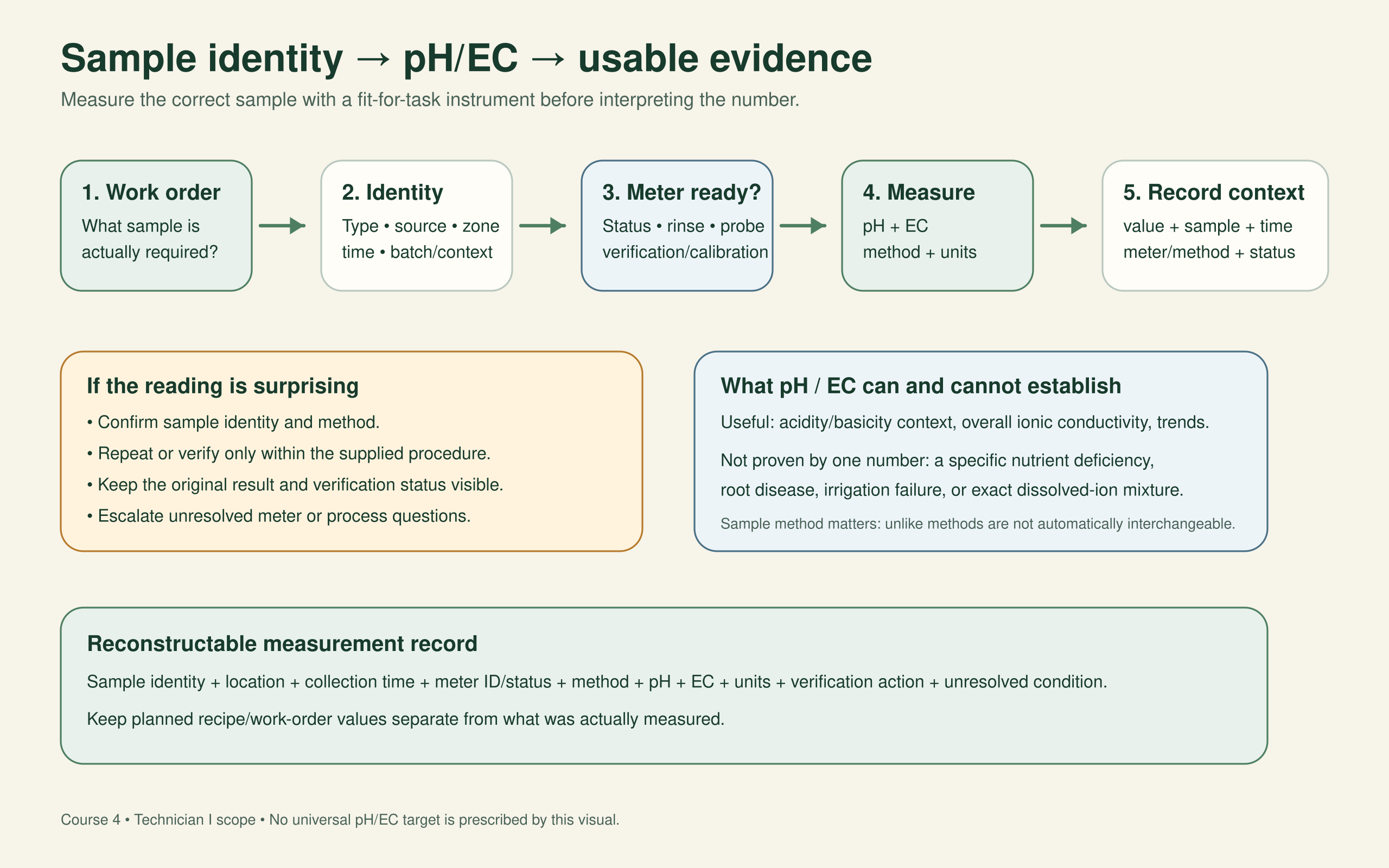
Technician I measurement begins with the correct sample and a trustworthy instrument, not with a number. Learners practice confirming whether the task requires source water, prepared nutrient solution, runoff/drainage or another defined sample; following permitted meter inspection, rinse, storage and calibration or verification steps; recording pH and EC with units and sample identity; and recognizing when a suspect reading must be repeated or escalated instead of used to change the crop.
Key vocabulary
The controlled description of what liquid or root-zone sample was collected, where it came from and when it was collected.
A logarithmic measure related to hydrogen ion activity that describes acidity or basicity of a solution.
A measure of solution conductivity influenced by the concentration and mobility of dissolved ions; it does not identify individual nutrients.
A permitted comparison or readiness step used to determine whether a meter or measurement appears fit for the assigned task.
Confirm the sample before measuring
Source water, prepared feed, runoff or drainage and root-zone extracts answer different questions and are not automatically interchangeable. The record should identify sample type, location or reservoir, time and any required batch or work-order context before the pH or EC value is interpreted.
Measurement quality comes before correction
Meters require the preparation and verification steps specified by the facility and manufacturer. A dirty, poorly stored, unstable or out-of-status probe can create false precision. When a reading shifts unexpectedly, verify the meter and sample context before changing nutrient solution or irrigation practice.
Record what EC can and cannot tell you
EC is useful for tracking overall dissolved ionic concentration and trends, but similar EC values can result from different ionic mixtures. Technician I records the value, unit, sample method and context without presenting EC as a nutrient-specific chemical analysis.
pH is context, not a diagnosis
pH affects nutrient chemistry and availability, but a pH value by itself does not prove a specific deficiency or root-zone disorder. Interpretation should retain sample method, EC, root-zone condition, crop stage and other evidence when the task requires escalation.
Why pH changes nutrient chemistry without diagnosing the crop
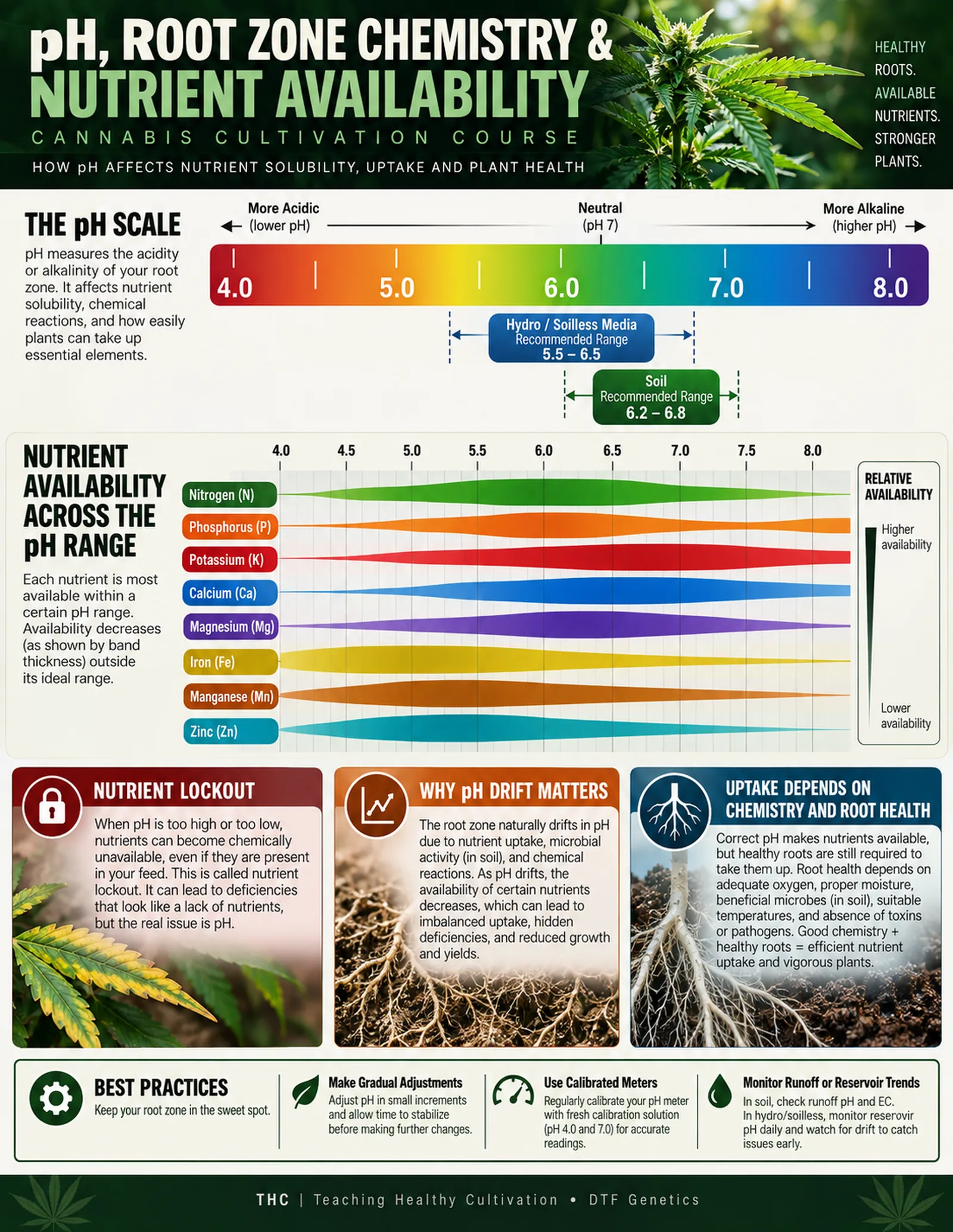
pH changes proton activity and can alter nutrient speciation, solubility, surface charge and microbial processes in the root environment. Those chemical effects help explain why nutrient availability varies with pH, but availability is also shaped by media chemistry, alkalinity, cation exchange, dissolved-ion concentration, temperature, oxygen, irrigation history and root activity. A chart can show general chemical tendencies; it cannot prove that a visible symptom is caused by one element.
Worked examples
- A pH meter reading suddenly shifts after storage. The technician follows the supplied meter verification or calibration procedure before treating the new number as a crop condition.
- A runoff EC result is recorded as runoff from an identified zone and irrigation event rather than compared as though it were the same measurement method as a pore-water or saturated-media extract.
Common mistakes
- Measuring an unidentified cup and attaching the result to the wrong room or solution.
- Treating EC as a direct measurement of each individual nutrient.
- Adjusting a solution based on one suspect meter result before verification.
- Comparing values from different sample methods as though the methods were equivalent.
Technician measurement sequence
Match the work order to source water, prepared solution, runoff/drainage or other defined sample type.
Record room, zone, reservoir, batch or other required identity plus collection time.
Perform only the inspection, rinse, storage, calibration or verification steps permitted by the supplied procedure.
Use the defined method and allow the reading to stabilize as required before recording.
Preserve pH or EC result together with the context needed to reconstruct the measurement.
Repeat or verify within procedure and escalate unresolved measurement problems before using them for crop decisions.
Downloadable practice: water / solution measurement record
Use this printable worksheet to practice sample identity, meter readiness, pH/EC method and units, repeat verification, evidence limits and escalation while keeping supplied targets separate from actual measurements.
Practical application
Use the downloadable water/solution measurement practice sheet with labeled and unlabeled sample containers, a meter-status packet and a work order. Select the correct sample, identify any data-quality problem, follow the permitted readiness sequence, and produce a pH/EC record with sample identity, units, time, meter/method context and escalation status.
Lesson summary
Reliable water and nutrient-solution measurements require correct sample identity, fit-for-task instruments and reconstructable records. pH and EC are valuable context measurements, but neither should be turned into a nutrient-specific or root-cause diagnosis without supporting evidence.