IPM Scouting, Incidence, Severity and Quarantine Evidence
IPM scouting is a repeatable evidence system. Technician I learners follow a defined route, inspect relevant plant structures, traps and room locations, distinguish symptoms from direct signs, record where findings occur and how widely or severely they occur, protect quarantine or isolation boundaries, and escalate evidence without independently selecting pesticide treatment or claiming applicator authority.
Key vocabulary
The count or proportion of observed plants or sites showing a defined condition.
The degree or intensity of damage or symptoms on an affected plant, tissue or observation unit.
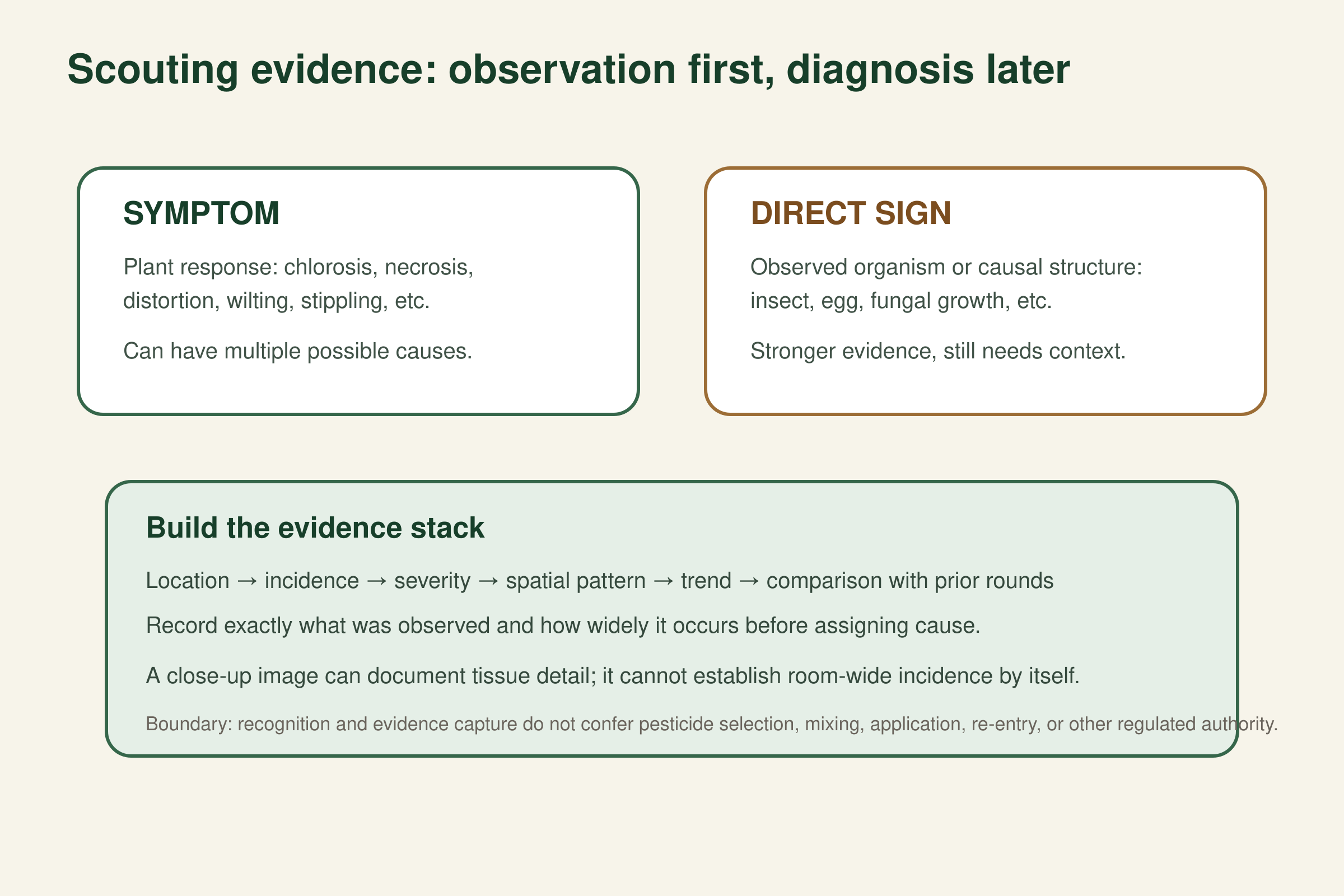
Direct evidence of a causal organism or agent, such as an insect, egg, fungal growth or other identifiable structure.
A plant response such as chlorosis, necrosis, distortion or wilting that can have multiple possible causes.
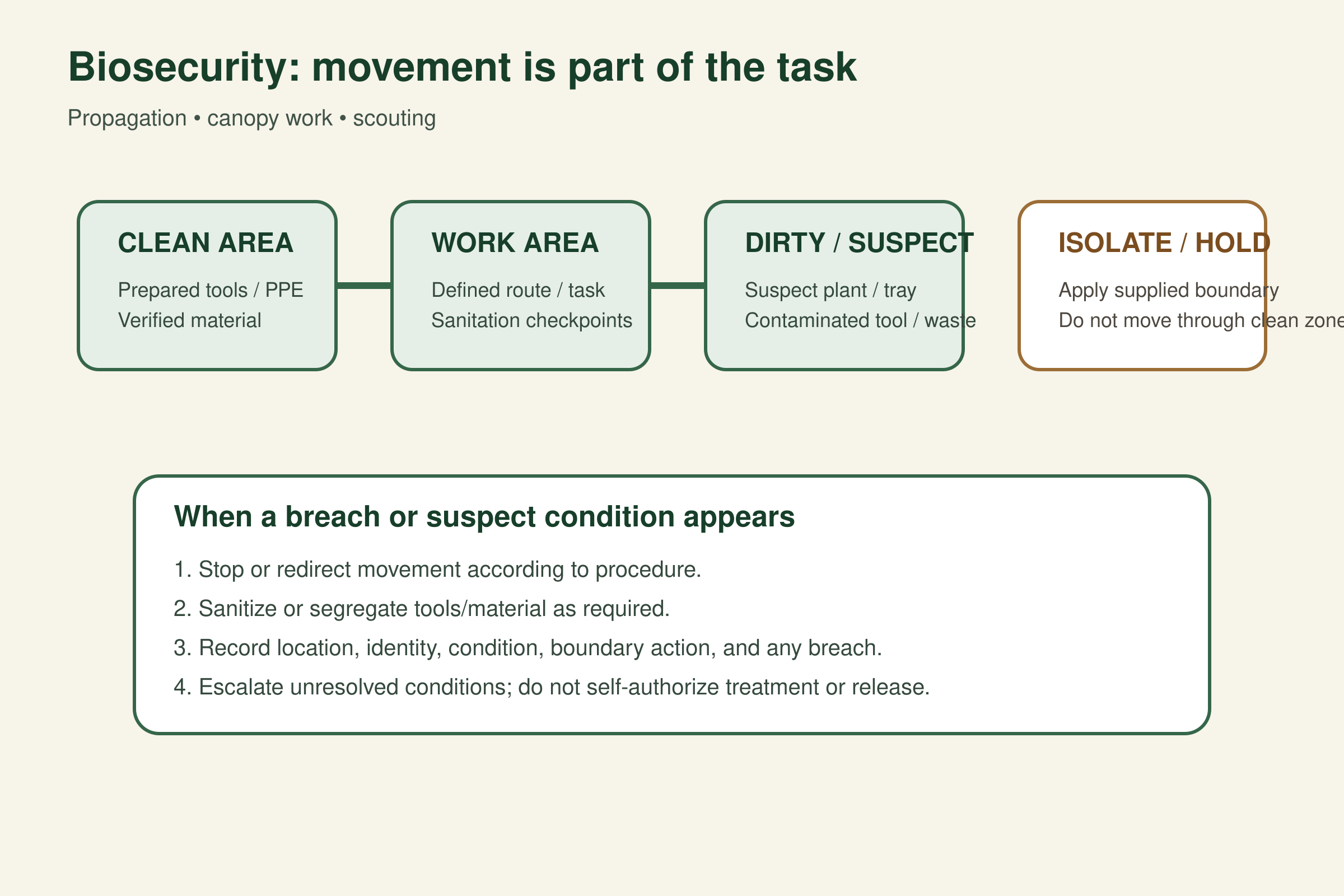
A controlled separation used to limit movement of pests, pathogens or potentially contaminated plant material, people or tools.
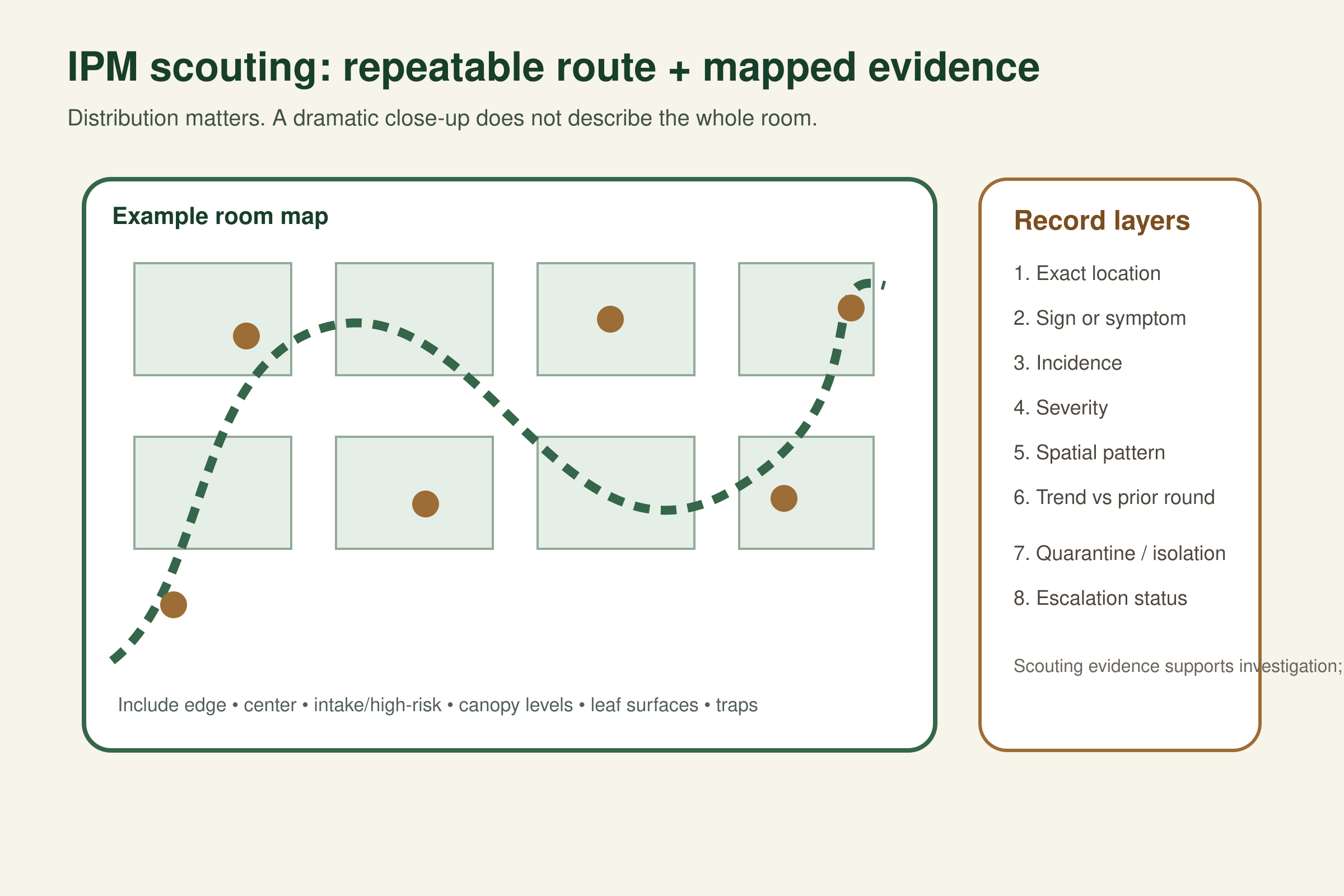
A repeatable route reduces scouting bias
Use the supplied path and inspection pattern across representative canopy heights, leaf surfaces, growing points, media or root-zone surfaces, traps and defined high-risk locations. Scouting only the most damaged plants or only easy-to-reach positions cannot establish reliable incidence or distribution.
Signs and symptoms are not interchangeable
A symptom is the plant response and can overlap across pests, disease, nutrition, environment or mechanical damage. Direct signs of an organism are stronger evidence but still need location, distribution and identification context. Record what is actually observed before naming a cause.
Incidence, severity and trend answer different questions
Incidence describes how many observation units are affected; severity describes how strongly an affected unit is impacted; repeated rounds show whether the pattern is stable, expanding or resolving. One dramatic photograph cannot substitute for a room-level distribution record.
Scouting does not grant treatment authority
Technician I can recognize and document evidence, follow supplied containment or quarantine steps and escalate. This credential does not independently authorize pesticide selection, mixing, application or decisions reserved for a licensed or otherwise authorized applicator or specialist.
Worked examples
- Two mildly affected plants become twelve over three repeated scouting rounds. Even if individual severity remains low, the rising incidence trend supports escalation.
- A sticky-card count is much higher near one intake. The technician records trap identity, location and count trend, inspects the surrounding area and escalates rather than calling the room uniformly infested from one card.
Common mistakes
- Scouting only after damage becomes obvious.
- Recording a pest or disease name without documenting the evidence used.
- Using one close-up photo as proof of room-wide incidence.
- Selecting or applying a pesticide merely because the technician recognizes a likely pest.
Scouting evidence layers
| Layer | Example | Technician I use |
|---|---|---|
| Symptom | Leaf stippling or distortion | Record appearance and location; do not treat the symptom alone as proof of cause |
| Sign | Observed insect or identifiable biological structure | Record direct evidence with location and identification context |
| Incidence | 5 of 30 sampled plants affected | Describe how widely the defined condition occurs in the sample |
| Severity | Affected leaves show low/moderate/high defined damage | Describe intensity using the supplied scale |
| Trend | Affected count rises across repeated rounds | Escalate meaningful change even if individual severity remains modest |
| Spatial pattern | Findings concentrated near an intake or one bench | Preserve distribution because it informs qualified investigation |
Downloadable practice: IPM scouting route
Use this printable worksheet to practice room mapping, sign/symptom classification, incidence, severity, spatial pattern, trend, quarantine actions, uncertainty and escalation without treatment selection.
Practical application
Complete a simulated scouting route with trap counts, plant symptoms, one direct pest sign, one quarantine-zone boundary and repeated-round data. Use the downloadable IPM scouting practice sheet to record incidence, severity, spatial pattern, trend, biosecurity action, uncertainty and escalation without selecting a treatment.
Lesson summary
IPM scouting turns plant-health observations into comparable evidence. Technician I follows a consistent route, separates signs from symptoms, records incidence/severity/trend, protects containment boundaries and escalates without exceeding treatment authority.