Sensor Placement, Verification and Data-Quality Triage
A sensor can display a plausible number and still fail to represent the crop. Learners practice checking placement, comparison with nearby sensors, calibration or verification status, airflow and equipment influence, logging interval and obvious physical condition before treating an outlier as a real room change. Technician I verifies within procedure and escalates unresolved faults instead of performing unauthorized repair.
Key vocabulary
A systematic measurement error that shifts readings away from the true condition.
A position chosen to reflect the environment relevant to the crop rather than an atypical local microclimate.
A permitted check that gathers evidence about whether a measurement or device is behaving as expected without necessarily adjusting or repairing it.
The documented state showing whether an instrument has received required calibration or comparison procedures within the applicable interval.
Placement can create a valid local reading that is invalid for the question
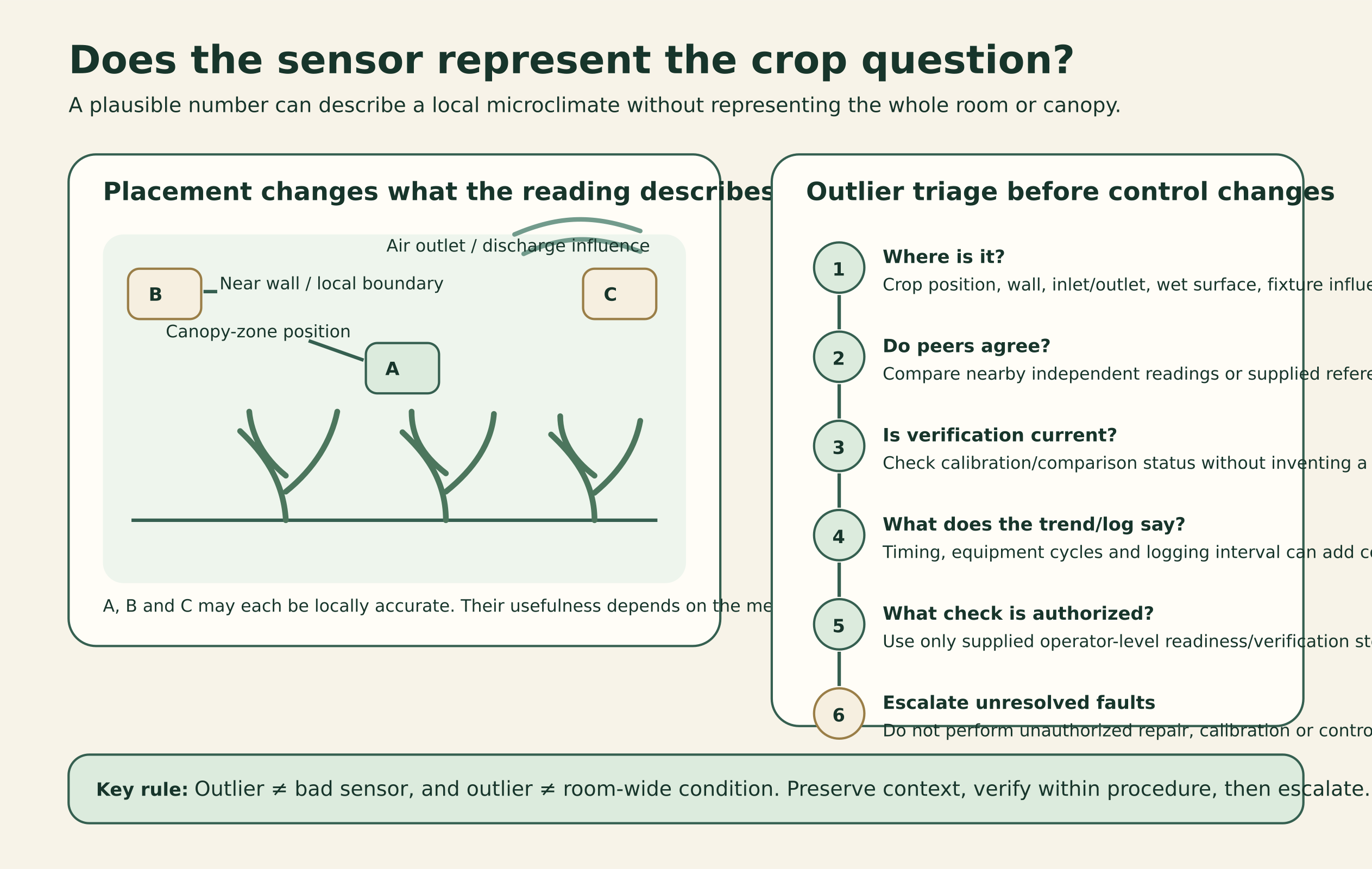
A sensor close to an intake, dehumidifier outlet, wet surface, lamp, wall or dense canopy may accurately measure that local microclimate but fail to represent the room or crop question. Technician I records the sensor location and compares it with the intended measurement purpose before escalating a reading.
Compare evidence before changing controls
When one sensor disagrees with peers, compare placement, recent trends, calibration or verification status and any obvious equipment or airflow context. A single outlier does not automatically prove the room is wrong or the sensor is wrong; it identifies a condition requiring structured verification.
Operator care has a boundary
Technician I may perform explicitly permitted checks such as cleanliness inspection, connection/status review, documented comparison or simple readiness steps. Opening electrical equipment, altering protected calibration settings or repairing HVAC/control systems is outside the role unless separately authorized and trained.
Worked examples
- One RH sensor reads much lower than four peers. It is found directly in a dehumidifier discharge path. The technician records the placement and comparison and escalates according to sensor procedure rather than changing the entire room set point.
- A sensor is overdue for the facility-required verification interval. The technician marks the reading context as suspect/incomplete and follows the supplied process rather than presenting it as fully verified data.
Common mistakes
- Assuming the newest sensor cannot be biased.
- Treating a disagreement as proof that the room or sensor is definitely wrong without verification.
- Moving a sensor to make readings match instead of preserving and documenting the original placement context.
- Performing electrical or calibration adjustments beyond technician authorization.
Outlier triage questions
| Question | Evidence to check | Do not assume |
|---|---|---|
| Where is the sensor? | Crop position, wall/intake/outlet/wet surface/fixture influence | That the value represents the whole room |
| Do peers agree? | Nearby independent sensors or reference check | That majority agreement alone proves accuracy |
| Is verification current? | Calibration/comparison status and procedure | That a displayed number is automatically trustworthy |
| What changed over time? | Trend around lights, irrigation or equipment cycling | That a daily average captures every event |
| Is operator action authorized? | Supplied equipment-care procedure | That recognizing a fault grants repair authority |
Downloadable practice: PPFD grid and sensor verification
Use the sensor-verification section of this shared printable worksheet to practice placement review, peer comparison, verification status, trend context, operator-level checks and escalation while preserving the original outlier evidence.
One sensor disagrees
Setting: Five canopy sensors cluster closely while one wall sensor reads much drier. The outlier is near an air outlet.
Prompt: What is the strongest Technician I response?
- Change the room humidity set point to match the wall sensor
- Document placement, compare readings and verification status, then escalate unresolved discrepancy under procedure
- Delete the wall reading because it differs
- Move all canopy sensors to the wall
Check response
Answer: Document placement, compare readings and verification status, then escalate unresolved discrepancy under procedure
The outlier may reflect location, instrument bias or a real local condition. Structured verification comes before control redesign.
Practical application
Use the shared PPFD and sensor-verification practice sheet with a supplied outlier scenario. Record the sensor identity, reading, placement, peer evidence, verification/calibration status and trend context; classify the reading as representative, suspect/incomplete or requiring escalation; then document only the operator-level check actually authorized.
Lesson summary
Good environmental decisions depend on measurement quality. Technician I checks whether a sensor represents the crop, compares outliers with independent evidence, performs only permitted verification and escalates unresolved faults without unauthorized repair.