Alarms, Trends, Environmental Records and Shift Handoff
Environmental work is not complete when a technician reads a dashboard. Learners practice distinguishing instantaneous values, trends, averages and alarms; documenting verification actions; connecting readings to crop location and equipment context; and producing a shift handoff that makes unresolved environmental or lighting conditions reconstructable without hiding uncertainty.
Key vocabulary
A sequence of measurements over time used to identify direction, cycling, transitions or recurring patterns.
A system or procedural indication that a defined condition or rule has been met and requires a specified response.
A value that differs substantially from comparison values or the surrounding pattern and therefore warrants context or verification.
A structured transfer of completed checks, observations, deviations, unresolved conditions and priorities to the next responsible person.
Instantaneous values, averages and trends answer different questions
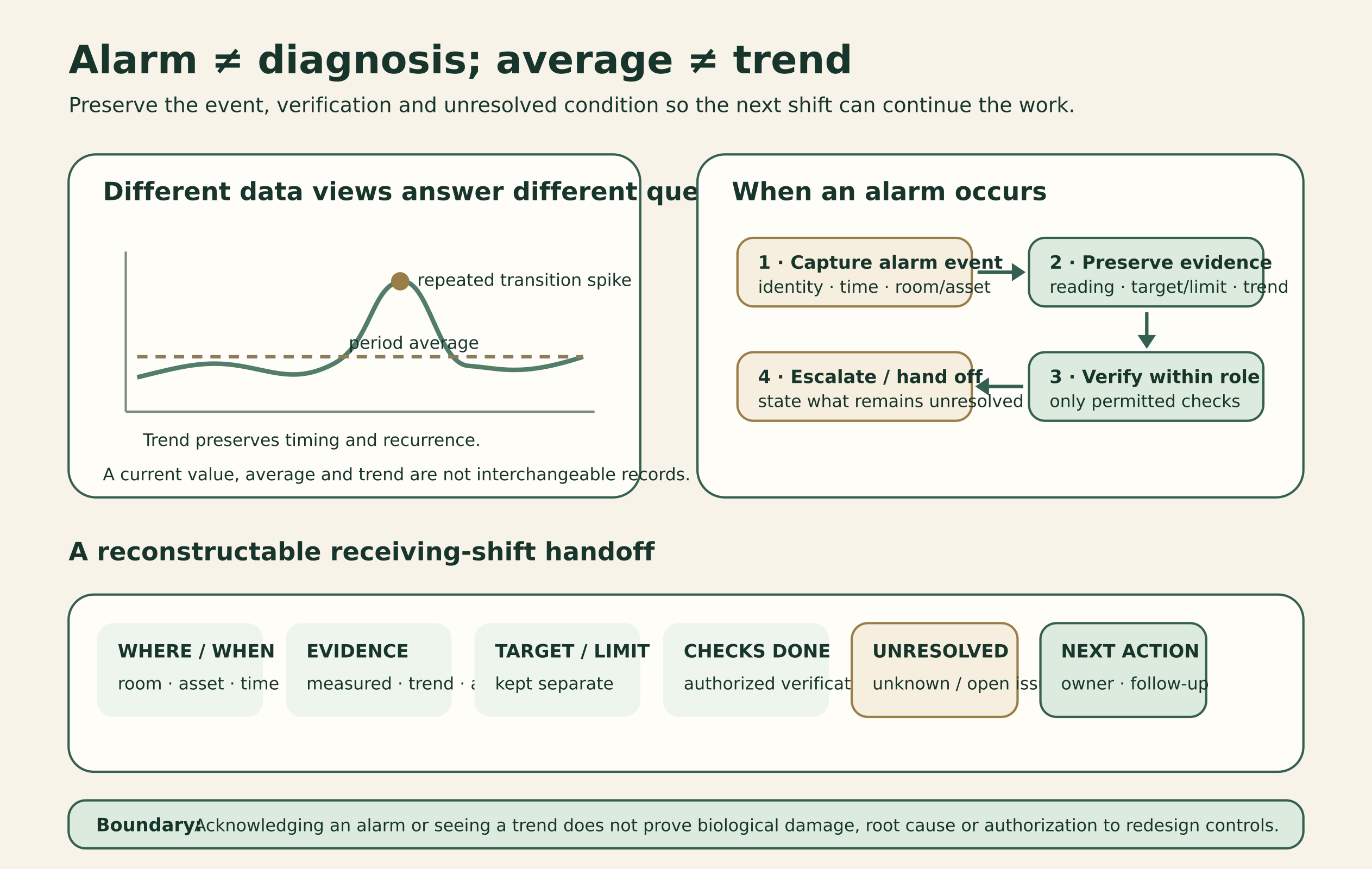
A current value shows one moment, an average summarizes a period and a trend preserves change over time. Equipment cycling, lights-on/off transitions or short excursions can disappear inside averages, so technicians use the form of data required by the task instead of treating every summary as interchangeable.
An alarm is evidence of a rule event, not a diagnosis
When an alarm occurs, record the alarm identity, affected room or asset, time, relevant readings and the permitted verification actions. The alarm may indicate a threshold or system condition, but it does not by itself establish biological damage or root cause.
Handoffs preserve unresolved conditions
A useful handoff states what was observed, what target or limit applied, what checks were completed, what remained unresolved, who was notified and what follow-up is required. If data quality is uncertain, the uncertainty is part of the handoff rather than being replaced with a guessed value or cause.
Worked examples
- A daily temperature average appears normal, but the trend shows a repeated lights-on spike. The technician records the recurring transition pattern and escalates under the supplied procedure rather than reporting only the average.
- A photoperiod alarm is cleared after an authorized status check, but the cause is not established. The handoff records the alarm, observed controller/light state, check performed and unresolved cause.
Common mistakes
- Using a daily average to dismiss short repeated excursions.
- Writing an alarm as a confirmed diagnosis or equipment root cause.
- Closing a handoff with ‘fixed’ when only the alarm was acknowledged and the cause remains unresolved.
- Backfilling a missed reading from memory as though it were measured at the scheduled time.
Environmental deviation handoff
A reconstructable handoff separates evidence, checks and unresolved work.
Downloadable practice: environmental measurement and handoff record
Use this printable worksheet to practice separating targets from observed readings, preserving sensor/time/location context, evaluating representativeness, documenting permitted verification and carrying unresolved uncertainty into escalation and shift handoff.
Average hides a repeated spike
Setting: The 24-hour average temperature is within the supplied range, but the trend shows a short spike at each lights-on transition.
Prompt: What is the strongest record?
- Report only the acceptable average
- Document the repeated transition spike with time/location context and escalate if the supplied procedure requires it
- Delete the spikes because they are brief
- Independently change HVAC controls without authorization
Check response
Answer: Document the repeated transition spike with time/location context and escalate if the supplied procedure requires it
Averages can conceal meaningful dynamics. The trend should be preserved without assuming root cause or exceeding role authority.
Practical application
Use the environmental measurement practice sheet with a simulated 24-hour environmental/light trend containing one outlier and one alarm. Record target versus measured evidence, identify the important trend event, document only permitted verification, preserve unresolved cause/data-quality questions, and create a receiving-shift handoff with the next required check and owner.
Lesson summary
Environmental records need time, location, measurement and equipment context. Trends and alarms support investigation but do not automatically prove cause. Technician I verifies within procedure, records uncertainty honestly and hands off unresolved conditions so the next qualified person can continue the work.