Observation, Pattern, Context and Diagnostic Boundaries
A Technician I creates reliable evidence for diagnosis without pretending that every visible symptom proves a cause. This lesson trains learners to separate direct observations from interpretations, describe incidence and spatial pattern, add available environmental or work-history context, recognize urgent abnormalities, and escalate when the evidence or authority boundary does not support an independent conclusion.
Key vocabulary
A description of directly visible, measured or otherwise documented evidence without an unsupported causal conclusion.
A reasoned meaning assigned to observations that may remain provisional until additional evidence confirms it.
The proportion or count of observed units showing a defined condition within the sampled population.
A set of plausible explanations considered when evidence does not yet support one confirmed cause.
Describe before you diagnose
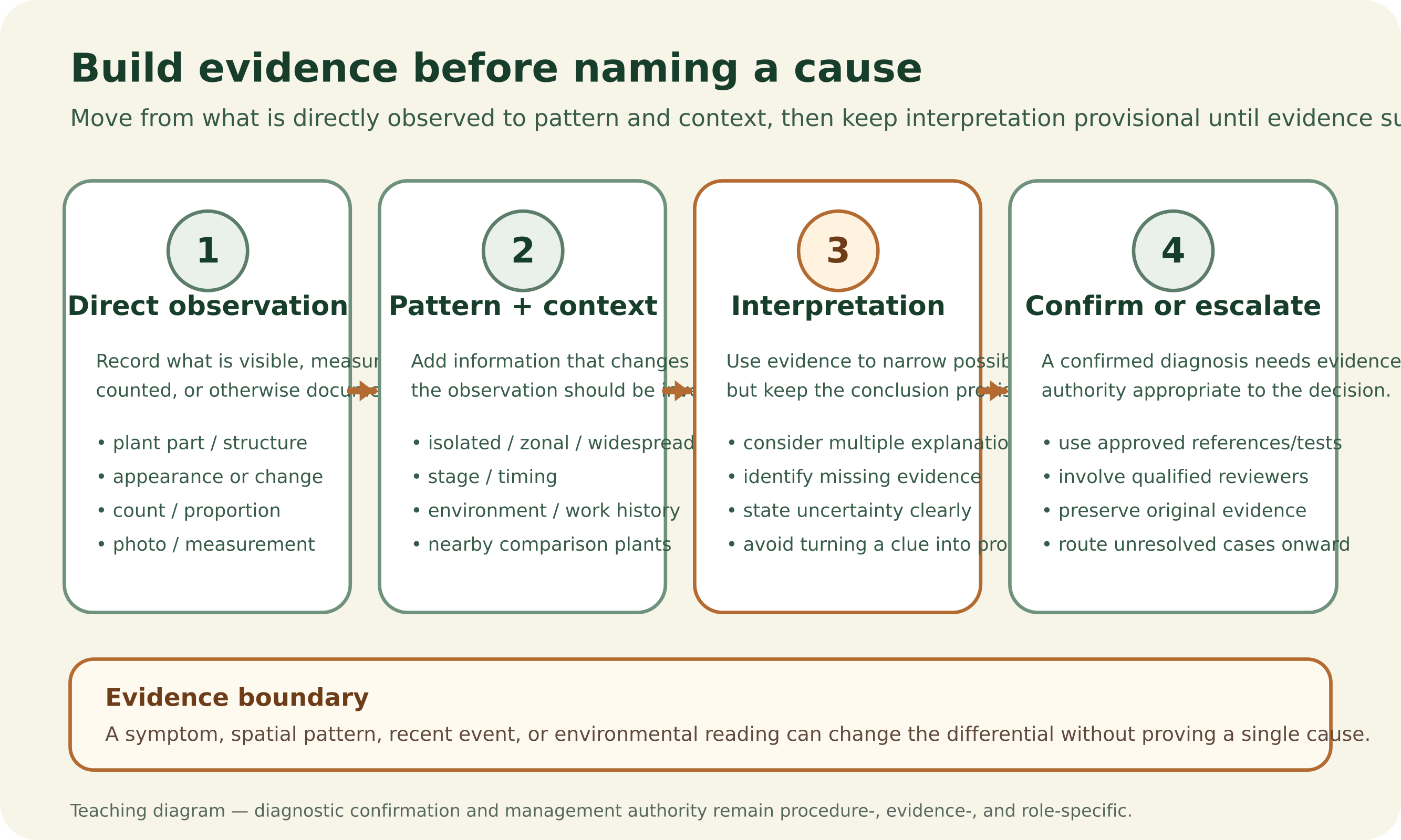
Color change, tissue damage, posture, architecture, root appearance, developmental differences and spatial patterns can be recorded directly. A causal label such as nutrient deficiency, pathogen, irrigation failure or genetic weakness requires supporting evidence. Technician I records the observation and routes the case when diagnosis exceeds the task or available evidence.
Pattern changes the investigation
One plant, one bench, one irrigation zone, one room edge and an entire room represent different evidence patterns. Record counts or proportions where practical, location and severity using supplied definitions, and whether neighboring comparison plants show the same condition. Public extension diagnostic guidance likewise treats whole-plant distribution and site pattern as important clues rather than as stand-alone proof of cause.
Context strengthens a note without proving cause
Recent irrigation, environmental readings, lighting or equipment events, transplant or canopy work, IPM history and developmental stage can make an observation more useful. Diagnostic guidance emphasizes plant identity, site conditions and management history because different causes can produce similar symptoms. Context should therefore remain attached as evidence unless the supplied procedure and additional evidence justify a confirmed conclusion.
Interpretation is a hypothesis layer
A strong interpretation narrows possibilities and identifies what evidence would distinguish them; it does not erase uncertainty. When multiple causes remain plausible, preserve the differential and the missing evidence rather than converting the most familiar explanation into a fact.
Escalate consequence and uncertainty
Sudden widespread wilt, suspected spreading pest or disease evidence, unexpected reproductive morphology, strong root-zone abnormality, substantial zone differences or damage associated with equipment or work can require prompt escalation. Follow the supplied procedure and preserve the original condition before changing it when safe to do so.
Worked examples
- Older lower leaves on 6 of 20 sampled plants in Zone B show interveinal yellowing. The note records distribution, location, photos and available root-zone measurements without declaring a specific deficiency.
- A room-wide droop appears shortly after a scheduled irrigation event. The technician records the timing and pattern, checks supplied irrigation and environmental status, and escalates rather than independently changing the control strategy.
Common mistakes
- Replacing an objective description with a disease or nutrient label that has not been verified.
- Recording an environmental or irrigation event as proof of cause rather than as context.
- Treating one spatial pattern as uniquely diagnostic when multiple explanations remain possible.
- Changing conditions before documenting the original abnormal state when there is no immediate safety reason to do so.
Evidence layers in a crop note
| Layer | Example | How to treat it |
|---|---|---|
| Direct observation | Six lower leaves show interveinal yellowing | Record as observed evidence |
| Pattern | Six of twenty sampled plants, concentrated in Zone B | Record distribution and sample context |
| Context | Irrigation event completed 45 minutes earlier | Attach as relevant history, not automatic proof |
| Interpretation | Irrigation delivery could be involved | Keep provisional unless evidence supports confirmation |
| Unsupported diagnosis | The room has a specific deficiency | Do not record as fact without sufficient evidence/authority |
One zone droops after irrigation
Setting: Plants in one irrigation zone are drooping while the rest of the room remains upright. A scheduled irrigation event just completed.
Prompt: What is the strongest Technician I response?
- Record irrigation failure as confirmed and reprogram the controller
- Record the zone pattern, compare representative points, check supplied irrigation/environment status and escalate unresolved deviation
- Water the entire room again because droop always means drought
- Delete the observation if plants may recover later
Check response
Answer: Record the zone pattern, compare representative points, check supplied irrigation/environment status and escalate unresolved deviation
The spatial pattern and timing are useful evidence, but neither proves the cause or authorizes independent control redesign.
Public source: plant diagnostic reasoning
Penn State Extension guidance used for transferable principles involving host identity, site and management history, whole-plant inspection, symptoms/signs and pattern-based diagnostic reasoning.
Practical application
Sort a set of crop notes into direct observation, pattern, context, interpretation and unsupported diagnosis. Rewrite weak notes to include location, distribution, developmental context, uncertainty and escalation status, then identify what additional evidence would be needed before a stronger conclusion could be supported.
Lesson summary
Technician I observation protects the distinction between evidence and diagnosis. Strong notes preserve what changed, where, how widely, under what context, what remains uncertain and what was escalated, allowing a qualified person to investigate without inheriting an unsupported conclusion.