Crop Observation Records, Photographs and Shift Handoff
Observation only becomes operational evidence when another qualified person can reconstruct what was inspected and what remains unresolved. Learners build crop records that preserve identity, time, sample route, objective descriptions, photographs, available context, actions and escalation. Photography is treated as evidence: images retain plant and location identity, include both context and detail, and avoid edits that can materially change appearance.
Key vocabulary
A record containing enough identity, timing, context and history for another qualified person to understand what occurred.
The identity, location, scale or scene information needed to interpret a crop image correctly.
A structured transfer of completed work, observations, deviations, unresolved conditions and priorities to the next responsible person or shift.
A clearly stated limit in what the available evidence supports, preserved rather than hidden by an invented conclusion.
A crop note needs identity and timing
A useful record identifies the room or zone, crop or batch, plant or bench when relevant, date/time, developmental context and the person or controlled system responsible for the entry. A technically correct observation attached to the wrong location or time can mislead later decisions.
Photographs preserve both detail and context
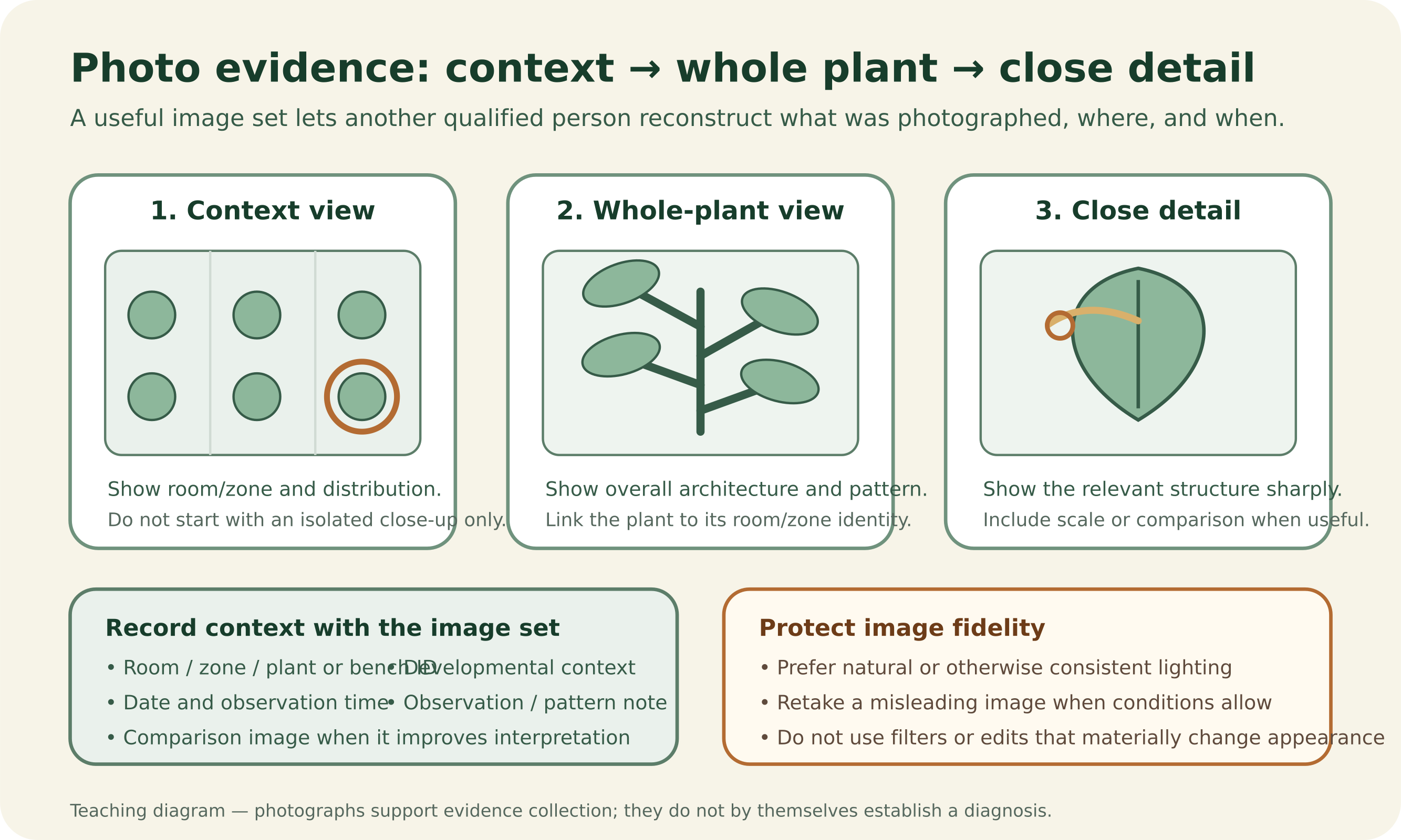
Current university diagnostic guidance recommends photographs that show the overall setting as well as closer views of relevant plant features. Natural or otherwise consistent lighting, useful comparison views, and inclusion of relevant structures when needed can make an image set more interpretable. Link each image set to crop identity and time, and retake images that are blurred, misleading or too context-poor to support review.
Photo evidence should support comparison
A strong image set often includes an overall crop or area view, a whole-plant or representative view, and a close detail of the feature being documented. When practical, comparison images of a more typical plant help the reviewer understand what differs. Avoid color filters or edits that materially alter the evidence.
Handoffs distinguish done, observed and unresolved
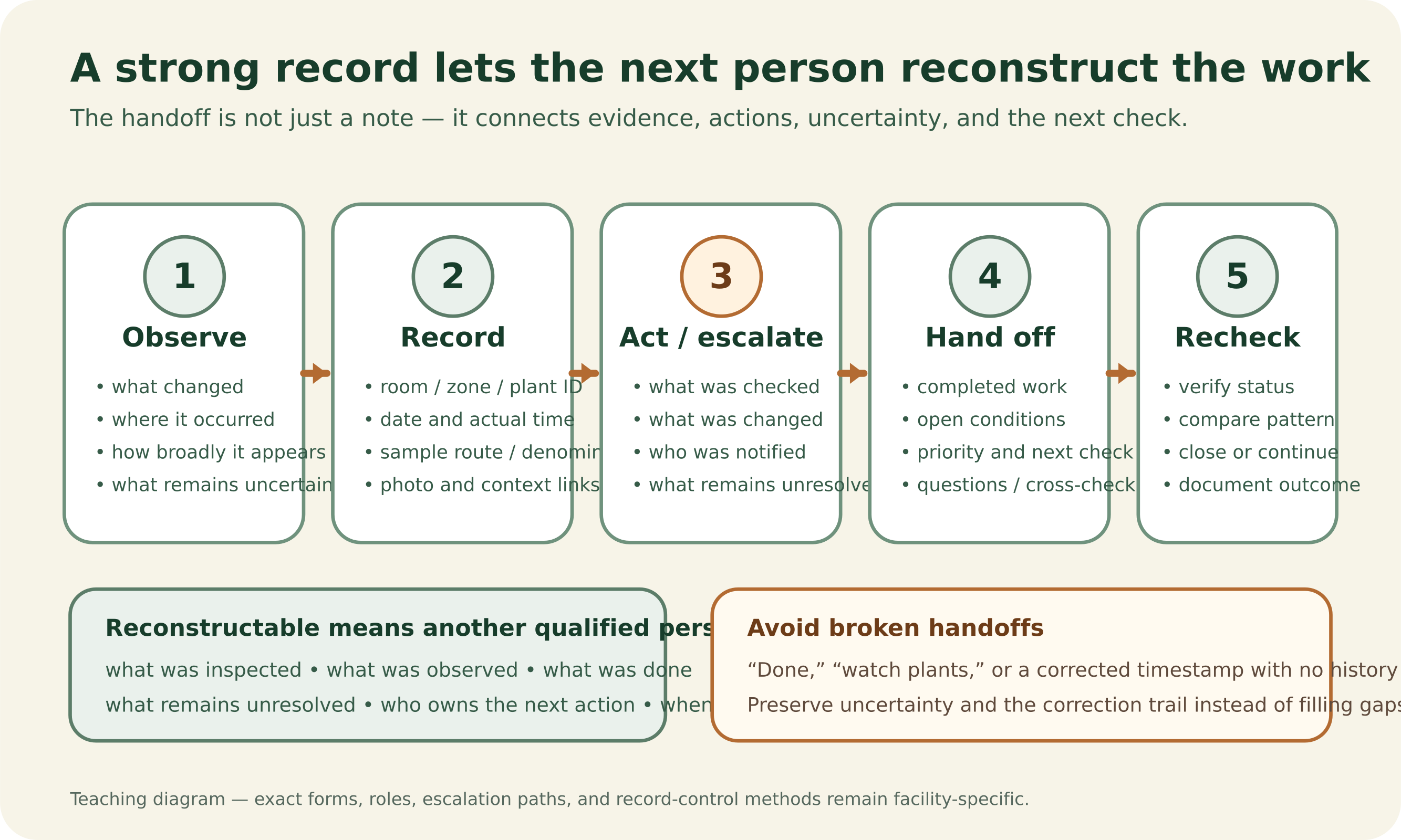
The receiving person should be able to tell what was completed, what was observed, what actions were taken, what conditions remain unresolved, what was escalated and what should be checked next. Human-factors guidance on shift handover emphasizes preparation, two-way exchange and cross-checking rather than treating handoff as a one-direction note dump.
Corrections preserve the observation history
If an observation record is corrected, use the supplied record-control method so the original history remains understandable. Do not silently replace a plant identity, timestamp or finding in a way that makes the record appear to have always contained the corrected information.
Worked examples
- A photo set includes an overall area view, a whole-plant image and a close image of the observed structure, all tied to room, zone, plant identity, date/time and the corresponding written observation.
- A comparison set includes one affected plant and a nearby typical plant photographed under similar lighting so the reviewer can see the difference without relying on a filtered image.
- A shift handoff states that a zone was rechecked, documents the remaining pattern, notes that the cause is unresolved, records who was notified and specifies the next required observation rather than writing only 'watch plants.'
Common mistakes
- Saving observation photographs without plant, room or zone identity.
- Using color filters, enhancement or inconsistent lighting as the primary evidence for a color-related observation.
- Submitting only a close-up image with no whole-plant or area context.
- Writing a handoff that lists completed tasks but omits unresolved abnormalities or uncertainty.
- Silently overwriting the original observation when correcting an identity or timestamp error.
Minimum crop-observation record
Exact fields vary by facility, but the record should preserve enough context for reconstruction.
Diagnostic photo evidence set
Show the plant or observation area in its production context so location and distribution are understandable.
Capture the overall plant form and visible distribution of the observation.
Capture the relevant structure sharply enough for review.
Include a nearby typical comparison under similar conditions when it helps show the difference.
Link the image set to the correct crop, location and observation time instead of relying on an unlabeled camera roll.
Downloadable practice: photo evidence audit
Audit four synthetic example image sets for missing context, missing detail, identity/time linkage, comparison value, lighting consistency, image fidelity, retake needs and the limits of what photographs alone can support.
Handoff content that supports continuity
| Handoff element | What the receiving person needs |
|---|---|
| Completed | What work or observation was actually completed |
| Observed | What condition or pattern was documented |
| Action taken | What was changed, checked or escalated |
| Unresolved | What remains uncertain, abnormal or incomplete |
| Next check | What the receiving role should verify and when |
| Cross-check | Questions or confirmation needed to ensure the handoff was understood |
Downloadable practice: observation record and handoff
Print or open this worksheet to practice reconstructable observation records, photo-evidence checks, relevant context, uncertainty, escalation, next-check ownership, receiving-person cross-check and correction history.
Public source: diagnostic photo guidance
University of Minnesota Extension guidance used for transferable image-context, comparison-view and photo-quality principles in this lesson.
Practical application
Use the downloadable observation/handoff worksheet and photo-evidence audit worksheet with a simulated room map, image set and work-history packet. Preserve crop/photo identity, direct observation and pattern, contextual evidence, image limitations, actions, uncertainty, escalation, next check, cross-check and any correction history so another learner can reconstruct both the crop record and the quality of its photographic evidence.
Lesson summary
Crop records turn observation into transferable evidence. Preserve identity, timing, sample context, objective wording, photographs, actions, uncertainty and follow-up so the next qualified person can reconstruct the crop state and continue the work without guessing.