Course outline & progress
Course outline
0 of 18 lessons marked complete
- 1. Applied Cultivation Workplace Safety
- 1.1 Hazard recognition and control boundaries
- 1.2 PPE, chemical labels and Safety Data Sheets
- 1.3 Cannabis-specific exposures and emergency escalation
- 2. Sanitation, Biosecurity & Controlled Movement
- 2.1 Contamination routes and zone discipline
- 2.2 Cleaning, disinfection and sanitation verification
- 2.3 Quarantine, holds and biosecurity breach response
- 3. SOPs, Work Orders, Authority & Escalation
- 3.1 Reading controlled SOPs and work orders
- 3.2 Working within authorization
- 3.3 Deviations, incomplete work and honest status
- 4. Traceability, Material Movement, Inventory & Waste
- 4.1 Identity through the cultivation workflow
- 4.2 Movement, inventory and vendor-neutral tracking
- 4.3 Discrepancies, waste and destruction documentation
- 5. Equipment Readiness, Operator Care & Fault Reporting
- 5.1 Equipment pre-use and readiness checks
- 5.2 Routine operator care versus skilled maintenance
- 5.3 Alarms, fault context and maintenance escalation
- 6. Records, Shift Handoff & Integrated Workflow
- 6.1 Contemporaneous records and data integrity
- 6.2 Professional shift handoff
- 6.3 Integrated Technician I workflow
PPE, chemical labels and Safety Data Sheets
Use supplied PPE requirements, chemical labels and safety data sheet information to prepare for an assigned cultivation task without exceeding training or authorization.
Use supplied PPE requirements, chemical labels and safety data sheet information to prepare for an assigned cultivation task without exceeding training or authorization.
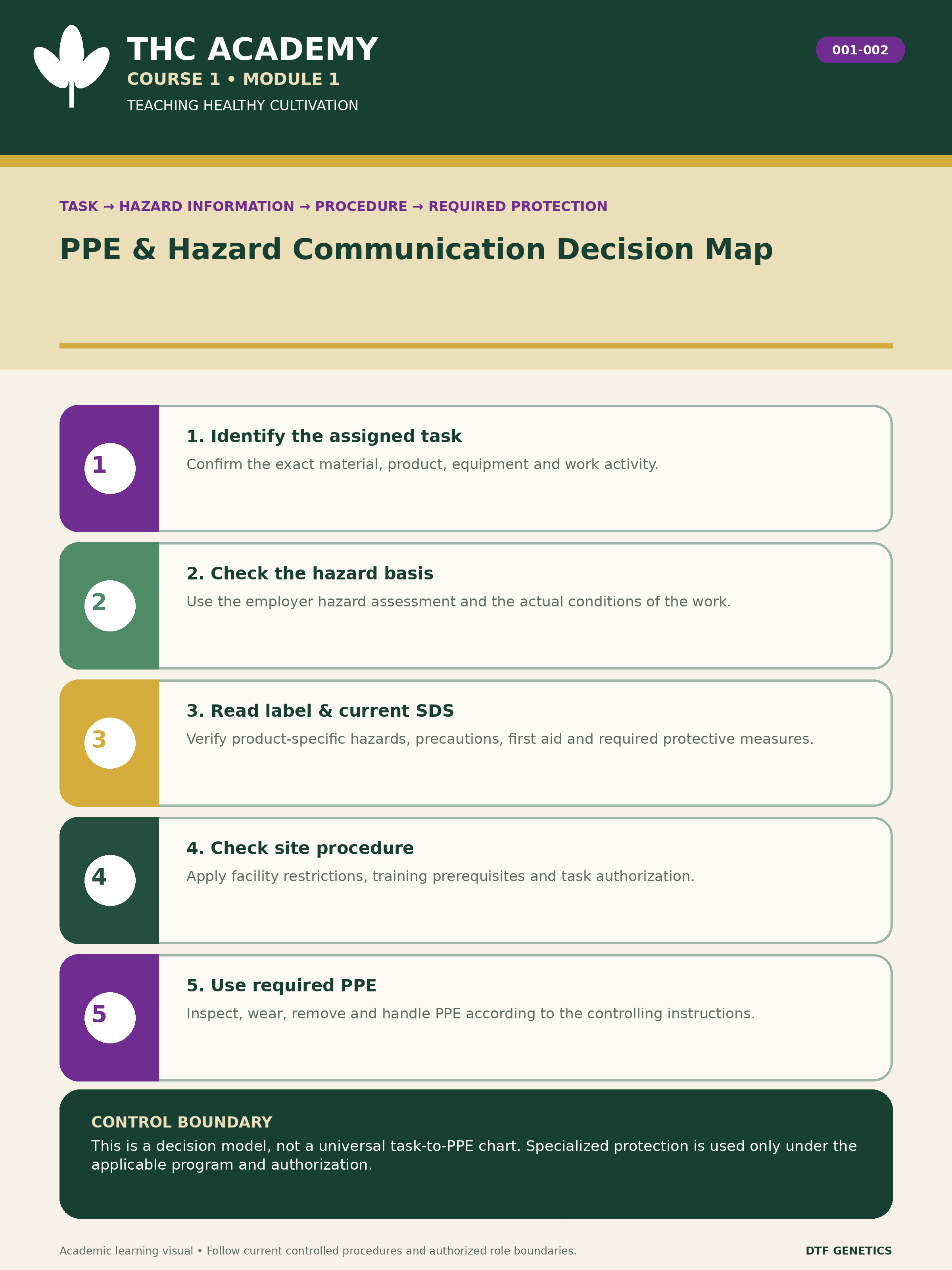
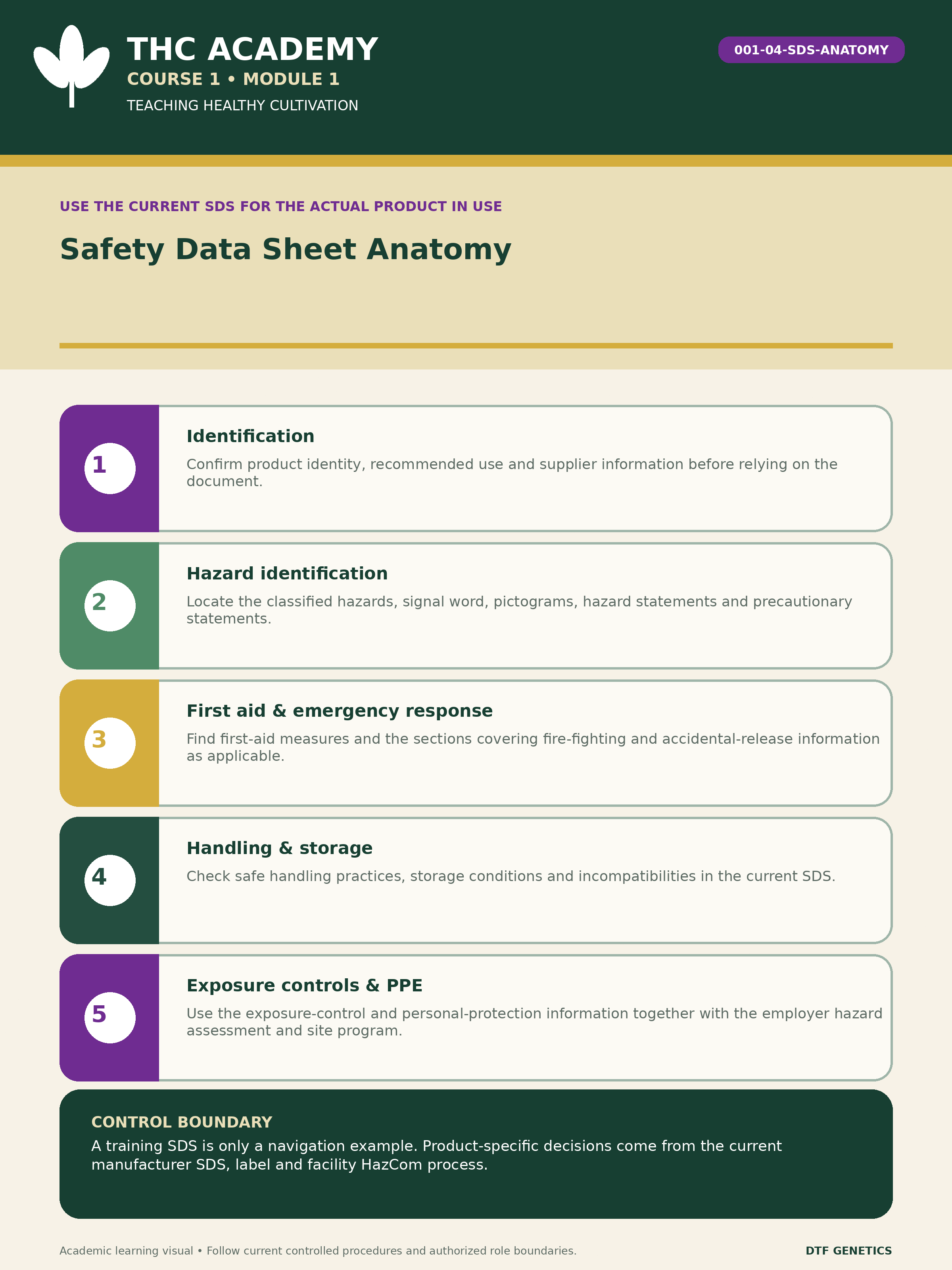
PPE is task-specific
Personal protective equipment is one layer of control, not a substitute for eliminating hazards that can reasonably be controlled another way. OSHA’s general PPE framework places the hazard assessment before equipment selection: the workplace evaluates the hazard and selects PPE that protects against it.
Technicians use the PPE specified by the employer’s hazard assessment, work instruction, chemical label and applicable requirements. Inspect required PPE before use and report missing, damaged, contaminated, poorly fitting or unsuitable equipment.
Do not invent a personal rule that “more PPE is always safer.” Incorrect or excessive PPE can create heat stress, visibility problems, dexterity problems or a false sense of security. The correct standard is appropriate PPE for the assessed task.
Scientific foundation — match protection to the exposure route
PPE works only when it interrupts a relevant exposure route and is appropriate for the hazard. Common routes include inhalation, eye contact, skin contact and accidental ingestion from contaminated hands or surfaces. A glove selected for one chemical is not automatically suitable for another; eye protection does not control inhalation; a face covering is not automatically a respirator; and respiratory protection can require a formal program, medical evaluation, fit testing and task-specific selection.
That is why the hazard assessment comes before PPE selection. The learner should be able to explain what hazard is present, how exposure could occur, what higher-level controls are already in place, and what residual exposure the assigned PPE is intended to reduce.
Read the current chemical information
Hazard Communication uses labels, Safety Data Sheets and training to communicate chemical hazards. A technician should be able to locate:
- product identity;
- signal word and hazard information;
- precautionary statements;
- first-aid information;
- storage/handling guidance;
- relevant exposure controls/PPE;
- spill or emergency information.
The SDS does not replace training or the site SOP. It is one source inside a controlled hazard-communication system.
Read an SDS as a structured technical document
Under OSHA Hazard Communication, SDS information follows a standardized section structure. For routine Technician I work, the most operationally useful sections commonly include identification; hazard identification; composition/information on ingredients; first-aid measures; accidental-release measures; handling and storage; exposure controls/PPE; physical and chemical properties; stability/reactivity; and toxicological information. The exact response still comes from the current product label, SDS, employer procedure and applicable rule.
Do not reduce SDS use to memorizing a signal word. Signal words communicate relative hazard severity within the labeling system, but safe work decisions also depend on the specific hazard statements, precautionary statements, exposure route, task conditions and emergency instructions.
Pesticide work has additional boundaries
Agricultural pesticide work can involve restricted-entry intervals, warnings, labeling requirements and specific early-entry or handler protections. The REI is label-based and depends on the pesticide and use. A Technician I course does not make the learner a pesticide handler, licensed applicator or respirator-qualified worker.
If a treated-area restriction, label requirement, site procedure or jurisdictional rule blocks the task, the restriction controls until authorized clearance is established.
Worked case
A technician is assigned to move plants in a room treated earlier that day. The daily task list says the move is due, but the room still carries a restricted-entry notice. The correct action is to verify the current restriction and authorization, not to enter because the schedule is inconvenient to change.
Guided practice — label/SDS lookup
Using a supplied mock label and SDS, locate:
- the product identifier;
- the primary hazard information;
- required precautions;
- PPE named for the assigned task;
- first-aid section;
- storage incompatibility or warning;
- any condition that should stop or escalate the task.
Common mistakes
- Using PPE based on habit instead of the current task.
- Relying on memory from a different product.
- Assuming a short exposure is automatically safe.
- Treating a course certificate as pesticide-handler authorization.
Retrieval check
- Name three sources that can control PPE requirements for a task.
- Why should a worker avoid substituting a different chemical based only on similar intended use?
- What should happen when a production schedule conflicts with a restricted-entry requirement?