Course outline & progress
Course outline
0 of 18 lessons marked complete
- 1. Applied Cultivation Workplace Safety
- 1.1 Hazard recognition and control boundaries
- 1.2 PPE, chemical labels and Safety Data Sheets
- 1.3 Cannabis-specific exposures and emergency escalation
- 2. Sanitation, Biosecurity & Controlled Movement
- 2.1 Contamination routes and zone discipline
- 2.2 Cleaning, disinfection and sanitation verification
- 2.3 Quarantine, holds and biosecurity breach response
- 3. SOPs, Work Orders, Authority & Escalation
- 3.1 Reading controlled SOPs and work orders
- 3.2 Working within authorization
- 3.3 Deviations, incomplete work and honest status
- 4. Traceability, Material Movement, Inventory & Waste
- 4.1 Identity through the cultivation workflow
- 4.2 Movement, inventory and vendor-neutral tracking
- 4.3 Discrepancies, waste and destruction documentation
- 5. Equipment Readiness, Operator Care & Fault Reporting
- 5.1 Equipment pre-use and readiness checks
- 5.2 Routine operator care versus skilled maintenance
- 5.3 Alarms, fault context and maintenance escalation
- 6. Records, Shift Handoff & Integrated Workflow
- 6.1 Contemporaneous records and data integrity
- 6.2 Professional shift handoff
- 6.3 Integrated Technician I workflow
Reading controlled SOPs and work orders
Identify the correct controlled SOP or work order for a task and distinguish required steps, acceptance criteria, exceptions and escalation points.
Identify the correct controlled SOP or work order for a task and distinguish required steps, acceptance criteria, exceptions and escalation points.
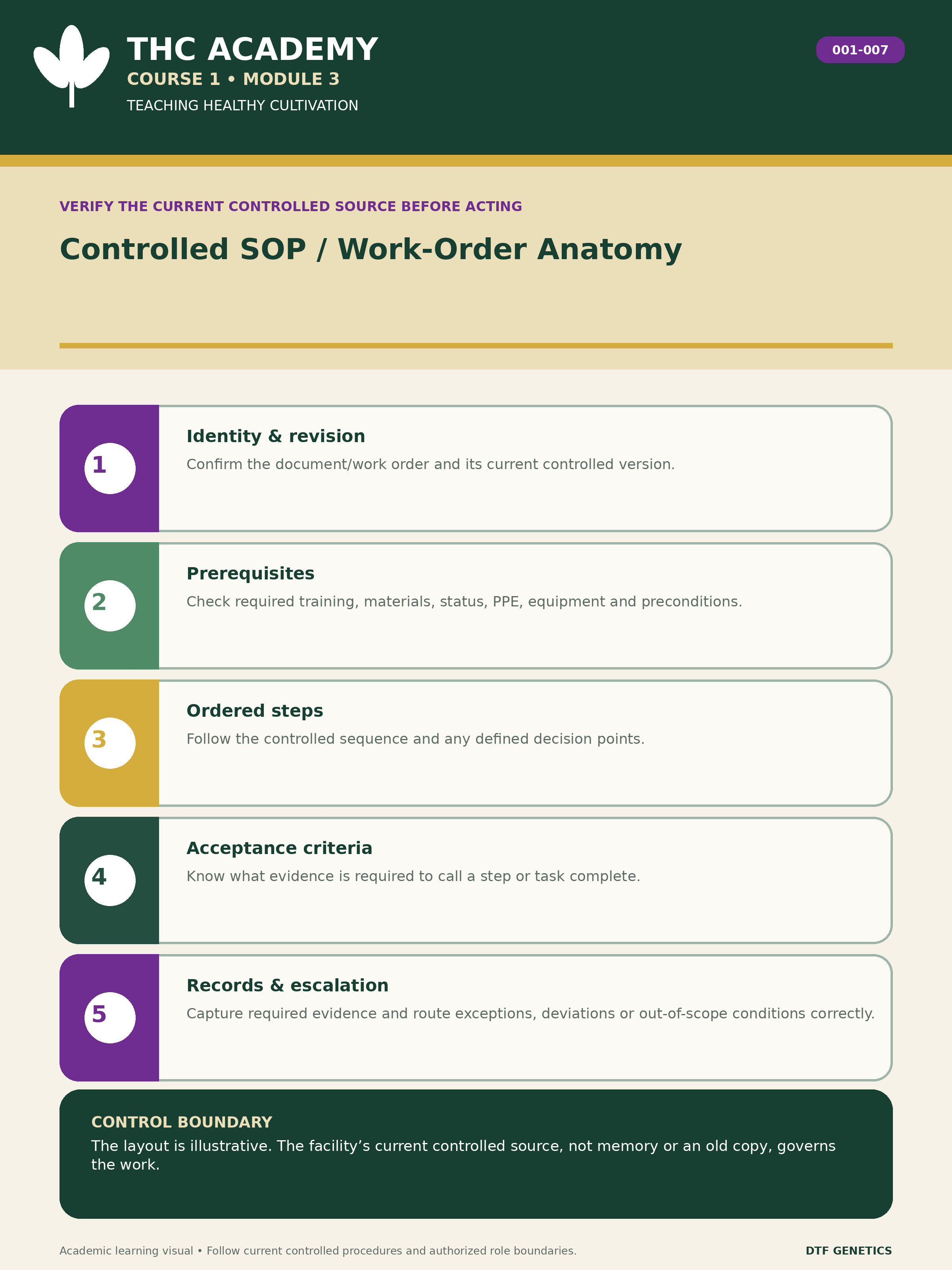
SOP and work order have different jobs
An SOP defines the standard method within a defined scope. A work order applies controlled work to a specific room, batch, quantity, date, asset or shift. They should agree. If they conflict, the technician should not choose whichever instruction is more convenient.
Scientific foundation — controlled instructions reduce process variation
Every repeated cultivation task contains sources of variation: different workers, different shifts, changing rooms, different tools, different plant states and changing environmental conditions. A controlled SOP reduces avoidable variation by making the required method, sequence, decision points and acceptance criteria explicit.
That does not mean every plant or situation behaves identically. A strong SOP separates the fixed parts of the process from the decision points where measured conditions determine the next action. This is important in cultivation, where a rigid recipe can be inappropriate when plant state, media water content, environment or equipment condition differs from the assumed starting condition.
Before work, identify:
- current document/revision;
- task scope;
- prerequisites and authorization;
- plant/material/room/asset identity;
- required tools/materials;
- sequence;
- acceptance criteria;
- required records;
- exceptions/decision points;
- escalation contact.
Current copies matter
A printed instruction can look official and still be obsolete. EPA SOP guidance stresses accessibility of current instructions to the people performing the work. If the controlled system says revision 5 is current while a binder contains revision 3, resolve the document-control issue before performing affected steps.
Acceptance criteria convert “done” into evidence
“Finished” should mean more than the worker reached the end of the page. A controlled task may require a verified count, cleanliness state, measurement, completed record, identity check, supervisor signoff or other acceptance condition.
Acceptance criteria versus process steps
A process step tells the worker what to do. An acceptance criterion tells the operation what must be true before the task can be considered acceptable. Mixing those concepts creates weak training because a learner can execute every motion while still producing an unacceptable result.
Examples:
- “wipe the bench” is an action; “surface visibly free of soil/debris before disinfectant application” is an acceptance condition;
- “move 24 plants” is an action; “24 correct identifiers verified at the documented destination” is an acceptance condition;
- “take a measurement” is an action; “valid reading obtained with the required instrument status and recorded against the correct room/asset” is an acceptance condition.
Worked case
The work order assigns a plant move to Room 3 but lists a batch identifier currently assigned to Room 4. Do not guess which field is correct. The identity conflict must be resolved before movement.
Guided practice — mark the instruction
Review a supplied SOP/work order and mark:
- prerequisites;
- actions;
- acceptance criteria;
- records;
- exceptions;
- escalation points.
Then identify one planted inconsistency between the SOP and work order.
Retrieval check
- What is the difference between an SOP and a work order?
- Why can an obsolete instruction be dangerous even if workers know it well?
- What should happen when two controlled identifiers conflict?