Course outline & progress
Course outline
0 of 18 lessons marked complete
- 1. Applied Cultivation Workplace Safety
- 1.1 Hazard recognition and control boundaries
- 1.2 PPE, chemical labels and Safety Data Sheets
- 1.3 Cannabis-specific exposures and emergency escalation
- 2. Sanitation, Biosecurity & Controlled Movement
- 2.1 Contamination routes and zone discipline
- 2.2 Cleaning, disinfection and sanitation verification
- 2.3 Quarantine, holds and biosecurity breach response
- 3. SOPs, Work Orders, Authority & Escalation
- 3.1 Reading controlled SOPs and work orders
- 3.2 Working within authorization
- 3.3 Deviations, incomplete work and honest status
- 4. Traceability, Material Movement, Inventory & Waste
- 4.1 Identity through the cultivation workflow
- 4.2 Movement, inventory and vendor-neutral tracking
- 4.3 Discrepancies, waste and destruction documentation
- 5. Equipment Readiness, Operator Care & Fault Reporting
- 5.1 Equipment pre-use and readiness checks
- 5.2 Routine operator care versus skilled maintenance
- 5.3 Alarms, fault context and maintenance escalation
- 6. Records, Shift Handoff & Integrated Workflow
- 6.1 Contemporaneous records and data integrity
- 6.2 Professional shift handoff
- 6.3 Integrated Technician I workflow
Equipment pre-use and readiness checks
Perform permitted pre-use, readiness, cleaning and operator-care checks on assigned cultivation or irrigation equipment using the supplied procedure.
Perform permitted pre-use, readiness, cleaning and operator-care checks on assigned cultivation or irrigation equipment using the supplied procedure.
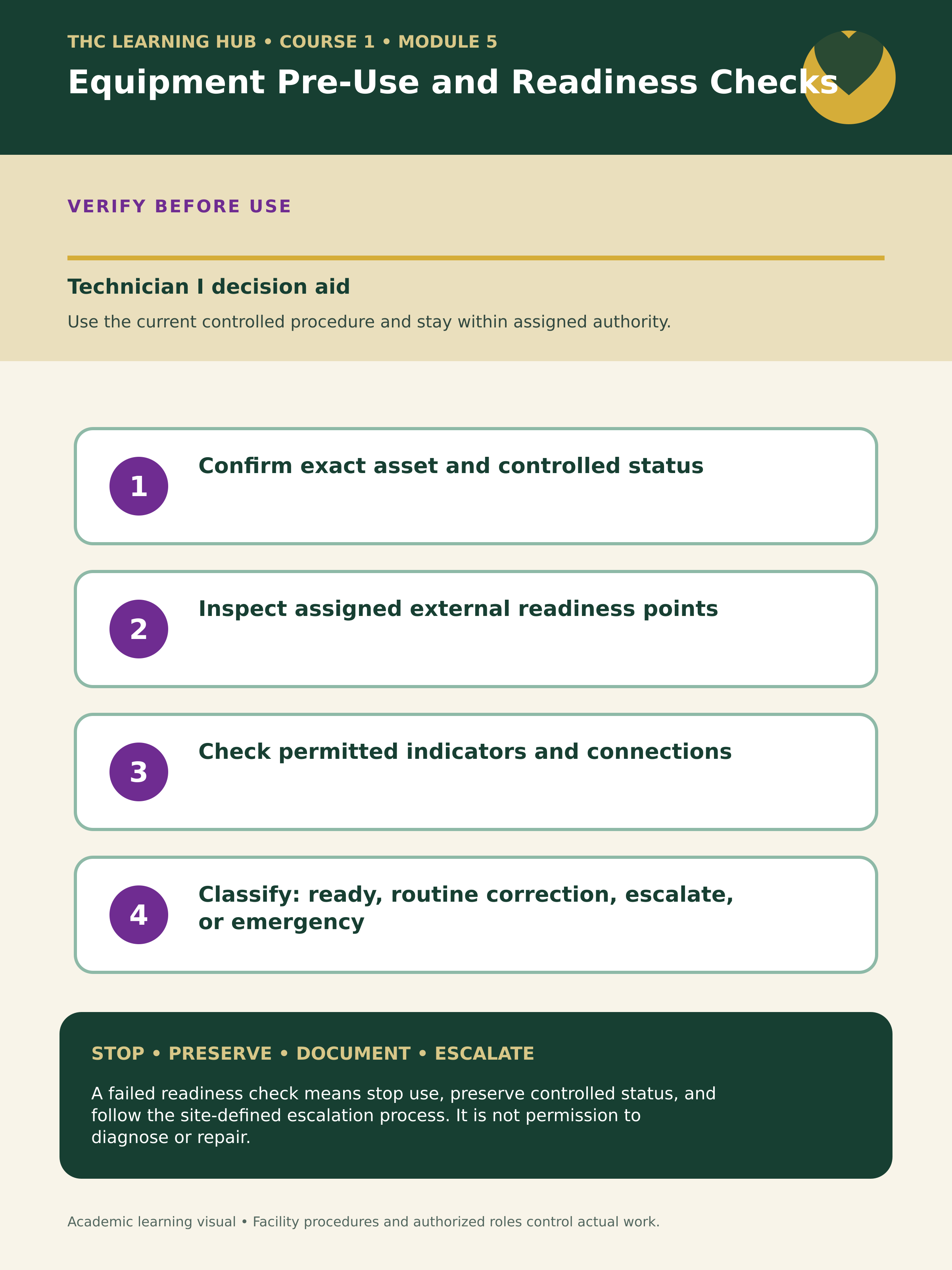
Check before operation
A pre-use check is a defined inspection intended to catch obvious readiness problems before they become worker injury, crop damage, process failure or downtime.
Scientific foundation — readiness checks are a form of preventive risk control
Equipment failures rarely matter only to the machine itself. In cultivation, one abnormal pump, fan, sensor, controller or dehumidifier can propagate into water stress, environmental drift, process delay, worker exposure or loss of traceability. Pre-use checks are therefore a simple form of failure interception: detect an abnormal condition before the equipment is relied on for production.
A useful mental model is:
expected state → observation → compare → decide → document
The technician does not need to diagnose every failure. The important skill is recognizing when the observed state no longer meets the expected operating condition.
The exact checklist belongs to the equipment manufacturer and facility procedure, but common categories include:
- correct asset identity;
- required cleanliness/sanitation state;
- visible damage;
- leaks;
- secure hoses/connections;
- guards or protective devices present;
- cords/plugs where relevant;
- abnormal sounds or odors before/at startup;
- warning indicators;
- calibration/readiness status where assigned;
- clear work area.
A failed readiness check changes the task
If a required guard is missing, a cord is damaged, a line leaks unexpectedly, or another acceptance condition fails, follow the out-of-service/escalation procedure. Do not compensate for a missing safeguard with “extra careful” behavior.
Worked case
A trimming or processing device has a missing guard but production is behind schedule. The machine still runs. The correct response is not to use it carefully; the missing safeguard changes equipment status. Follow the site’s out-of-service process and escalate.
Guided practice — pre-use inspection
Inspect a simulated asset using a checklist containing eight conditions. Classify each finding as:
- acceptable;
- routine operator correction;
- out-of-service/maintenance escalation;
- emergency hazard.
Then document the asset identity and decision.
Retrieval check
- Why are yesterday’s successful operations not proof that today’s pre-use check can be skipped?
- What is the purpose of a safeguard?
- What should happen when a readiness criterion fails?