Course outline & progress
Course outline
0 of 18 lessons marked complete
- 1. Applied Cultivation Workplace Safety
- 1.1 Hazard recognition and control boundaries
- 1.2 PPE, chemical labels and Safety Data Sheets
- 1.3 Cannabis-specific exposures and emergency escalation
- 2. Sanitation, Biosecurity & Controlled Movement
- 2.1 Contamination routes and zone discipline
- 2.2 Cleaning, disinfection and sanitation verification
- 2.3 Quarantine, holds and biosecurity breach response
- 3. SOPs, Work Orders, Authority & Escalation
- 3.1 Reading controlled SOPs and work orders
- 3.2 Working within authorization
- 3.3 Deviations, incomplete work and honest status
- 4. Traceability, Material Movement, Inventory & Waste
- 4.1 Identity through the cultivation workflow
- 4.2 Movement, inventory and vendor-neutral tracking
- 4.3 Discrepancies, waste and destruction documentation
- 5. Equipment Readiness, Operator Care & Fault Reporting
- 5.1 Equipment pre-use and readiness checks
- 5.2 Routine operator care versus skilled maintenance
- 5.3 Alarms, fault context and maintenance escalation
- 6. Records, Shift Handoff & Integrated Workflow
- 6.1 Contemporaneous records and data integrity
- 6.2 Professional shift handoff
- 6.3 Integrated Technician I workflow
Cannabis-specific exposures and emergency escalation
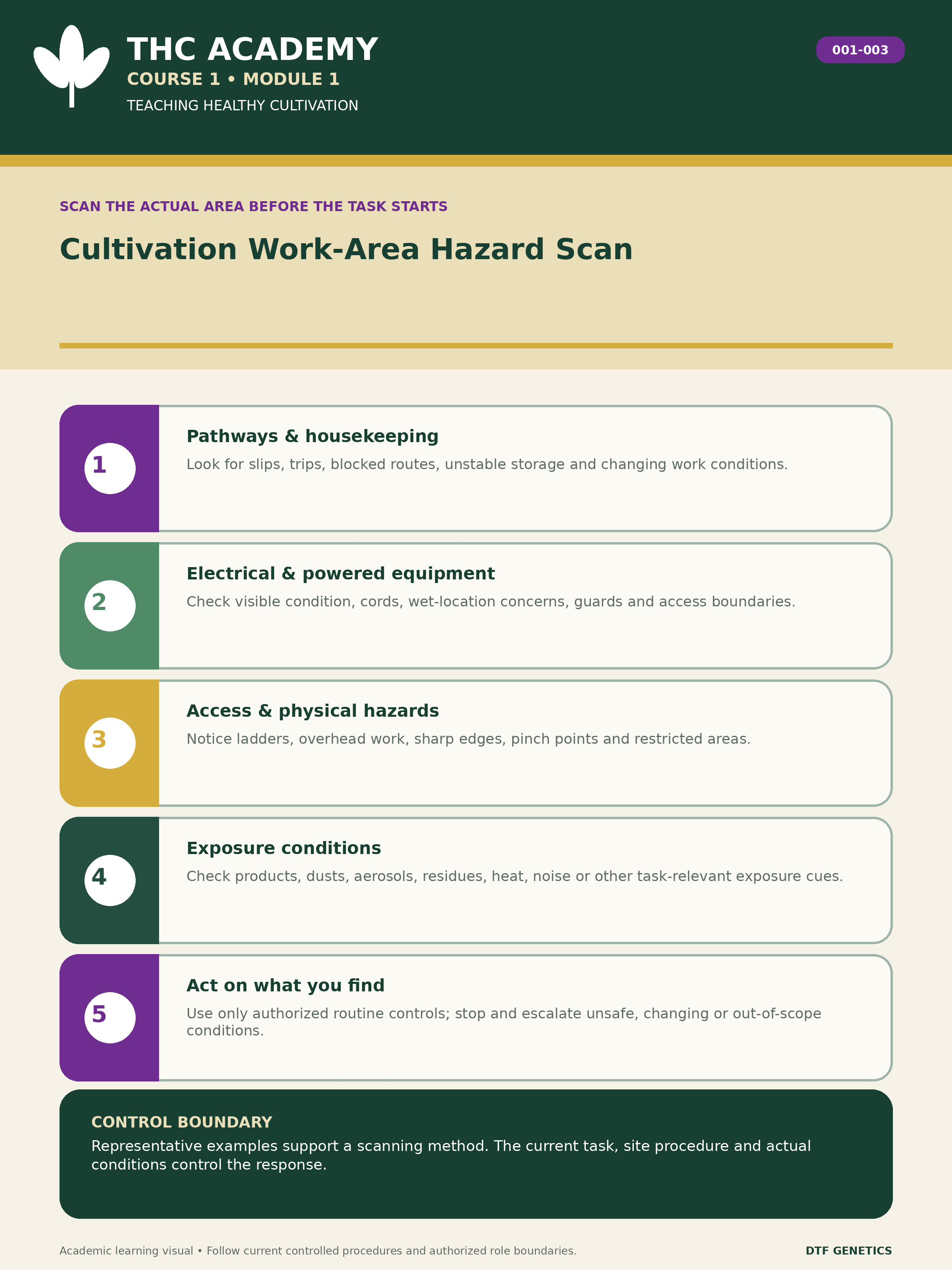
Identify common cultivation workplace hazards and select the correct routine response: control within authorization, stop, isolate where authorized, or escalate.
Identify common cultivation workplace hazards and select the correct routine response: control within authorization, stop, isolate where authorized, or escalate.
Use supplied PPE requirements, chemical labels and safety data sheet information to prepare for an assigned cultivation task without exceeding training or authorization.
“Natural” does not mean “nonhazardous”
Cannabis plant material can contribute to occupational exposure. NIOSH has reported allergic and irritant symptoms among cannabis workers and has continued to identify work-related asthma as a concern. Depending on the facility and task, exposure can involve plant dust/organic particulate, microbes, allergens, pesticides, ozone, carbon dioxide, heat, noise, repetitive work or other physical stressors.
This does not mean every worker or facility faces the same exposure level. The facility must assess actual conditions. Technician I must know how to recognize symptoms or alarms that require reporting or escalation.
Scientific foundation — respiratory exposure can be irritant, allergic or mixed
Work-related breathing problems do not all arise through the same mechanism. Some workplace agents act primarily as irritants; others can act as sensitizers that trigger an immune response after a latency period; and some work conditions can worsen pre-existing disease. NIOSH describes cannabis-industry concerns that include plant material, organic dust/particulate, microbes, cleaning chemicals and other exposures. Recent NIOSH reporting also documents work-related asthma cases in cannabis cultivation and processing.
For the technician, the operational lesson is not to diagnose the mechanism. It is to recognize a credible work pattern, report it early, and support exposure control. Repeated symptoms during a particular task, improvement away from the task, or recurrence after re-exposure are useful facts to report to the workplace health process and a qualified clinician.
Report work-related symptoms
Recurring cough, wheeze, chest tightness, shortness of breath, eye irritation, skin reactions or other symptoms associated with work should be reported through the workplace health and safety process. NIOSH’s 2026 asthma material emphasizes early recognition and prevention; the technician should not self-diagnose or hide symptoms because of stigma or production pressure.
Medical evaluation belongs to qualified health professionals. The worker’s role is to report the pattern accurately and follow the workplace response.
Alarms are action signals, not diagnosis invitations
Carbon dioxide is colorless and odorless, so human senses are not a reliable warning system for an unsafe accumulation. Elevated CO₂ can displace oxygen and can also cause direct physiological effects at sufficiently high concentrations. A carbon-dioxide or other life-safety alarm should therefore trigger the posted response procedure, not an informal “smell test” or visual inspection.
If the worker is not assigned emergency-response duties, do not enter merely to look at a controller or “see if it feels okay.” Follow the emergency plan and chain of command. Alarm setpoints, ventilation interlocks, emergency actions and re-entry criteria are facility-specific engineering and safety controls, not values the learner should invent from a generic course.
Decision scenario
A worker reports coughing only during one dusty dry-plant handling task. Another employee suggests using any available dust mask and continuing. A stronger response is to report the work-related symptoms, review the assessed controls and PPE requirements for that task, and involve the site safety/health process. Improvised respiratory protection may be ineffective and can create additional regulatory requirements.
Module application — pre-task safety brief
Prepare a one-page pre-task brief for a mock cultivation task. Include:
- task and work area;
- top hazards;
- controls and PPE from supplied instructions;
- conditions that stop the task;
- conditions requiring escalation;
- emergency communication path.
Module retrieval
Without notes, explain the difference among hazard recognition, routine control, stop-work, and technical repair. Then explain why Technician I competence includes knowing where authorization ends.