Course outline & progress
Course outline
0 of 18 lessons marked complete
- 1. Applied Cultivation Workplace Safety
- 1.1 Hazard recognition and control boundaries
- 1.2 PPE, chemical labels and Safety Data Sheets
- 1.3 Cannabis-specific exposures and emergency escalation
- 2. Sanitation, Biosecurity & Controlled Movement
- 2.1 Contamination routes and zone discipline
- 2.2 Cleaning, disinfection and sanitation verification
- 2.3 Quarantine, holds and biosecurity breach response
- 3. SOPs, Work Orders, Authority & Escalation
- 3.1 Reading controlled SOPs and work orders
- 3.2 Working within authorization
- 3.3 Deviations, incomplete work and honest status
- 4. Traceability, Material Movement, Inventory & Waste
- 4.1 Identity through the cultivation workflow
- 4.2 Movement, inventory and vendor-neutral tracking
- 4.3 Discrepancies, waste and destruction documentation
- 5. Equipment Readiness, Operator Care & Fault Reporting
- 5.1 Equipment pre-use and readiness checks
- 5.2 Routine operator care versus skilled maintenance
- 5.3 Alarms, fault context and maintenance escalation
- 6. Records, Shift Handoff & Integrated Workflow
- 6.1 Contemporaneous records and data integrity
- 6.2 Professional shift handoff
- 6.3 Integrated Technician I workflow
Contamination routes and zone discipline
Execute sanitation and controlled-movement procedures that reduce cross-contamination risk between plants, rooms, tools and work zones.
Execute sanitation and controlled-movement procedures that reduce cross-contamination risk between plants, rooms, tools and work zones.
Think in pathways, not appearances
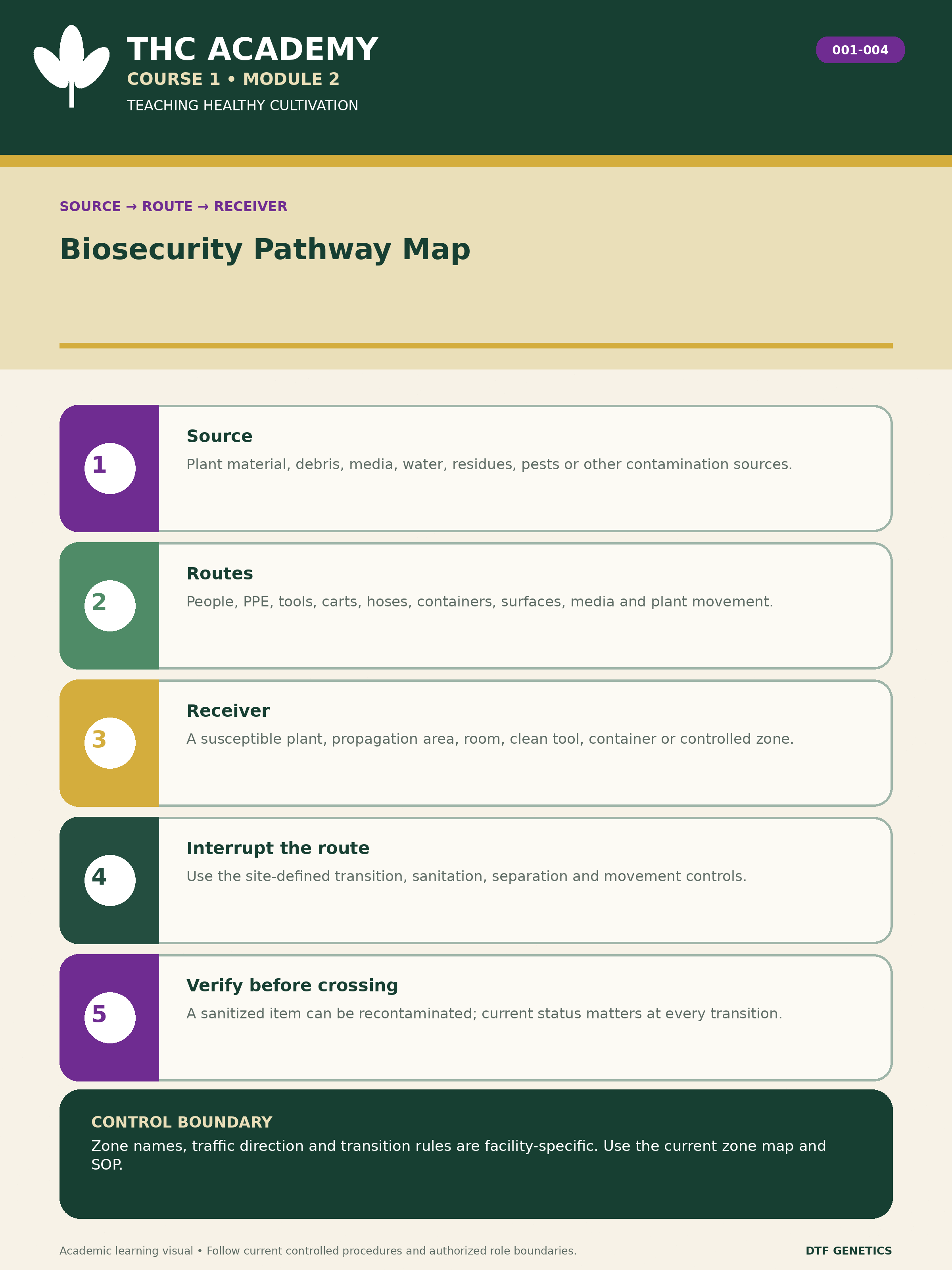
Biosecurity is easier to understand when you ask, “How could material move from this place to that place?” Pathogens or pests do not need to ride on a visibly sick plant. Greenhouse disease guidance identifies contaminated media, tools, hose ends, plant debris, containers and work surfaces as possible sources or routes. Workers and carts can connect areas as well.
Penn State specifically warns that clean media can be recontaminated through dirty tools, hose ends, surfaces and materials. This is an important mental model: clean status is not permanent if the item re-enters a contaminated pathway.
Scientific foundation — contamination requires a source, a route and a susceptible target
A useful biosecurity model is a three-part chain:
source → transfer route → susceptible plant or clean area
The source can be infected or infested plant material, contaminated media, standing water, plant debris, a dirty tool, a reused container, footwear, gloves, a cart, or another contaminated surface. The route can be direct contact, splash, airflow, irrigation movement, worker movement, tool movement or shared equipment. The target can be a propagation tray, mother stock, a clean bench, fresh media or another plant population.
Interrupting any link can reduce spread. For example, room-specific tools interrupt equipment transfer; hand and glove protocols reduce worker-mediated transfer; removing debris reduces reservoirs; and clean-to-dirty workflow reduces the chance that workers carry material back into a cleaner zone.
This model is more useful than memorizing a list of pests because it still works when the exact organism is unknown.
Scientific foundation — sanitation is risk reduction, not sterilization
Most cultivation sanitation programs do not create a sterile environment. The operational goal is to reduce contamination pressure and prevent avoidable transfer to a level the facility can control. That distinction matters because “we disinfected it” should never be interpreted as proof that no biological material remains.
Visible cleanliness, microbial load and disease risk are related but not identical. A surface can look clean while still carrying microorganisms; a visibly dirty surface can also shield microorganisms from a disinfectant. This is why process quality—correct cleaning, correct product, correct contact conditions and controlled movement—matters more than appearance alone.
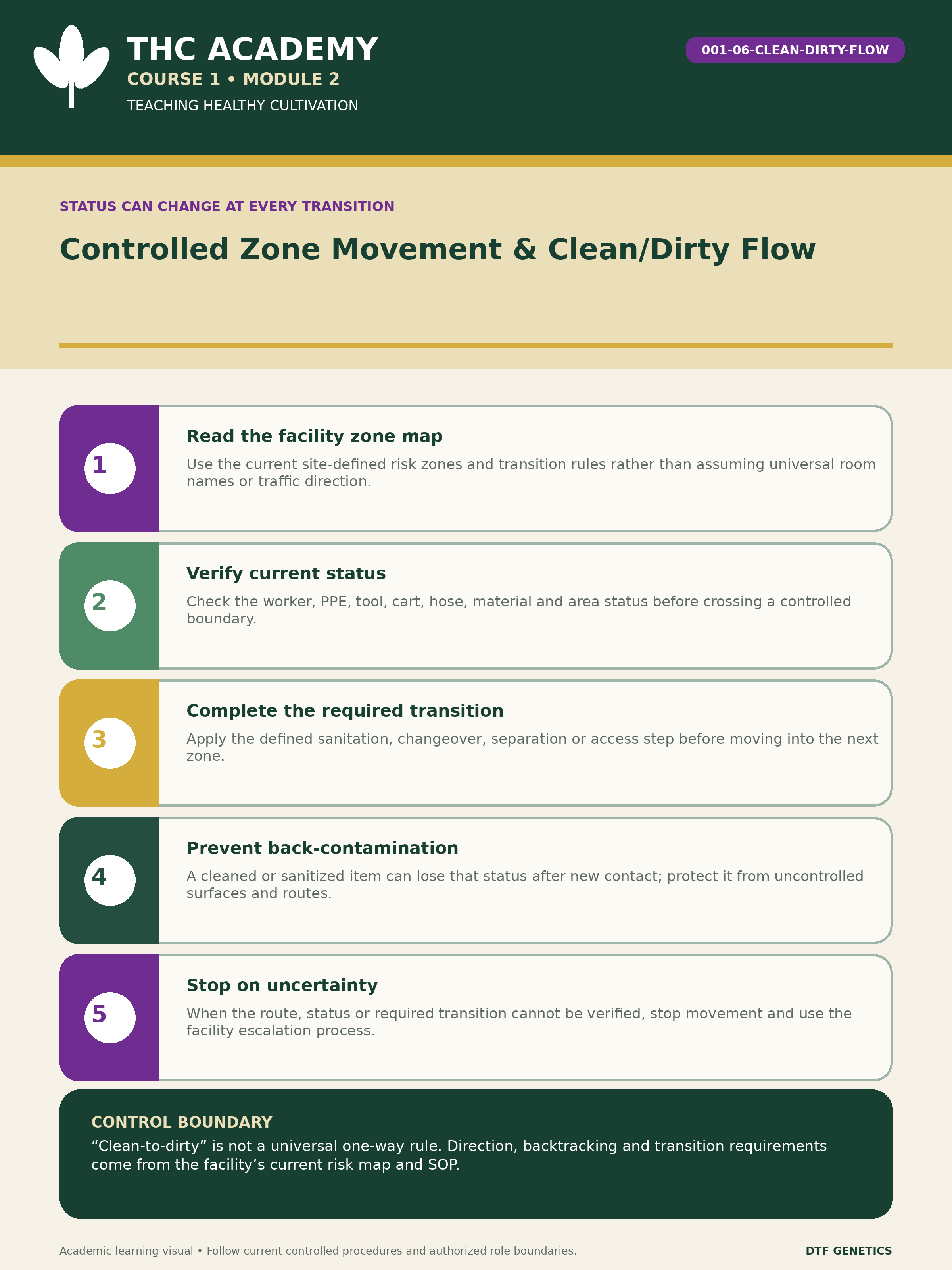
Zone names vary; movement logic does not
Facilities may use terms such as clean zone, production, quarantine, isolation, mother room, propagation, hold area or restricted area. Names vary. The operating principle is stable: movement controls reduce the chance that a worker or object carries risk from a higher-risk area into a cleaner or more sensitive area.
When the SOP uses clean-to-dirty movement:
- perform lower-risk work first;
- follow clothing/glove/footwear change rules;
- keep room-specific tools in the assigned zone where required;
- sanitize shared equipment before crossing boundaries;
- avoid unnecessary backward travel.
Worked case
A cart used in quarantine is urgently needed in propagation. Wiping one visible spot is not automatically sufficient. The cart follows the approved cleaning/disinfection and release workflow before entering the cleaner zone. Production urgency does not remove the contamination pathway.
Guided practice — contamination map
On a facility map, draw arrows showing possible movement through:
- technician travel;
- shared tools;
- carts;
- irrigation hose ends;
- incoming plant material;
- waste/debris removal.
Then redesign the sequence to reduce avoidable cross-zone travel.
Retrieval check
- Name five non-plant contamination routes.
- Why can a healthy-looking incoming plant still require quarantine?
- What is the purpose of clean-to-dirty sequencing?