Course outline & progress
Course outline
0 of 18 lessons marked complete
- 1. Applied Cultivation Workplace Safety
- 1.1 Hazard recognition and control boundaries
- 1.2 PPE, chemical labels and Safety Data Sheets
- 1.3 Cannabis-specific exposures and emergency escalation
- 2. Sanitation, Biosecurity & Controlled Movement
- 2.1 Contamination routes and zone discipline
- 2.2 Cleaning, disinfection and sanitation verification
- 2.3 Quarantine, holds and biosecurity breach response
- 3. SOPs, Work Orders, Authority & Escalation
- 3.1 Reading controlled SOPs and work orders
- 3.2 Working within authorization
- 3.3 Deviations, incomplete work and honest status
- 4. Traceability, Material Movement, Inventory & Waste
- 4.1 Identity through the cultivation workflow
- 4.2 Movement, inventory and vendor-neutral tracking
- 4.3 Discrepancies, waste and destruction documentation
- 5. Equipment Readiness, Operator Care & Fault Reporting
- 5.1 Equipment pre-use and readiness checks
- 5.2 Routine operator care versus skilled maintenance
- 5.3 Alarms, fault context and maintenance escalation
- 6. Records, Shift Handoff & Integrated Workflow
- 6.1 Contemporaneous records and data integrity
- 6.2 Professional shift handoff
- 6.3 Integrated Technician I workflow
Hazard recognition and control boundaries
Identify common cultivation workplace hazards and select the correct routine response: control within authorization, stop, isolate where authorized, or escalate.
Identify common cultivation workplace hazards and select the correct routine response: control within authorization, stop, isolate where authorized, or escalate.
Start with observation, not normalization
A hazard is a source or condition with the potential to cause harm. Risk adds context: how likely harm is and how serious the outcome could be. A wet aisle, damaged cord, unstable ladder, blocked walkway, sharp tool, leaking line, unguarded moving part, chemical splash risk, hot work area, or unsafe gas condition should not become invisible simply because workers see it every day.
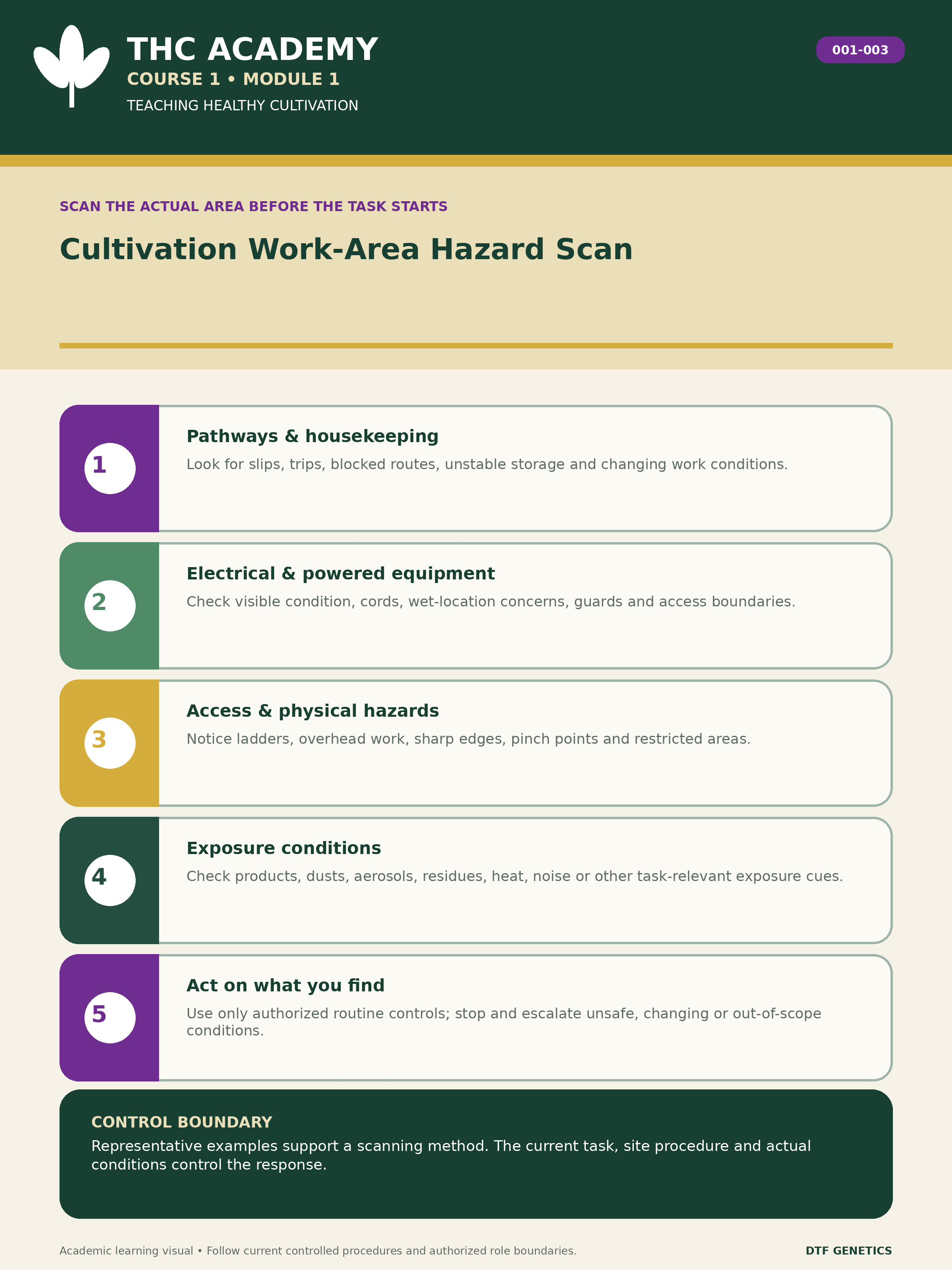
A good Technician I scan asks four questions before production work begins:
- What can injure or expose a person?
- What could spread contamination or damage crop material?
- What equipment or environmental condition is not in its normal controlled state?
- Is the required response inside my training and authorization?
The fourth question is important. Recognizing a fault does not automatically qualify the technician to repair it.
Scientific foundation — hazard, exposure and risk are different questions
A hazard can exist without a worker being exposed to it, and an exposure can vary greatly in route, intensity, duration and frequency. That distinction matters in cultivation because the same room can contain electrical, chemical, biological, ergonomic and environmental hazards at the same time. A technician should therefore avoid treating risk as a single visual impression such as “this room looks safe.”
For routine work, think in a short causal chain:
hazard source → pathway or contact opportunity → worker/crop receptor → possible consequence → control
Examples:
- irrigation water becomes an electrical risk when it creates a contact pathway toward energized or damaged equipment;
- plant dust becomes a respiratory concern when a task suspends particulate in the breathing zone;
- a sanitizer becomes a chemical-exposure concern when its concentration, handling method or splash/aerosol pathway creates contact;
- a blocked aisle becomes a fall or emergency-egress concern because it changes how people can safely move through the work area.
This is why observation must include both the source and the pathway. Removing or interrupting the pathway can be a stronger control than simply warning a worker to “be careful.”
Use the hierarchy of controls — and stay inside authorization
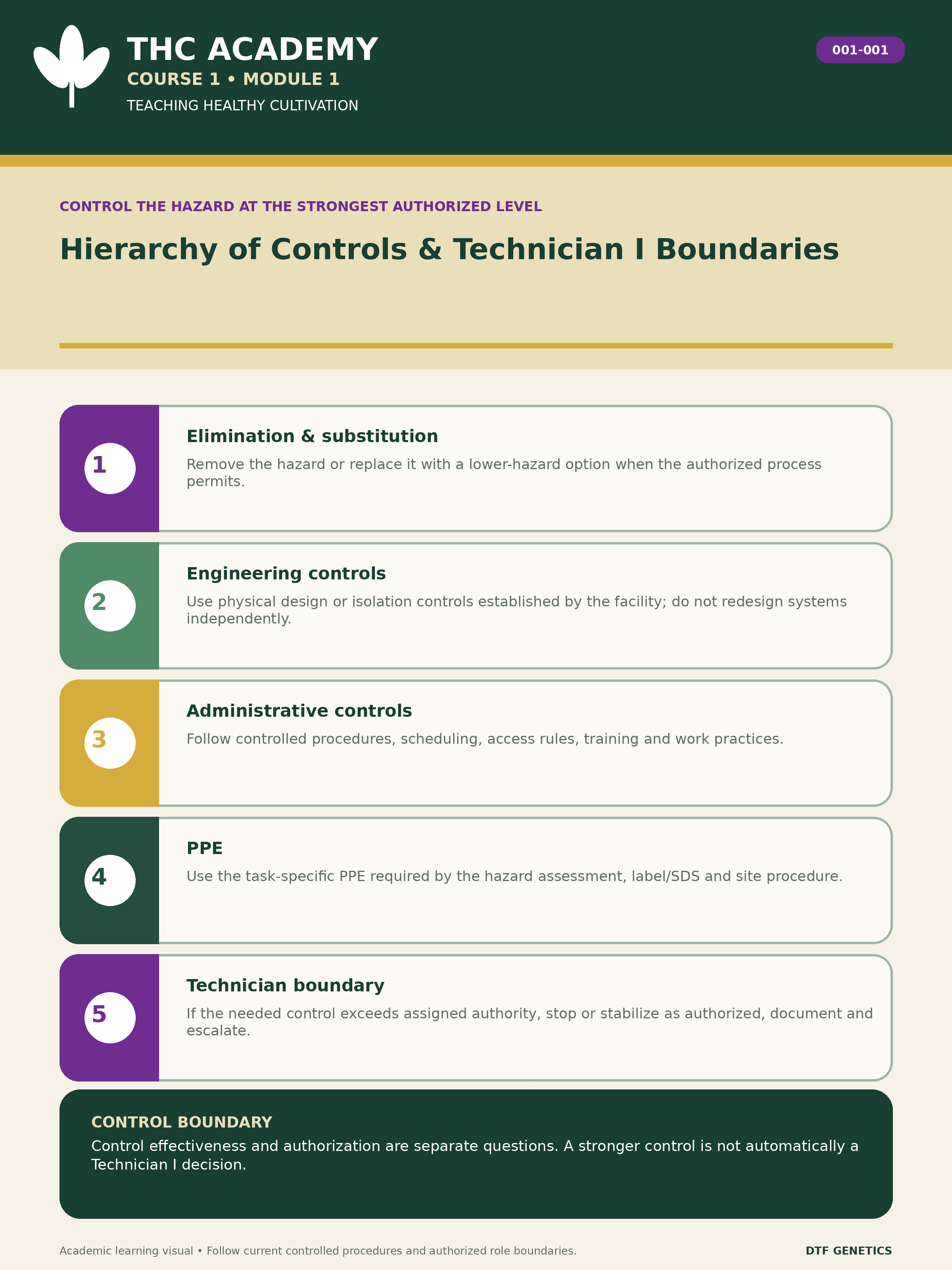
OSHA and NIOSH use a hierarchy that prioritizes controls that act on the hazard itself before controls that depend mainly on worker behavior. In general, the order is elimination, substitution, engineering controls, administrative/work-practice controls, then PPE. The hierarchy is not permission to redesign equipment or processes on your own; Technician I applies only controls authorized by the site procedure and escalates changes that require engineering, electrical, chemical, supervisory or other specialist authority.
Use the strongest authorized control
When the work procedure allows it, changing the work environment is usually stronger than relying only on worker attention. A hose that repeatedly crosses an aisle should be rerouted or secured rather than turned into a permanent “watch your step” problem. A spill covered by an approved routine procedure should be corrected promptly. Damaged electrical equipment should not be opened or investigated by an unqualified technician simply because production is waiting.
A useful operational decision model is:
- Control within authorization — a defined, safe routine response is permitted.
- Stop — the task cannot proceed under current conditions.
- Isolate where authorized — prevent use or access using the facility’s defined process.
- Escalate — transfer the unresolved condition to the person or team with the authority and competence to resolve it.
Worked case
You enter a corridor and find irrigation water spreading toward a powered device with visible cord damage. The daily task list says irrigation must begin immediately. The schedule does not override the hazard. Do not touch exposed electrical components. Follow the site’s stop/isolate process and escalate the electrical condition. A delayed task is preferable to an uncontrolled electrical exposure.
Guided practice — classify the first response
For each condition, choose routine control, stop/isolate, or escalate, then justify the choice:
- a hose partially blocks an aisle and can be placed on the approved hanger;
- a ladder has a damaged step;
- an unknown life-safety alarm is sounding in an enriched room;
- a small spill is covered by the site’s routine spill procedure;
- a powered hand tool has a damaged cord;
- a cart blocks a marked emergency route.
Common mistakes
- Treating a repeated hazard as acceptable because nobody has been hurt yet.
- Assuming the quickest response is always the safest response.
- Attempting a repair that exceeds training or authorization.
- Focusing only on crop risk while ignoring worker risk.
Retrieval check
- Why is “we have always done it this way” weak evidence that a condition is safe?
- What is the difference between recognizing a hazard and being authorized to repair it?
- Give one example where removing the hazard is stronger than warning workers about it.