Course outline & progress
Course outline
0 of 18 lessons marked complete
- 1. Applied Cultivation Workplace Safety
- 1.1 Hazard recognition and control boundaries
- 1.2 PPE, chemical labels and Safety Data Sheets
- 1.3 Cannabis-specific exposures and emergency escalation
- 2. Sanitation, Biosecurity & Controlled Movement
- 2.1 Contamination routes and zone discipline
- 2.2 Cleaning, disinfection and sanitation verification
- 2.3 Quarantine, holds and biosecurity breach response
- 3. SOPs, Work Orders, Authority & Escalation
- 3.1 Reading controlled SOPs and work orders
- 3.2 Working within authorization
- 3.3 Deviations, incomplete work and honest status
- 4. Traceability, Material Movement, Inventory & Waste
- 4.1 Identity through the cultivation workflow
- 4.2 Movement, inventory and vendor-neutral tracking
- 4.3 Discrepancies, waste and destruction documentation
- 5. Equipment Readiness, Operator Care & Fault Reporting
- 5.1 Equipment pre-use and readiness checks
- 5.2 Routine operator care versus skilled maintenance
- 5.3 Alarms, fault context and maintenance escalation
- 6. Records, Shift Handoff & Integrated Workflow
- 6.1 Contemporaneous records and data integrity
- 6.2 Professional shift handoff
- 6.3 Integrated Technician I workflow
Quarantine, holds and biosecurity breach response
Recognize quarantine, restricted-entry, hold and isolation conditions and apply the response defined by the supplied procedure.
Recognize quarantine, restricted-entry, hold and isolation conditions and apply the response defined by the supplied procedure.
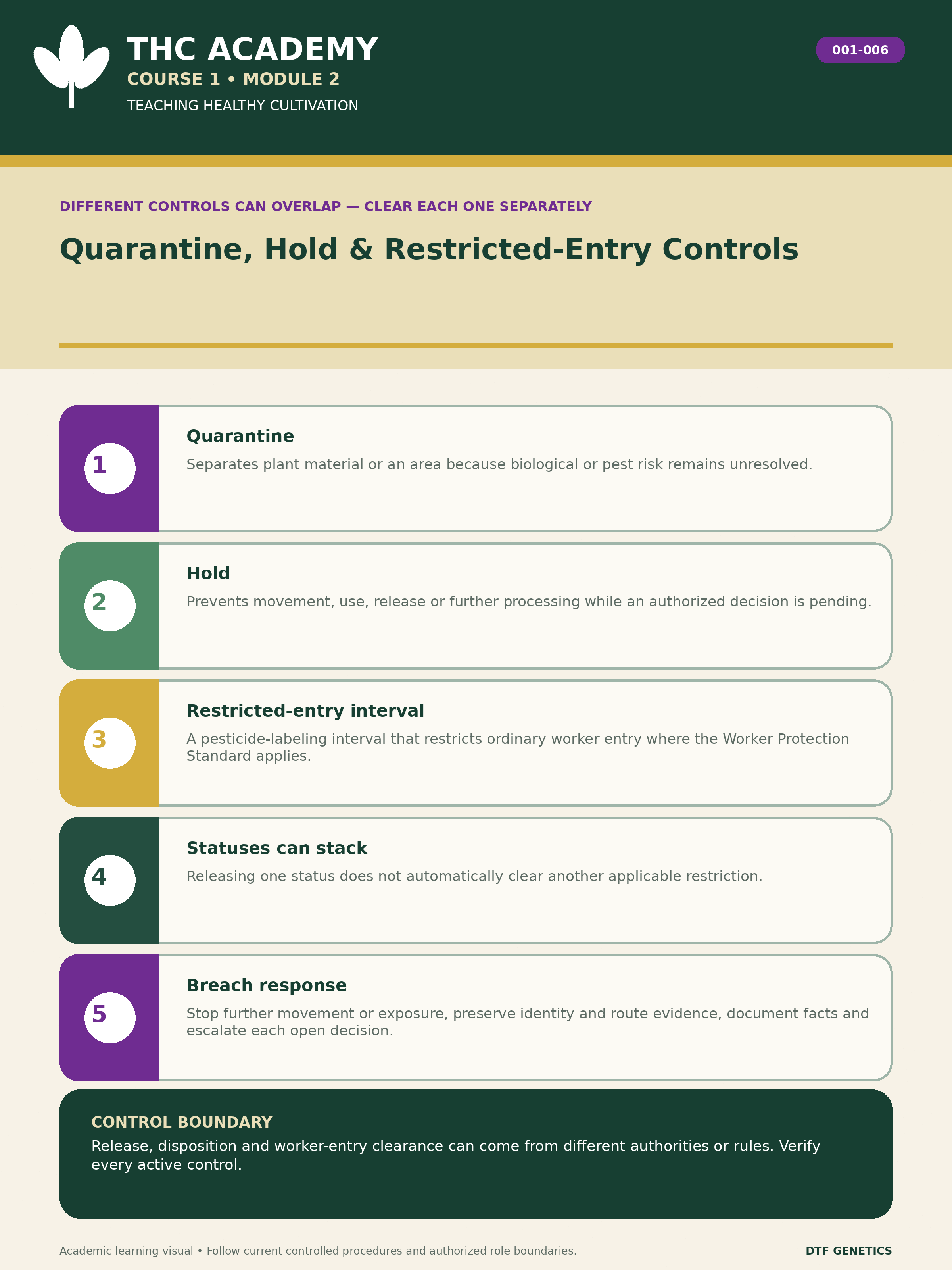
A hold preserves decision space
Quarantine or hold status protects the operation while an unresolved condition is evaluated. The concern might involve suspected pest/disease risk, incoming material, pesticide entry restrictions, identity uncertainty or another controlled issue. Technician I does not independently release a hold because plants look healthy.
Do not confuse plant-health quarantine with pesticide restricted-entry status. They can coexist, but they come from different control systems.
Scientific foundation — quarantine changes uncertainty into a controlled state
Quarantine is fundamentally an uncertainty-management tool. It separates material whose risk status is not yet resolved from the general production population. The material may ultimately prove healthy, but separation prevents an unresolved risk from becoming a facility-wide exposure.
A good quarantine system therefore needs more than physical distance. It also needs identity, movement control, dedicated or controlled tools, defined entry/exit rules, observation criteria, release authority and records. Without those controls, a “quarantine room” can still leak risk through people, tools, carts, irrigation equipment or mislabeled material.
Stop further spread first
If a quarantine tray appears in general production, a tool crosses a controlled boundary without required sanitation, or an area is entered improperly, the first objective is to stop additional movement or exposure within the procedure. Preserve identity and the current state. Notify the correct role and document what is known.
Useful breach information includes:
- exact area/material identifiers;
- time discovered;
- movement that already occurred;
- tools/carts/people potentially involved;
- immediate control taken;
- person notified;
- remaining uncertainty.
Do not destroy evidence while “fixing” the problem
Moving questionable material without documenting its route, discarding labels, combining lots, or cleaning every involved object before the movement history is captured can make the situation harder to investigate.
Decision scenario
A tray from quarantine is found on a general-production cart. The plants look healthy. Returning it quietly would erase part of the exposure history. A stronger response is to stop further movement, preserve identity, follow the breach procedure, identify where the cart traveled, and escalate for the authorized containment/release decision.
Module application — biosecurity breach packet
Complete a simulated breach report containing:
- room map;
- plant/tray identifiers;
- worker/cart movements;
- sanitation status;
- immediate controls;
- open questions;
- required handoff.
Module retrieval
Explain how cleaning, disinfection, quarantine, and traceability work together. Give one example where failure in one weakens the others.