Course outline & progress
Course outline
0 of 18 lessons marked complete
- 1. Applied Cultivation Workplace Safety
- 1.1 Hazard recognition and control boundaries
- 1.2 PPE, chemical labels and Safety Data Sheets
- 1.3 Cannabis-specific exposures and emergency escalation
- 2. Sanitation, Biosecurity & Controlled Movement
- 2.1 Contamination routes and zone discipline
- 2.2 Cleaning, disinfection and sanitation verification
- 2.3 Quarantine, holds and biosecurity breach response
- 3. SOPs, Work Orders, Authority & Escalation
- 3.1 Reading controlled SOPs and work orders
- 3.2 Working within authorization
- 3.3 Deviations, incomplete work and honest status
- 4. Traceability, Material Movement, Inventory & Waste
- 4.1 Identity through the cultivation workflow
- 4.2 Movement, inventory and vendor-neutral tracking
- 4.3 Discrepancies, waste and destruction documentation
- 5. Equipment Readiness, Operator Care & Fault Reporting
- 5.1 Equipment pre-use and readiness checks
- 5.2 Routine operator care versus skilled maintenance
- 5.3 Alarms, fault context and maintenance escalation
- 6. Records, Shift Handoff & Integrated Workflow
- 6.1 Contemporaneous records and data integrity
- 6.2 Professional shift handoff
- 6.3 Integrated Technician I workflow
Cleaning, disinfection and sanitation verification
Execute sanitation and controlled-movement procedures that reduce cross-contamination risk between plants, rooms, tools and work zones.
Execute sanitation and controlled-movement procedures that reduce cross-contamination risk between plants, rooms, tools and work zones.
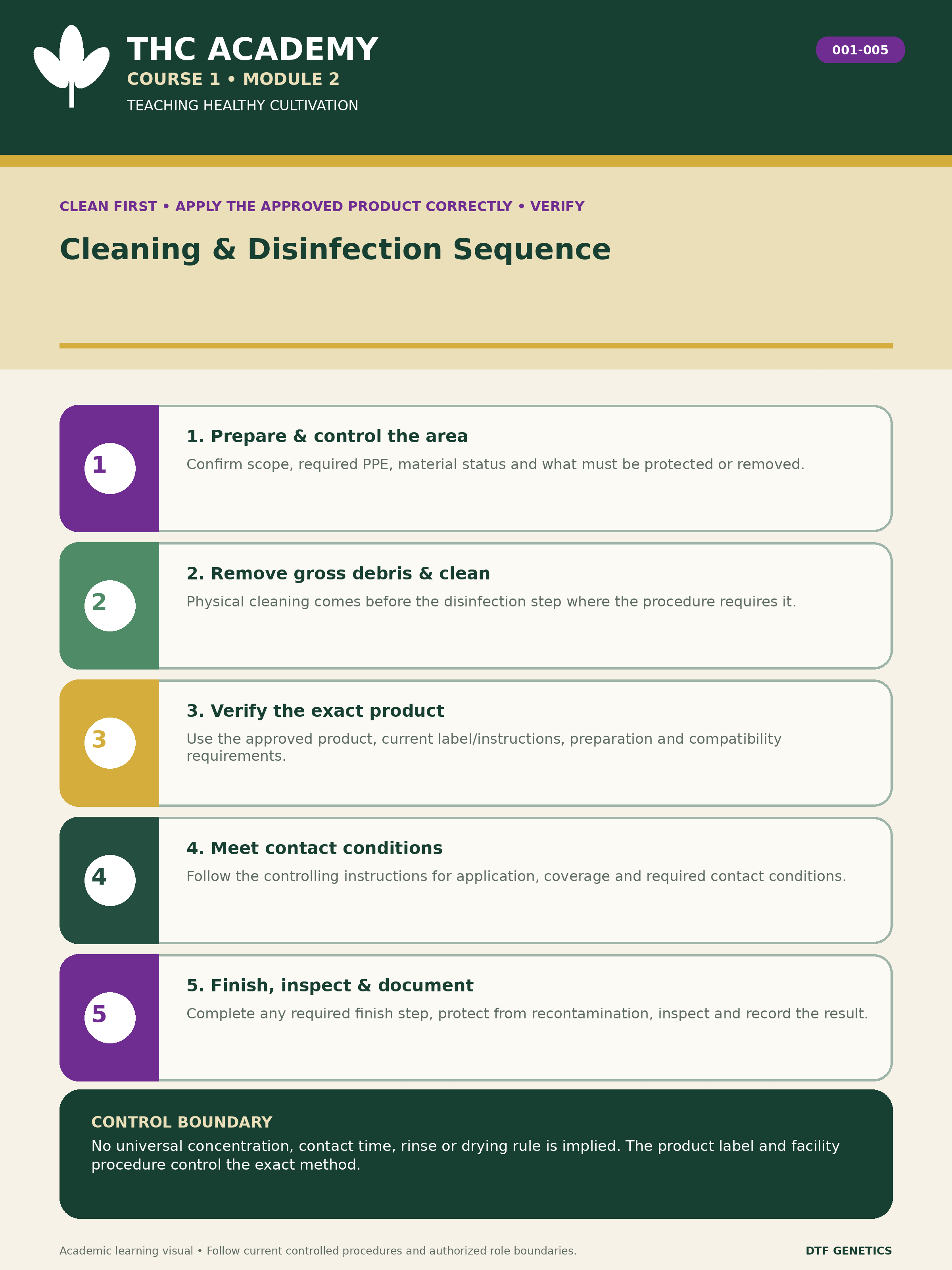
Cleaning and disinfection are different operations
UMass greenhouse guidance distinguishes physical cleaning from disinfection. Cleaning removes weeds, soil, media, organic matter and debris. Disinfection uses an approved product/process to reduce targeted microorganisms on appropriate cleaned surfaces or equipment.
Organic debris matters because it can prevent disinfectant contact or reduce efficacy. A bench covered with roots, growing media and leaf debris is not ready for a simple spray-and-walk-away sanitation step.
Scientific foundation — why cleaning changes disinfectant performance
Disinfection depends on the active ingredient reaching the target surface under the conditions required for that product. Soil, plant sap, organic debris and biofilm-like residues can physically shield microorganisms, consume or inactivate some disinfectants, and create uneven wetting. Cleaning therefore improves the probability that the disinfectant contacts the surface it is intended to treat.
The concept of contact time is equally important. A surface that is supposed to remain wet for a defined period may not receive an effective treatment if it dries too quickly or is wiped immediately. Conversely, extending contact or increasing concentration beyond the label is not automatically safer or more effective and may create worker, plant or material-compatibility hazards.
Follow the approved product and method
Disinfectants are not interchangeable. Products differ in labeled use, concentration, contact conditions, hazards and material compatibility. Follow the current label and facility SOP. Never strengthen a solution because “more must be better,” mix products unless specifically allowed, or invent an unlabeled use.
A generic sanitation sequence for learning purposes is:
- secure/remove plant or material as the procedure requires;
- remove debris and gross soil;
- physically clean the surface or item;
- verify the approved product and preparation;
- apply as directed;
- maintain required contact/wet conditions where applicable;
- complete the defined rinse/dry/finish step;
- inspect the result;
- document completion and exceptions.
The exact method comes from the product label, equipment constraints and facility SOP.
Worked case
A worker reaches for a sanitizer from the same brand family as the SOP product, but its active ingredient and label differ. Stop and verify the approved product. Brand similarity is not evidence of interchangeable use.
Guided practice — sequence and error hunt
Learners receive sanitation-step cards plus incorrect actions such as “apply over heavy debris,” “double concentration for safety,” “skip label check” and “combine unknown cleaners.” Put valid steps in order and remove unsupported actions. Explain whether each error primarily threatens efficacy, worker safety, material compatibility or record integrity.
Retrieval check
- Why should gross organic material generally be removed before disinfection?
- What information controls concentration/contact conditions?
- Why is “looks clean” not proof that a controlled sanitation process was completed?