Course outline & progress
Course outline
0 of 18 lessons marked complete
- 1. Applied Cultivation Workplace Safety
- 1.1 Hazard recognition and control boundaries
- 1.2 PPE, chemical labels and Safety Data Sheets
- 1.3 Cannabis-specific exposures and emergency escalation
- 2. Sanitation, Biosecurity & Controlled Movement
- 2.1 Contamination routes and zone discipline
- 2.2 Cleaning, disinfection and sanitation verification
- 2.3 Quarantine, holds and biosecurity breach response
- 3. SOPs, Work Orders, Authority & Escalation
- 3.1 Reading controlled SOPs and work orders
- 3.2 Working within authorization
- 3.3 Deviations, incomplete work and honest status
- 4. Traceability, Material Movement, Inventory & Waste
- 4.1 Identity through the cultivation workflow
- 4.2 Movement, inventory and vendor-neutral tracking
- 4.3 Discrepancies, waste and destruction documentation
- 5. Equipment Readiness, Operator Care & Fault Reporting
- 5.1 Equipment pre-use and readiness checks
- 5.2 Routine operator care versus skilled maintenance
- 5.3 Alarms, fault context and maintenance escalation
- 6. Records, Shift Handoff & Integrated Workflow
- 6.1 Contemporaneous records and data integrity
- 6.2 Professional shift handoff
- 6.3 Integrated Technician I workflow
Working within authorization
Identify the correct controlled SOP or work order for a task and distinguish required steps, acceptance criteria, exceptions and escalation points.
Identify the correct controlled SOP or work order for a task and distinguish required steps, acceptance criteria, exceptions and escalation points.
Identify common cultivation workplace hazards and select the correct routine response: control within authorization, stop, isolate where authorized, or escalate.
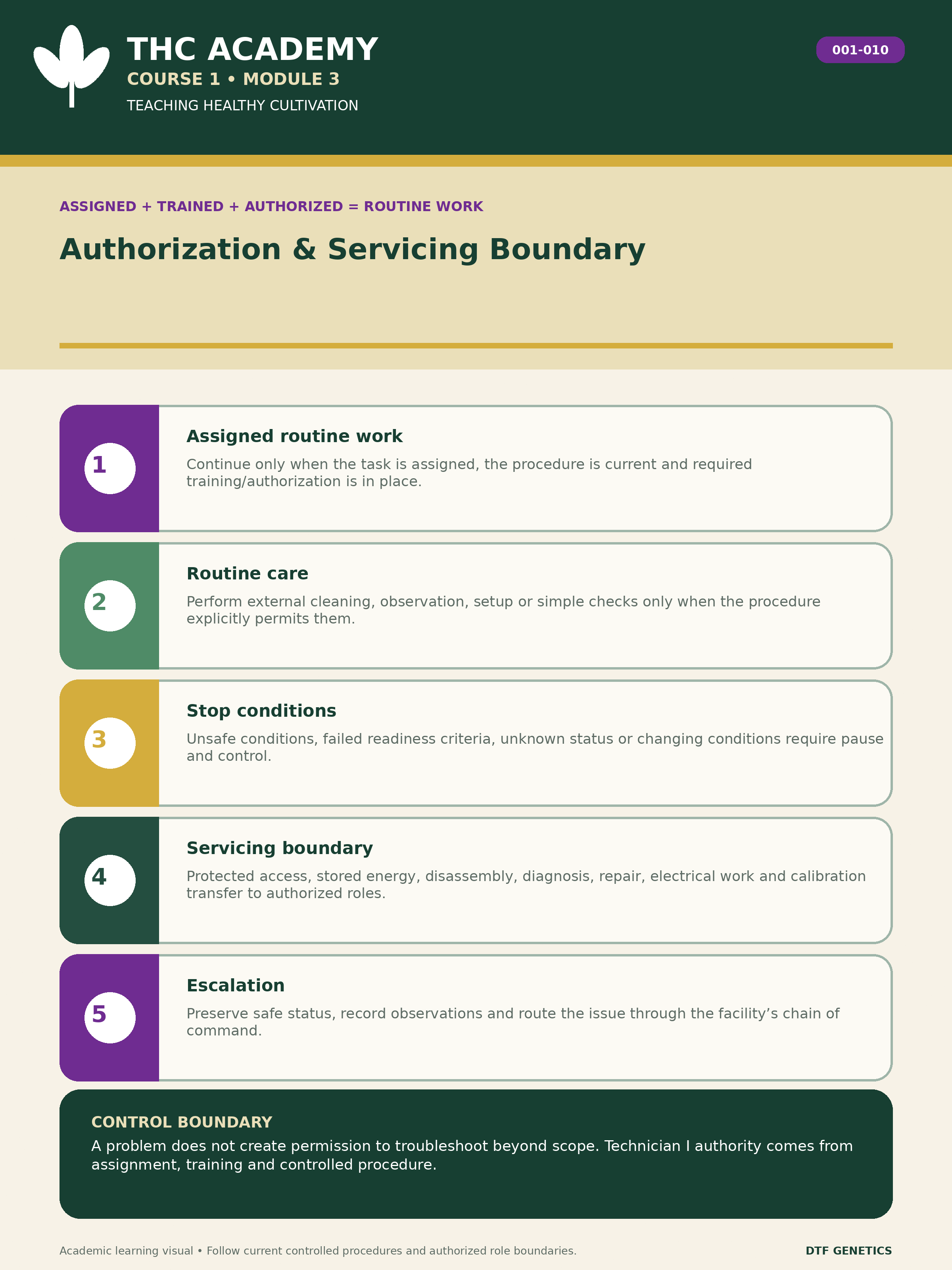
Capability does not equal permission
A technician may understand what an electrical panel does without being permitted to open it. A worker may recognize a pesticide-related restriction without having handler authority. A technician may identify that a pump has failed without being authorized to service it.
Technician I is intentionally an execution-and-escalation role. The course should reward correct boundaries, not heroic improvisation.
Decision quality includes knowing when not to act
Competence is not measured only by how many tasks a person can perform. In a controlled operation it also includes recognizing when the available information, authority, equipment state or safety condition is insufficient for action. A technician who stops at the correct boundary may be demonstrating stronger competence than someone who improvises a technically plausible but unauthorized repair.
This principle should appear repeatedly throughout the course: observe → verify authority → act if authorized → document → escalate unresolved conditions.
Affected versus authorized work is a useful model
OSHA’s hazardous-energy standard distinguishes affected employees from authorized employees in covered servicing. The course uses this as a role-boundary teaching model: a worker can be affected by servicing and must understand restrictions without being authorized to perform the energy-control work.
Where the next step requires removing/bypassing a guard, opening protected equipment, entering hazardous servicing conditions or performing work outside the operator procedure, the Technician I response is to stop and refer the condition.
Worked case
A pump alarm appears. The operator SOP allows checking reservoir level, visible leaks and an external breaker indicator. Those checks do not explain the problem. The next troubleshooting step would require opening an electrical control box. Technician I stops at the boundary, records the fault context and escalates.
Guided practice — authority sorting
Sort each action into one of six categories:
- routine technician action;
- stop/hold;
- supervisor decision;
- maintenance referral;
- safety response;
- regulated/specialist action.
Use a supplied role matrix rather than personal confidence.
Retrieval check
- Why does knowing how a repair works not prove authorization?
- Give one example of an operator-level check and one example of protected servicing.
- Why are role boundaries part of competency rather than a limitation on competency?