Course outline & progress
Course outline
0 of 18 lessons marked complete
- 1. Applied Cultivation Workplace Safety
- 1.1 Hazard recognition and control boundaries
- 1.2 PPE, chemical labels and Safety Data Sheets
- 1.3 Cannabis-specific exposures and emergency escalation
- 2. Sanitation, Biosecurity & Controlled Movement
- 2.1 Contamination routes and zone discipline
- 2.2 Cleaning, disinfection and sanitation verification
- 2.3 Quarantine, holds and biosecurity breach response
- 3. SOPs, Work Orders, Authority & Escalation
- 3.1 Reading controlled SOPs and work orders
- 3.2 Working within authorization
- 3.3 Deviations, incomplete work and honest status
- 4. Traceability, Material Movement, Inventory & Waste
- 4.1 Identity through the cultivation workflow
- 4.2 Movement, inventory and vendor-neutral tracking
- 4.3 Discrepancies, waste and destruction documentation
- 5. Equipment Readiness, Operator Care & Fault Reporting
- 5.1 Equipment pre-use and readiness checks
- 5.2 Routine operator care versus skilled maintenance
- 5.3 Alarms, fault context and maintenance escalation
- 6. Records, Shift Handoff & Integrated Workflow
- 6.1 Contemporaneous records and data integrity
- 6.2 Professional shift handoff
- 6.3 Integrated Technician I workflow
Deviations, incomplete work and honest status
Identify the correct controlled SOP or work order for a task and distinguish required steps, acceptance criteria, exceptions and escalation points.
Identify the correct controlled SOP or work order for a task and distinguish required steps, acceptance criteria, exceptions and escalation points.
Create contemporaneous, legible and attributable cultivation records and correct errors while preserving the original record history.
Produce a concise shift handoff that accurately communicates completed work, observations, deviations, unresolved conditions and priorities.
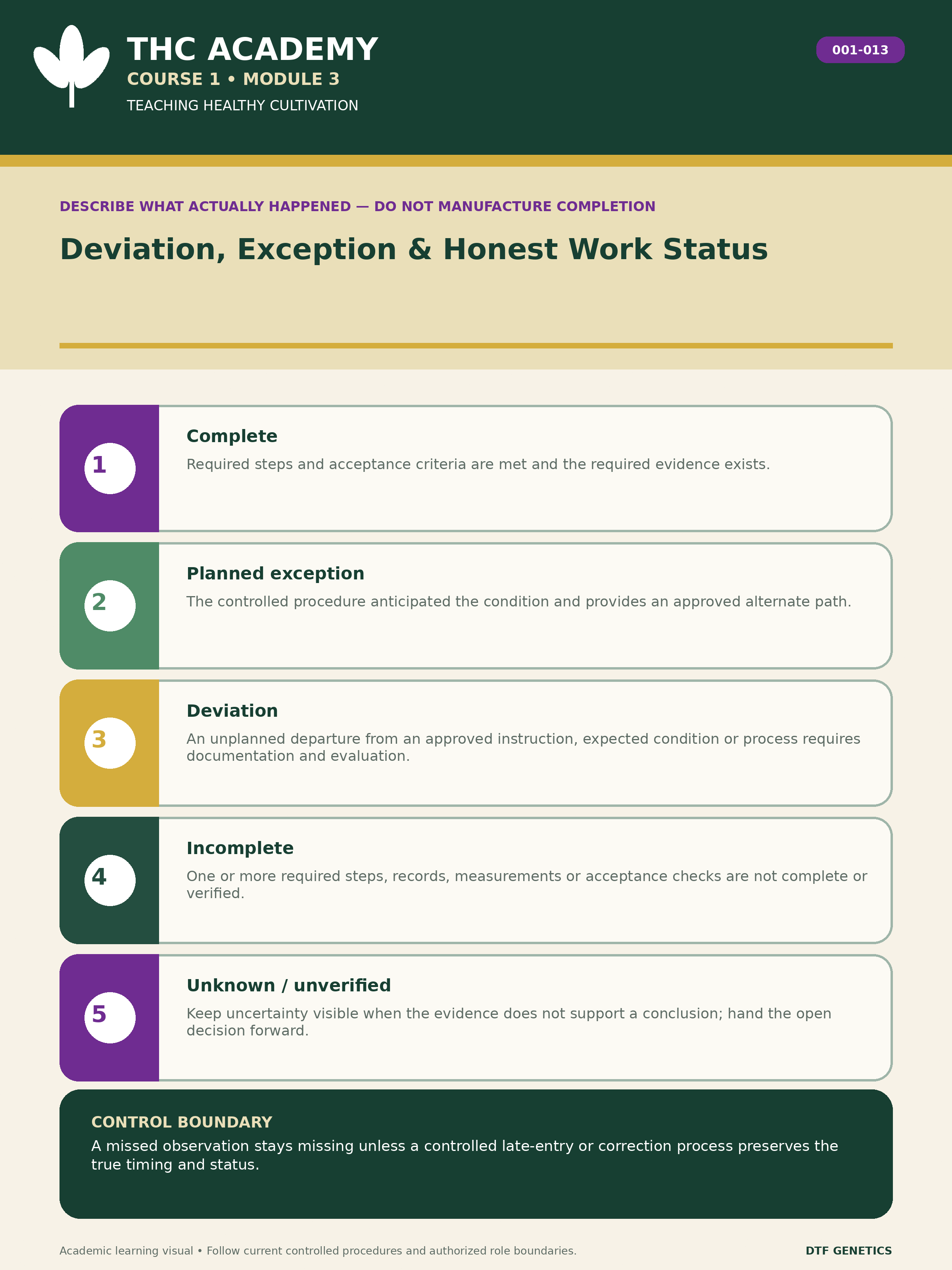
Deviations are operational information
Equipment faults, identity mismatches, alarms, shortages, contamination concerns and other conditions can interrupt the plan. A deviation is not automatically proof that a worker failed. Hiding it, however, removes information the operation needs to improve and can create a larger problem.
Do not manufacture completion
A task is complete only when required steps and acceptance criteria are met or an authorized exception is documented. If a required observation was missed, the record should show the true status according to procedure. Do not invent a value later and present it as contemporaneous.
WHO data-integrity guidance provides a useful transferred principle: records should remain attributable, legible, contemporaneous, original/true and accurate, as well as complete, consistent, enduring and available. In this course those are quality concepts, not pharmaceutical legal requirements.
Worked case
A sanitation cycle is interrupted when the correct product is unavailable. The shift is ending. Marking the job complete would create false status. Record what was completed, what was not, why the work stopped, who was notified and what must happen next.
Guided practice — incomplete work packet
Learners receive a partially completed packet containing:
- one missed measurement;
- one unresolved identity mismatch;
- one incomplete sanitation step;
- one equipment alarm;
- one completed task.
For each, state whether work can continue, must stop, or requires escalation, and write the truthful status for the next shift.
Module application — controlled work-order review
Complete a mock work order from start to handoff. The scenario includes an obsolete SOP copy, an identifier mismatch and a task that exceeds Technician I authority. Correct performance means catching those issues before they become execution errors.
Module retrieval
Explain why procedure compliance, authority boundaries, deviation reporting, and data integrity belong in the same module. Give one example where a failure in one area creates a problem in another.