Course outline & progress
Course outline
0 of 18 lessons marked complete
- 1. Applied Cultivation Workplace Safety
- 1.1 Hazard recognition and control boundaries
- 1.2 PPE, chemical labels and Safety Data Sheets
- 1.3 Cannabis-specific exposures and emergency escalation
- 2. Sanitation, Biosecurity & Controlled Movement
- 2.1 Contamination routes and zone discipline
- 2.2 Cleaning, disinfection and sanitation verification
- 2.3 Quarantine, holds and biosecurity breach response
- 3. SOPs, Work Orders, Authority & Escalation
- 3.1 Reading controlled SOPs and work orders
- 3.2 Working within authorization
- 3.3 Deviations, incomplete work and honest status
- 4. Traceability, Material Movement, Inventory & Waste
- 4.1 Identity through the cultivation workflow
- 4.2 Movement, inventory and vendor-neutral tracking
- 4.3 Discrepancies, waste and destruction documentation
- 5. Equipment Readiness, Operator Care & Fault Reporting
- 5.1 Equipment pre-use and readiness checks
- 5.2 Routine operator care versus skilled maintenance
- 5.3 Alarms, fault context and maintenance escalation
- 6. Records, Shift Handoff & Integrated Workflow
- 6.1 Contemporaneous records and data integrity
- 6.2 Professional shift handoff
- 6.3 Integrated Technician I workflow
Identity through the cultivation workflow
Preserve plant, batch, lot, room and material identity during routine cultivation movements, transfers and handoffs.
Preserve plant, batch, lot, room and material identity during routine cultivation movements, transfers and handoffs.
Identity is operational infrastructure
A cultivation operation may track individual plants, groups, lots, batches, rooms, containers, samples or other controlled objects depending on its process and jurisdiction. The naming system can vary, but the purpose is the same: keep observations and actions connected to the correct material.
GS1 distinguishes class-, batch/lot- and instance-level identification. Technician I does not need to memorize GS1 identifiers; the educational value is the underlying decision: what level of identity is required for this material and event?
Scientific foundation — traceability is a graph, not a list
A useful way to understand traceability is as a network of linked objects and events. Objects can include plants, lots, rooms, containers, samples or waste units. Events connect those objects through actions such as propagation, transplanting, movement, treatment, sampling, harvest, splitting, combining or disposition.
Each event should preserve enough information to answer questions such as:
- What object was involved?
- Where was it before and after the event?
- When did the event occur?
- What quantity or count changed?
- Which earlier object or event is it derived from?
- Who or what system recorded the event?
This graph model explains why a single missing identifier can damage much more than one record: it can break the connection between upstream history and downstream observations.
Transitions create identity risk
Identity is easiest to lose when something changes:
- seed or clone becomes a plant unit;
- transplant changes container or location;
- plants move between rooms;
- material is divided or combined;
- a sample is taken;
- harvest material changes container;
- waste is separated from usable material;
- data is moved from paper to digital systems.
Before a transition, verify the physical identifier against the work order and destination. After the transition, verify that the controlled record matches physical reality.
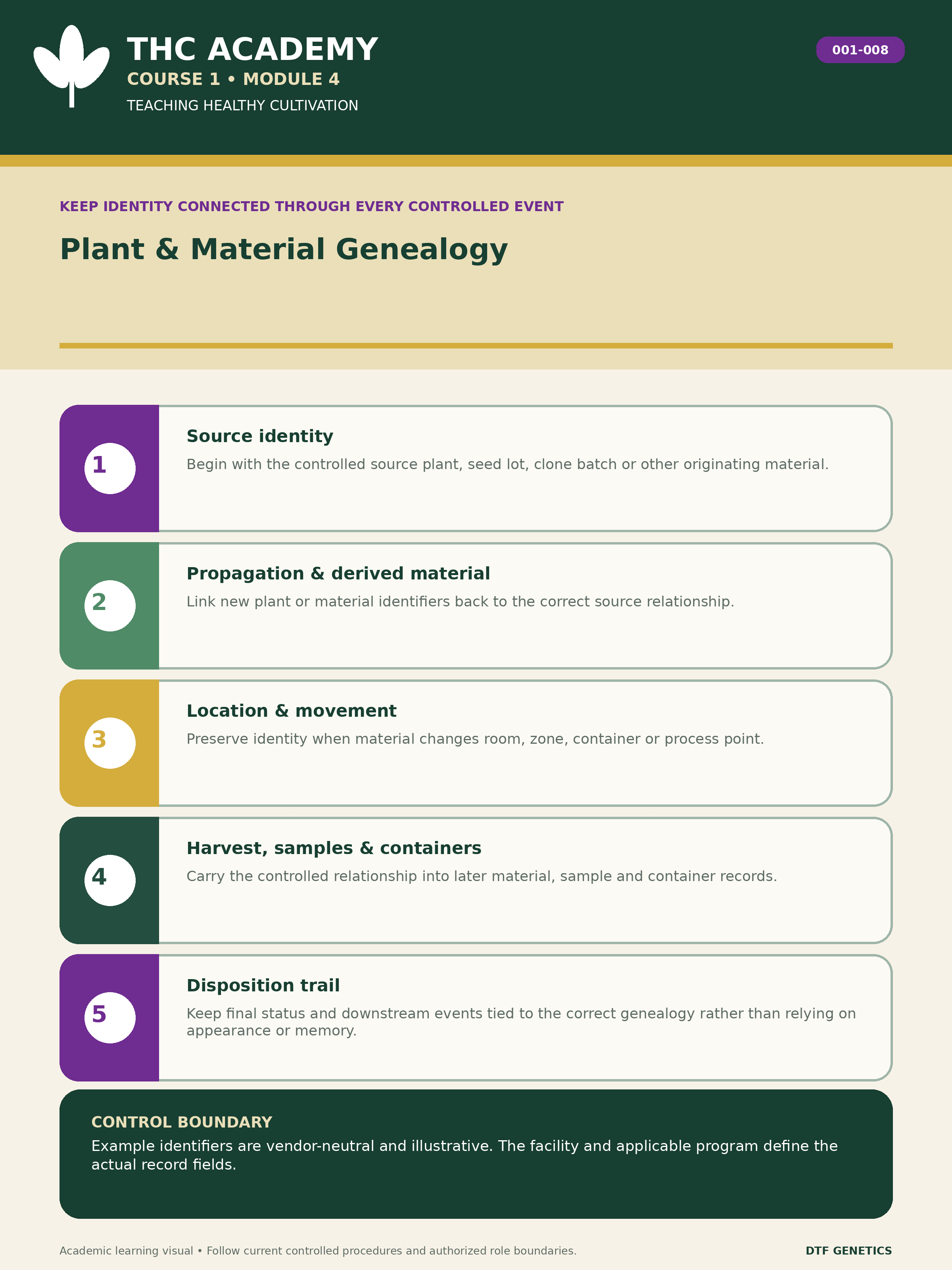
Genealogy matters
If a new identifier replaces or extends an earlier one, preserve the relationship. A harvest container does not erase the source plant/batch history. A sample ID should still connect to the material it represents. Good genealogy lets the operation reconstruct what happened and prevents unrelated records from becoming attached to the wrong material.
Worked case
A plant tag does not match the move order. The plant resembles the others and is probably part of the same cultivar group. Appearance is not enough to overwrite controlled identity. Stop the affected movement and resolve the mismatch under procedure.
Guided practice — genealogy chain
Trace a mock workflow from donor plant to clone tray, transplant batch, flowering room, harvest container and retained sample. For each transition, record:
- source identity;
- new/continuing identity;
- location;
- time/date;
- quantity/count where relevant;
- person/system recording the event.
Retrieval check
- Why is cultivar name alone usually insufficient as a unique identity?
- At what points in cultivation is identity most vulnerable?
- Why should a replacement identifier remain linked to the prior one?