Course outline & progress
Course outline
0 of 18 lessons marked complete
- 1. Applied Cultivation Workplace Safety
- 1.1 Hazard recognition and control boundaries
- 1.2 PPE, chemical labels and Safety Data Sheets
- 1.3 Cannabis-specific exposures and emergency escalation
- 2. Sanitation, Biosecurity & Controlled Movement
- 2.1 Contamination routes and zone discipline
- 2.2 Cleaning, disinfection and sanitation verification
- 2.3 Quarantine, holds and biosecurity breach response
- 3. SOPs, Work Orders, Authority & Escalation
- 3.1 Reading controlled SOPs and work orders
- 3.2 Working within authorization
- 3.3 Deviations, incomplete work and honest status
- 4. Traceability, Material Movement, Inventory & Waste
- 4.1 Identity through the cultivation workflow
- 4.2 Movement, inventory and vendor-neutral tracking
- 4.3 Discrepancies, waste and destruction documentation
- 5. Equipment Readiness, Operator Care & Fault Reporting
- 5.1 Equipment pre-use and readiness checks
- 5.2 Routine operator care versus skilled maintenance
- 5.3 Alarms, fault context and maintenance escalation
- 6. Records, Shift Handoff & Integrated Workflow
- 6.1 Contemporaneous records and data integrity
- 6.2 Professional shift handoff
- 6.3 Integrated Technician I workflow
Movement, inventory and vendor-neutral tracking
Complete routine inventory, movement and waste or destruction records accurately under a supplied vendor-neutral workflow.
Complete routine inventory, movement and waste or destruction records accurately under a supplied vendor-neutral workflow.
The record should follow physical reality
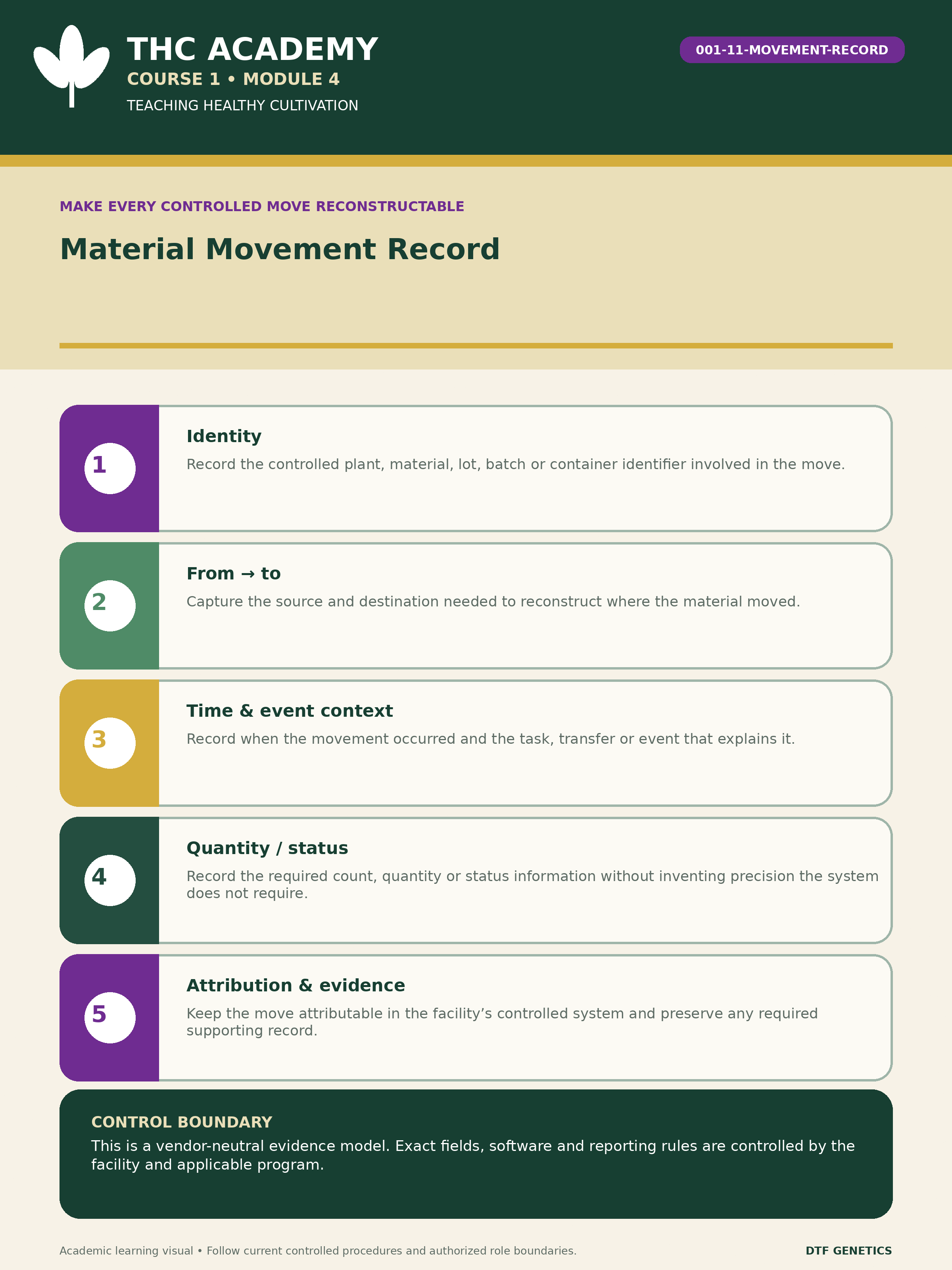
A movement entry should correspond to a real, authorized physical event. A useful generic movement record includes the identity of what moved, source, destination, time, applicable count/quantity, and the responsible person or system.
The exact legal data fields vary by jurisdiction. This course therefore teaches the stable operational logic rather than pretending one software interface is universal.
Reconciliation is comparison, not forced agreement
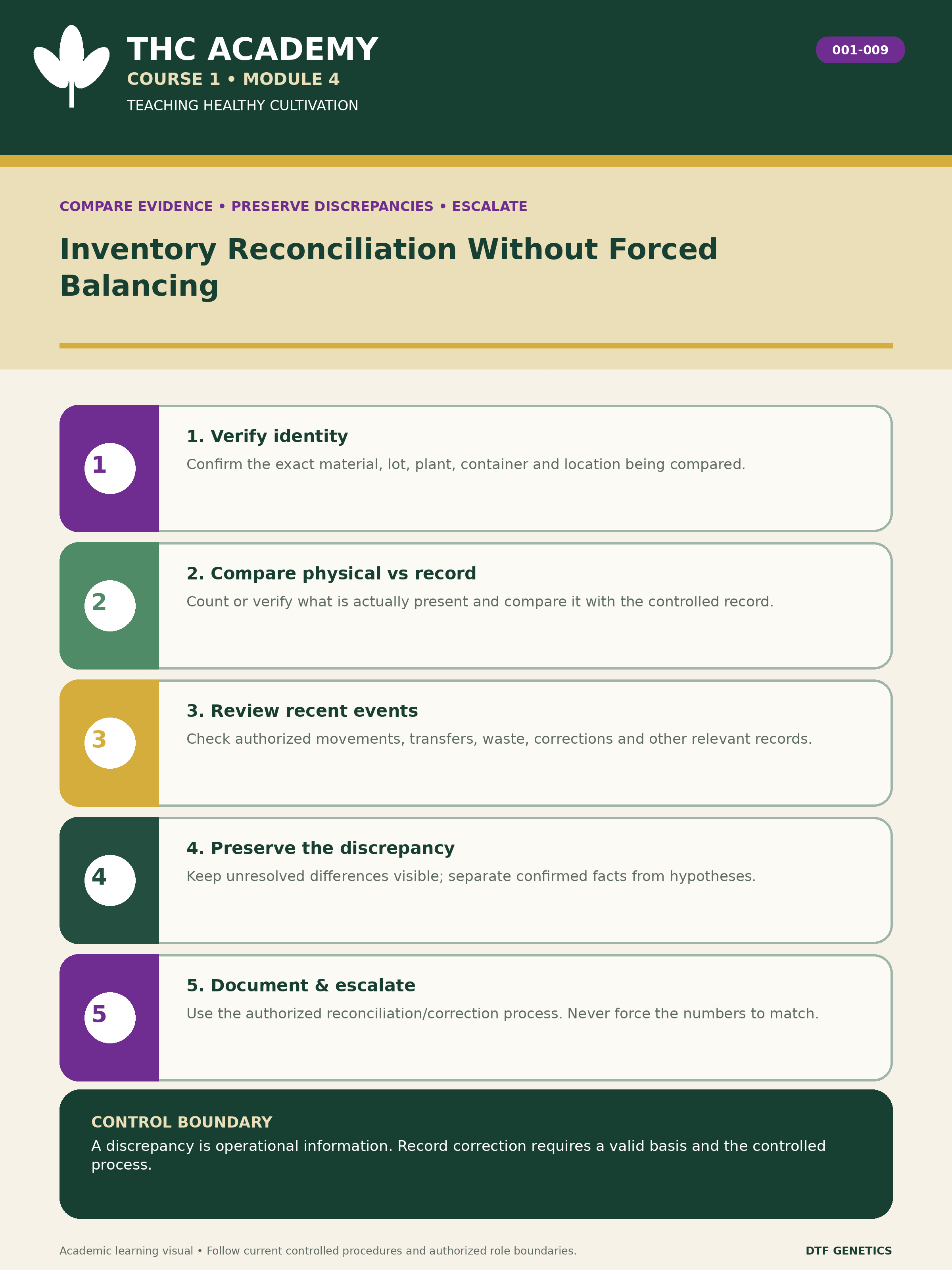
Inventory reconciliation compares the physical state with the controlled record. If the system expects 48 plants and the physical count is 47, do not change either side simply to make the numbers agree. Recount and verify within procedure, preserve the discrepancy, and escalate if it cannot be resolved.
A discrepancy can indicate:
- counting error;
- delayed record entry;
- wrong identifier;
- unrecorded movement;
- loss/damage;
- software or synchronization issue;
- another process failure.
Scientific foundation — reconciliation is an error-detection process
Reconciliation works because two representations of reality are compared: the physical state and the recorded state. Agreement increases confidence but does not prove perfection; disagreement is information that something needs investigation.
A strong reconciliation process avoids immediately editing the record to make the mismatch disappear. Instead, it preserves the observation, repeats or verifies measurements where appropriate, checks recent movement events and identities, and records the resolution path. This turns discrepancies into process-improvement evidence instead of hidden errors.
Technician I gathers permitted facts; a supervisor/compliance/QA role may own the investigation or final correction.
Worked case
A room move is complete physically, but the digital platform is unavailable. The site has a controlled downtime procedure. Record the event using the approved contingency method so the true time and identity are preserved, then reconcile when the system returns. Do not wait until the end of the day and reconstruct multiple movements from memory if the procedure provides a better method.
Guided practice — movement packet
Complete two simulated movements:
- a normal movement with matching identity/count;
- a movement containing a physical-versus-record discrepancy.
For the second, document what you verified, what remained uncertain, what you did not change, and who was notified.
Retrieval check
- What is the difference between reconciliation and changing a record until it matches expectations?
- Which movement facts are stable across software platforms?
- Why is a controlled downtime process better than retrospective memory entry?