Course outline & progress
Course outline
0 of 18 lessons marked complete
- 1. Applied Cultivation Workplace Safety
- 1.1 Hazard recognition and control boundaries
- 1.2 PPE, chemical labels and Safety Data Sheets
- 1.3 Cannabis-specific exposures and emergency escalation
- 2. Sanitation, Biosecurity & Controlled Movement
- 2.1 Contamination routes and zone discipline
- 2.2 Cleaning, disinfection and sanitation verification
- 2.3 Quarantine, holds and biosecurity breach response
- 3. SOPs, Work Orders, Authority & Escalation
- 3.1 Reading controlled SOPs and work orders
- 3.2 Working within authorization
- 3.3 Deviations, incomplete work and honest status
- 4. Traceability, Material Movement, Inventory & Waste
- 4.1 Identity through the cultivation workflow
- 4.2 Movement, inventory and vendor-neutral tracking
- 4.3 Discrepancies, waste and destruction documentation
- 5. Equipment Readiness, Operator Care & Fault Reporting
- 5.1 Equipment pre-use and readiness checks
- 5.2 Routine operator care versus skilled maintenance
- 5.3 Alarms, fault context and maintenance escalation
- 6. Records, Shift Handoff & Integrated Workflow
- 6.1 Contemporaneous records and data integrity
- 6.2 Professional shift handoff
- 6.3 Integrated Technician I workflow
Discrepancies, waste and destruction documentation
Complete routine inventory, movement and waste or destruction records accurately under a supplied vendor-neutral workflow.
Complete routine inventory, movement and waste or destruction records accurately under a supplied vendor-neutral workflow.
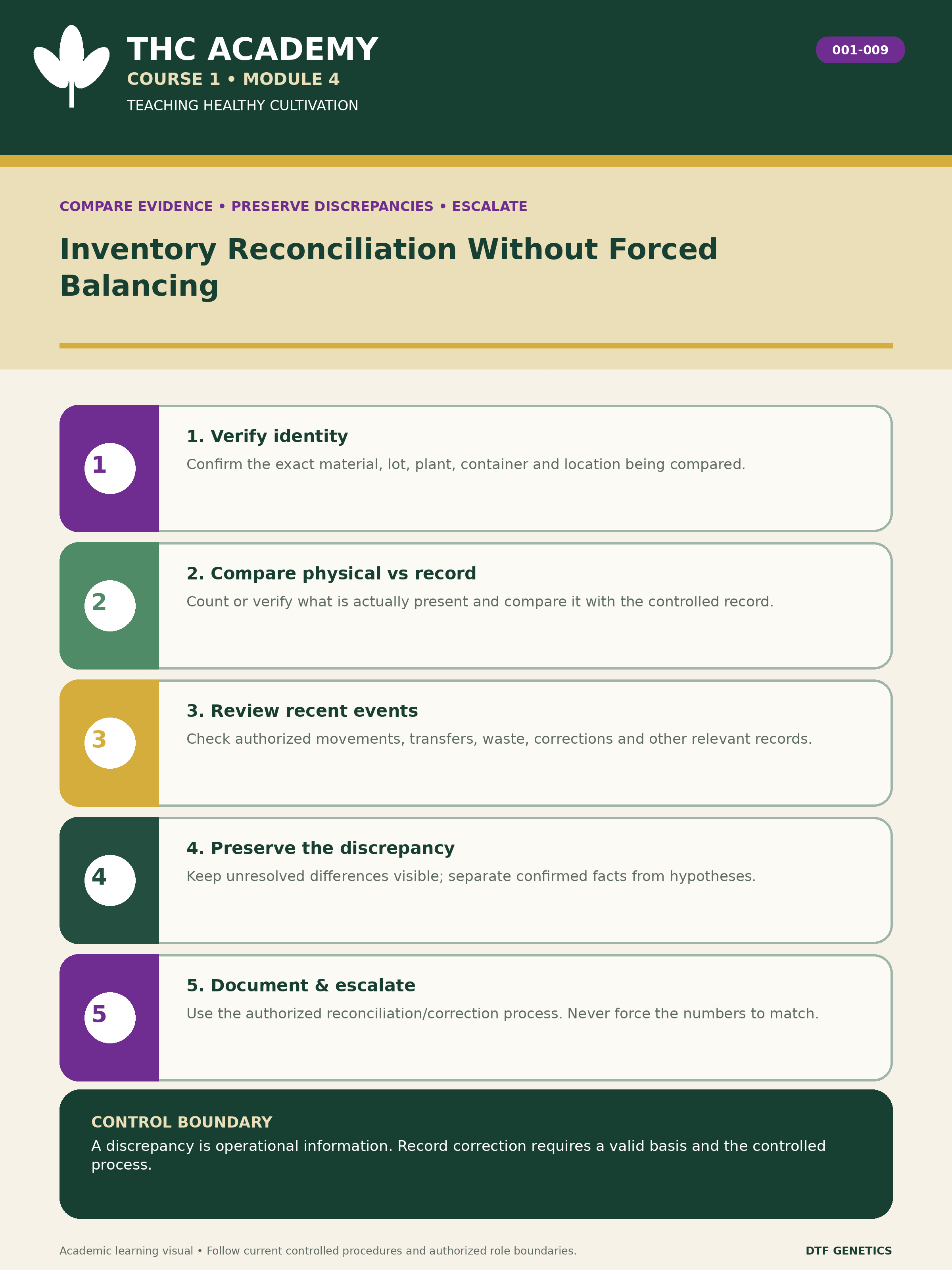
Detect and report a mismatch between physical material and a paper or digital record without falsifying or forcing reconciliation.
Waste does not automatically lose identity
Plant material designated as waste can still require identity, quantity, status and disposition records. The exact destruction method and reporting rules are jurisdiction-specific and must be taught locally. Technician I should understand a safer general principle: do not destroy the evidence chain before the required record is complete.
Preserve the discrepancy before correcting it
When the physical material and record disagree, preserve enough information to reconstruct what was observed. Silent corrections can make an investigation impossible. WHO data-integrity guidance supports maintaining complete, accurate, traceable records and preserving change history.
Hold questionable material when required
If waste lacks an identifier, a destruction entry exists while material remains, or two batches are about to be combined before required records are complete, stop the uncontrolled transition. The appropriate role determines final disposition.
Worked case
The digital system shows a batch as destroyed, but the physical waste container is still present. Throwing it away would make the record appear correct while concealing the discrepancy. Preserve the material/status, report the conflict, and follow the reconciliation process.
Guided practice — discrepancy investigation
Learners receive a mock event history with:
- beginning count;
- one transfer;
- one plant removed from production;
- one delayed digital entry;
- final physical count;
- one mislabeled waste container.
Build the most defensible timeline, identify what can be confirmed, identify what remains uncertain, and write the escalation note.
Module application — traceability reconciliation packet
Produce a portfolio-ready simulated packet containing:
- genealogy diagram;
- movement record;
- inventory reconciliation;
- discrepancy note;
- waste/disposition handoff.
Module retrieval
Explain the relationship among identity, event history, physical verification, reconciliation, and disposition. Then explain why a tracking platform can support traceability but cannot replace disciplined technician behavior.