Course outline & progress
Course outline
0 of 18 lessons marked complete
- 1. Applied Cultivation Workplace Safety
- 1.1 Hazard recognition and control boundaries
- 1.2 PPE, chemical labels and Safety Data Sheets
- 1.3 Cannabis-specific exposures and emergency escalation
- 2. Sanitation, Biosecurity & Controlled Movement
- 2.1 Contamination routes and zone discipline
- 2.2 Cleaning, disinfection and sanitation verification
- 2.3 Quarantine, holds and biosecurity breach response
- 3. SOPs, Work Orders, Authority & Escalation
- 3.1 Reading controlled SOPs and work orders
- 3.2 Working within authorization
- 3.3 Deviations, incomplete work and honest status
- 4. Traceability, Material Movement, Inventory & Waste
- 4.1 Identity through the cultivation workflow
- 4.2 Movement, inventory and vendor-neutral tracking
- 4.3 Discrepancies, waste and destruction documentation
- 5. Equipment Readiness, Operator Care & Fault Reporting
- 5.1 Equipment pre-use and readiness checks
- 5.2 Routine operator care versus skilled maintenance
- 5.3 Alarms, fault context and maintenance escalation
- 6. Records, Shift Handoff & Integrated Workflow
- 6.1 Contemporaneous records and data integrity
- 6.2 Professional shift handoff
- 6.3 Integrated Technician I workflow
Routine operator care versus skilled maintenance
Perform permitted pre-use, readiness, cleaning and operator-care checks on assigned cultivation or irrigation equipment using the supplied procedure.
Perform permitted pre-use, readiness, cleaning and operator-care checks on assigned cultivation or irrigation equipment using the supplied procedure.
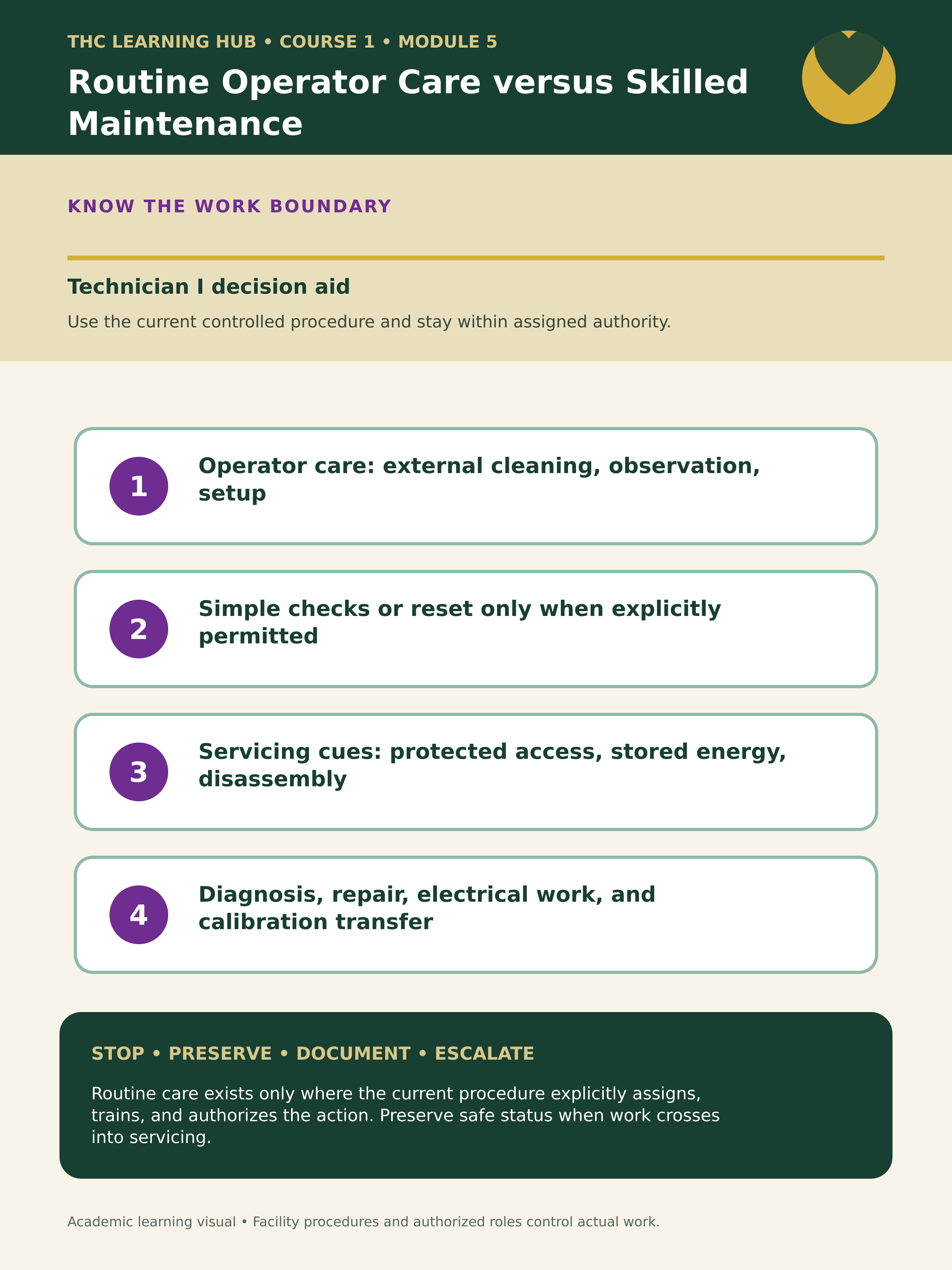
Operator care is explicitly assigned
Operator care can include external cleaning, inspection, simple setup, replacement of consumables, checking visible connections, or other tasks that the equipment manual and site SOP assign to the operator.
The key phrase is assigned to the operator. Technician I should not expand the task because the repair looks simple.
Servicing changes the hazard picture
Tasks can move into servicing when they require:
- removing/bypassing guards;
- reaching into hazardous motion areas;
- disassembling powered equipment;
- opening protected electrical components;
- releasing pressure/stored energy;
- clearing jams where unexpected startup is possible;
- other maintenance covered by the employer’s energy-control procedure.
OSHA 1910.147 requires appropriate energy-control procedures for covered servicing and distinguishes authorized employees from affected workers. Course completion does not make the learner an authorized lockout/tagout worker.
Worked case
An irrigation filter appears clogged. The operator procedure allows an external pressure reading and visual leak inspection. Clearing the suspected blockage requires disassembling a pressurized component. The technician stops at the assigned operator checks and refers the service task.
Guided practice — find the boundary
For ten equipment scenarios, draw a line between operator care and servicing. For each servicing task, state what information should be passed to maintenance instead of attempting the repair.
Retrieval check
- Why is “I know how” different from “I am authorized”?
- Give two examples of stored or hazardous energy.
- When can an operator check become a servicing task?