Course outline & progress
Course outline
0 of 18 lessons marked complete
- 1. Applied Cultivation Workplace Safety
- 1.1 Hazard recognition and control boundaries
- 1.2 PPE, chemical labels and Safety Data Sheets
- 1.3 Cannabis-specific exposures and emergency escalation
- 2. Sanitation, Biosecurity & Controlled Movement
- 2.1 Contamination routes and zone discipline
- 2.2 Cleaning, disinfection and sanitation verification
- 2.3 Quarantine, holds and biosecurity breach response
- 3. SOPs, Work Orders, Authority & Escalation
- 3.1 Reading controlled SOPs and work orders
- 3.2 Working within authorization
- 3.3 Deviations, incomplete work and honest status
- 4. Traceability, Material Movement, Inventory & Waste
- 4.1 Identity through the cultivation workflow
- 4.2 Movement, inventory and vendor-neutral tracking
- 4.3 Discrepancies, waste and destruction documentation
- 5. Equipment Readiness, Operator Care & Fault Reporting
- 5.1 Equipment pre-use and readiness checks
- 5.2 Routine operator care versus skilled maintenance
- 5.3 Alarms, fault context and maintenance escalation
- 6. Records, Shift Handoff & Integrated Workflow
- 6.1 Contemporaneous records and data integrity
- 6.2 Professional shift handoff
- 6.3 Integrated Technician I workflow
Alarms, fault context and maintenance escalation
Recognize obvious equipment faults, alarms, leaks, clogs or unsafe conditions and produce a useful escalation record without unauthorized repair.
Recognize obvious equipment faults, alarms, leaks, clogs or unsafe conditions and produce a useful escalation record without unauthorized repair.
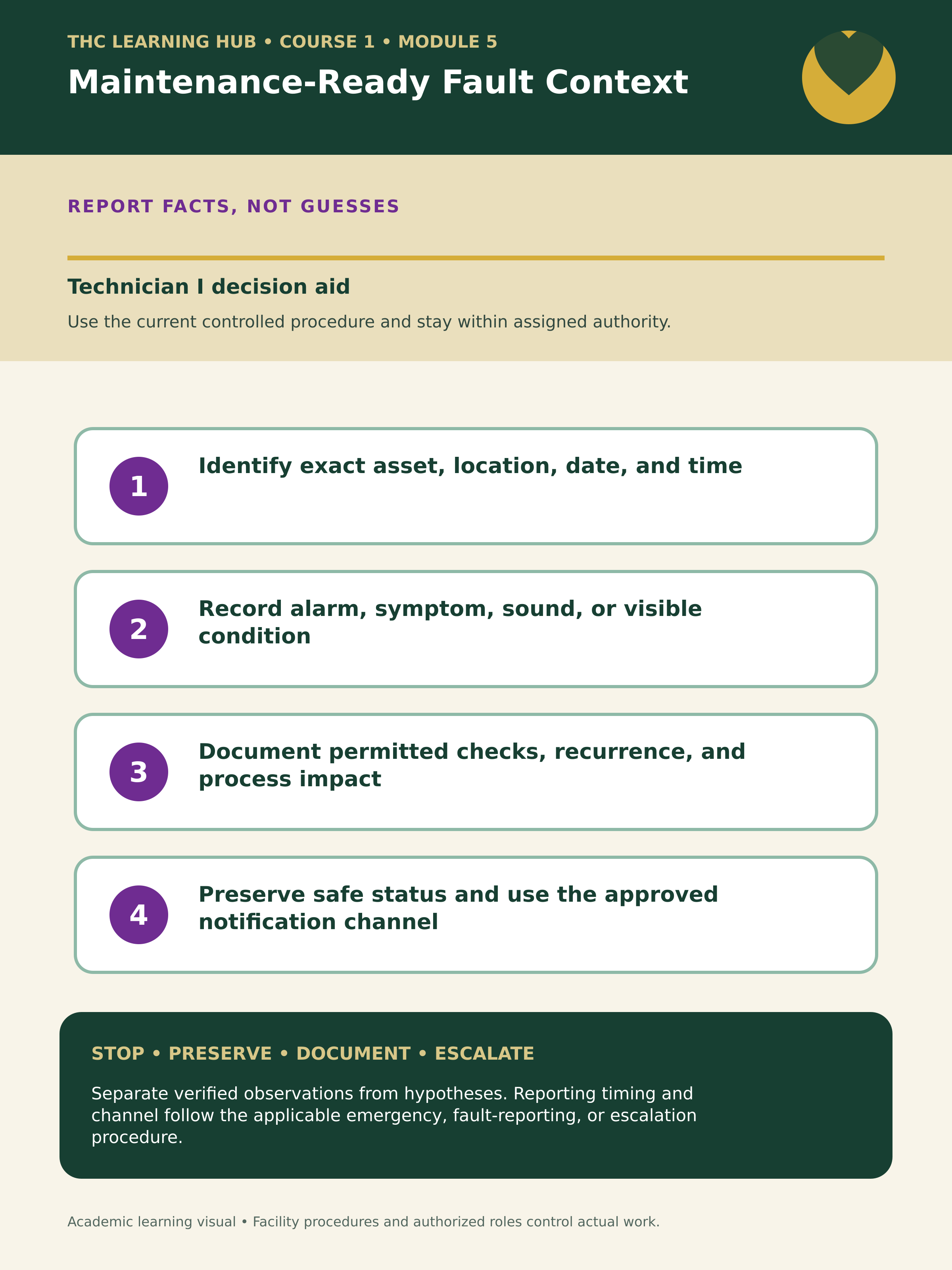
An alarm is evidence, not a root cause
A controller alert, failed zone, unusual noise, leak or abnormal reading is a symptom. It can narrow the investigation, but Technician I should not declare a root cause without evidence.
Scientific foundation — observation, hypothesis and diagnosis are not the same thing
A good fault report separates three levels:
- Observation: directly seen, heard, measured or reported by the system.
- Hypothesis: a possible explanation consistent with the observation.
- Diagnosis: a supported conclusion reached with sufficient evidence and appropriate authority.
For example, “Zone 3 has no measured flow” is an observation. “The filter may be blocked” is a hypothesis. “The filter is blocked” is a diagnosis that may require inspection beyond Technician I authority.
Keeping those levels separate prevents premature conclusions from becoming false maintenance history.
Useful fault context includes:
- asset ID;
- location/zone;
- exact time;
- alarm code/message;
- relevant readings;
- visible condition;
- operator checks completed;
- process/crop impact;
- safe action already taken;
- person/ticket notified.
Repeated resetting can hide the problem
Resetting an alarm without understanding the permitted procedure can erase useful context or allow repeated failure. If the operator SOP permits one reset after defined checks, follow it. If the condition returns or the procedure does not authorize reset, escalate.
Worked case
Pump P-12 alarms at 14:10. Tank level is normal, no visible leak is present, and Zone 3 receives no flow. The operator checklist is complete. A strong escalation states those facts. “Pump broken” is too vague; opening the control cabinet would exceed Technician I authority.
Guided practice — write the maintenance ticket
From a simulated dashboard, room map and operator checklist, write a maintenance-ready escalation using only observable facts. Separate:
- observation;
- permitted test/check;
- result;
- impact;
- hypothesis if allowed, clearly labeled as unconfirmed.
Module application — equipment fault report
Complete a portfolio-ready simulated report containing:
- pre-use inspection;
- alarm timeline;
- allowed checks;
- out-of-service decision;
- maintenance escalation;
- affected-task handoff.
Module retrieval
Explain why a technician who does not attempt an unauthorized repair may be demonstrating stronger competence than one who successfully improvises a repair outside procedure.