Course outline & progress
Course outline
0 of 18 lessons marked complete
- 1. Applied Cultivation Workplace Safety
- 1.1 Hazard recognition and control boundaries
- 1.2 PPE, chemical labels and Safety Data Sheets
- 1.3 Cannabis-specific exposures and emergency escalation
- 2. Sanitation, Biosecurity & Controlled Movement
- 2.1 Contamination routes and zone discipline
- 2.2 Cleaning, disinfection and sanitation verification
- 2.3 Quarantine, holds and biosecurity breach response
- 3. SOPs, Work Orders, Authority & Escalation
- 3.1 Reading controlled SOPs and work orders
- 3.2 Working within authorization
- 3.3 Deviations, incomplete work and honest status
- 4. Traceability, Material Movement, Inventory & Waste
- 4.1 Identity through the cultivation workflow
- 4.2 Movement, inventory and vendor-neutral tracking
- 4.3 Discrepancies, waste and destruction documentation
- 5. Equipment Readiness, Operator Care & Fault Reporting
- 5.1 Equipment pre-use and readiness checks
- 5.2 Routine operator care versus skilled maintenance
- 5.3 Alarms, fault context and maintenance escalation
- 6. Records, Shift Handoff & Integrated Workflow
- 6.1 Contemporaneous records and data integrity
- 6.2 Professional shift handoff
- 6.3 Integrated Technician I workflow
Professional shift handoff
Produce a concise shift handoff that accurately communicates completed work, observations, deviations, unresolved conditions and priorities.
Produce a concise shift handoff that accurately communicates completed work, observations, deviations, unresolved conditions and priorities.
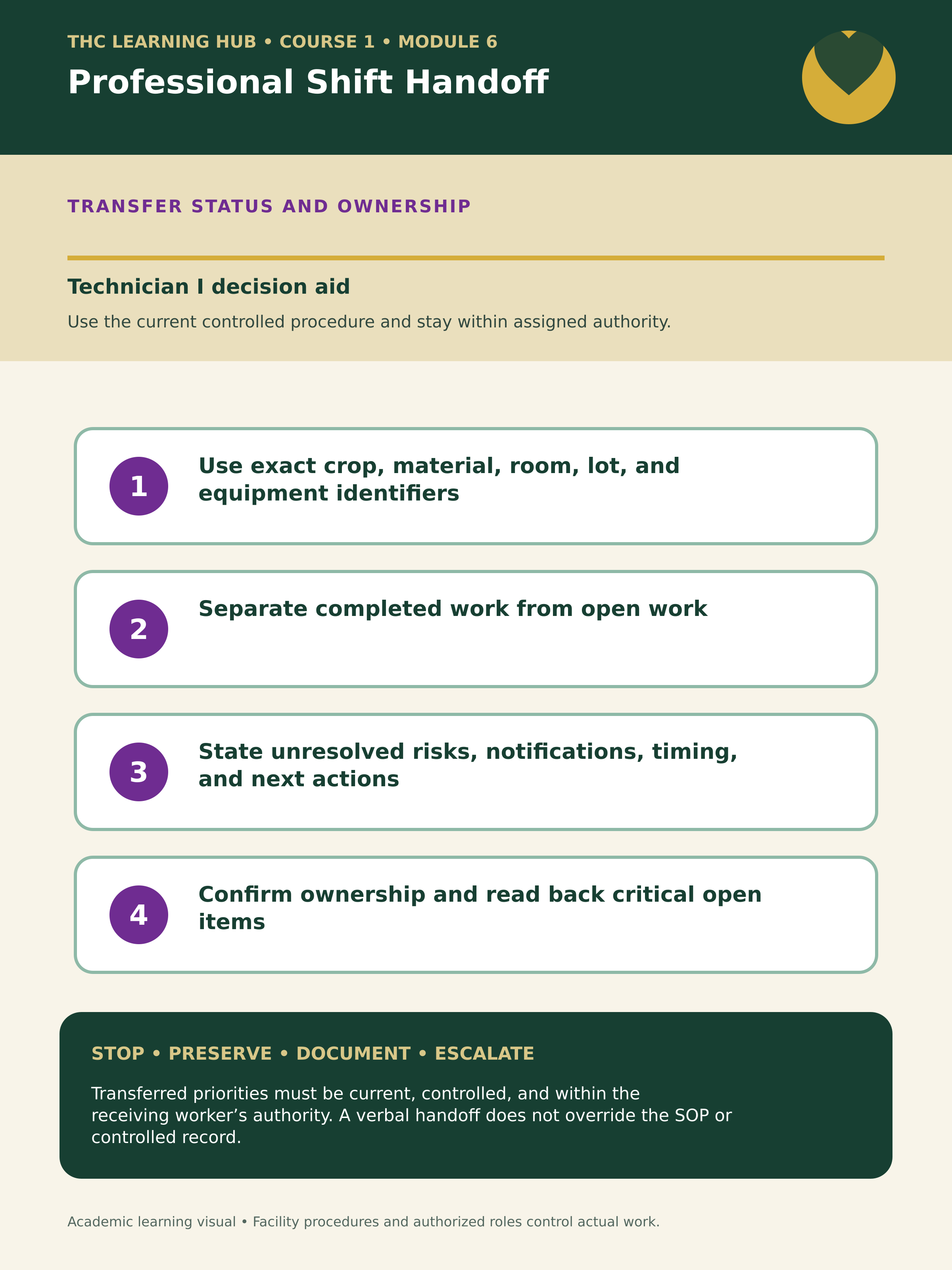
Handoff is a controlled transfer of responsibility
HSE describes effective shift handover as involving preparation by outgoing personnel, communication between outgoing and incoming personnel, and cross-checking by incoming staff. It also recommends both written and verbal communication for safety-critical handovers.
Scientific foundation — handoff is a human-factors control
Handoffs are vulnerable to memory limits, assumption, interruption, ambiguous language and information overload. A structured handoff reduces those failure modes by making critical information explicit and allowing the incoming worker to question or repeat back the open items.
The goal is not maximum detail. It is high signal: enough information to preserve safety, identity, process state and unfinished work without forcing the next shift to search through irrelevant history.
A cultivation handoff should make unresolved work visible, not bury it underneath a long list of routine completed tasks.
Prioritize what the next person needs
A strong handoff identifies:
- critical safety/biosecurity restrictions;
- holds/quarantine/restricted-entry status;
- incomplete work;
- identity or inventory discrepancies;
- equipment alarms/faults;
- abnormal observations;
- time-sensitive next actions;
- people already notified;
- decisions still waiting for authorization.
Use exact identifiers and bounded language
“Plants bad” is not actionable. “Room F2, north row, Batch B17: four plants with reduced turgor at 16:10; irrigation event confirmed in system; no diagnosis assigned; lead notified for follow-up” is far more useful.
Separate observation from diagnosis. Separate open status from completed status.
Worked case
Zone 2 emitters 5–8 show no flow at 16:20. Operator checks are complete, maintenance ticket M-44 is open, and the next scheduled irrigation is at 18:00. The next shift needs those facts, not simply “irrigation issue.”
Guided practice — handoff compression
Learners receive a messy page of shift notes. Convert it into a handoff with five categories:
- safety/restrictions;
- crop/material status;
- equipment/facility status;
- incomplete work/open deviations;
- next actions/notifications.
Then role-play a two-way handoff in which the incoming technician asks clarifying questions and repeats back critical open items.
Retrieval check
- Why should handoff be two-way rather than only a written note?
- Which unresolved conditions deserve priority placement?
- Why should observation and diagnosis be separated?