Course outline & progress
Course outline
0 of 18 lessons marked complete
- 1. Applied Cultivation Workplace Safety
- 1.1 Hazard recognition and control boundaries
- 1.2 PPE, chemical labels and Safety Data Sheets
- 1.3 Cannabis-specific exposures and emergency escalation
- 2. Sanitation, Biosecurity & Controlled Movement
- 2.1 Contamination routes and zone discipline
- 2.2 Cleaning, disinfection and sanitation verification
- 2.3 Quarantine, holds and biosecurity breach response
- 3. SOPs, Work Orders, Authority & Escalation
- 3.1 Reading controlled SOPs and work orders
- 3.2 Working within authorization
- 3.3 Deviations, incomplete work and honest status
- 4. Traceability, Material Movement, Inventory & Waste
- 4.1 Identity through the cultivation workflow
- 4.2 Movement, inventory and vendor-neutral tracking
- 4.3 Discrepancies, waste and destruction documentation
- 5. Equipment Readiness, Operator Care & Fault Reporting
- 5.1 Equipment pre-use and readiness checks
- 5.2 Routine operator care versus skilled maintenance
- 5.3 Alarms, fault context and maintenance escalation
- 6. Records, Shift Handoff & Integrated Workflow
- 6.1 Contemporaneous records and data integrity
- 6.2 Professional shift handoff
- 6.3 Integrated Technician I workflow
Integrated Technician I workflow
Identify common cultivation workplace hazards and select the correct routine response: control within authorization, stop, isolate where authorized, or escalate.
Identify common cultivation workplace hazards and select the correct routine response: control within authorization, stop, isolate where authorized, or escalate.
Use supplied PPE requirements, chemical labels and safety data sheet information to prepare for an assigned cultivation task without exceeding training or authorization.
Execute sanitation and controlled-movement procedures that reduce cross-contamination risk between plants, rooms, tools and work zones.
Recognize quarantine, restricted-entry, hold and isolation conditions and apply the response defined by the supplied procedure.
Identify the correct controlled SOP or work order for a task and distinguish required steps, acceptance criteria, exceptions and escalation points.
Preserve plant, batch, lot, room and material identity during routine cultivation movements, transfers and handoffs.
Complete routine inventory, movement and waste or destruction records accurately under a supplied vendor-neutral workflow.
Detect and report a mismatch between physical material and a paper or digital record without falsifying or forcing reconciliation.
Perform permitted pre-use, readiness, cleaning and operator-care checks on assigned cultivation or irrigation equipment using the supplied procedure.
Recognize obvious equipment faults, alarms, leaks, clogs or unsafe conditions and produce a useful escalation record without unauthorized repair.
Create contemporaneous, legible and attributable cultivation records and correct errors while preserving the original record history.
Produce a concise shift handoff that accurately communicates completed work, observations, deviations, unresolved conditions and priorities.
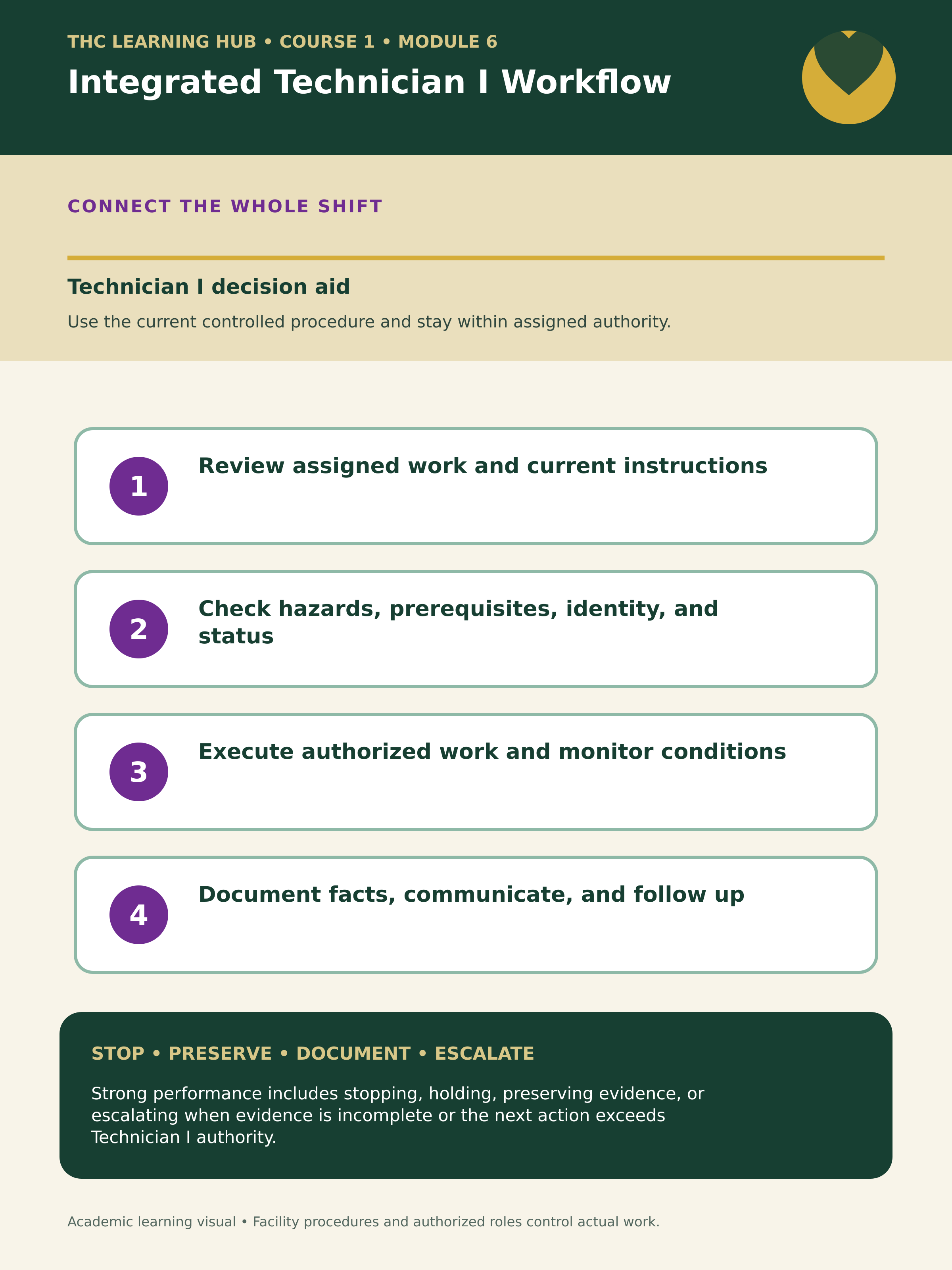
Read the whole situation before starting the first task
Real work arrives as a packet, not a textbook chapter. A technician may face a work order, prior-shift handoff, room restriction, equipment alarm, inventory discrepancy, sanitation requirement and time-sensitive crop task at the same time.
Competence means prioritizing the controls that block downstream work.
Integrated reasoning — dependencies determine priority
The first task on a schedule is not always the first task that can safely proceed. Cultivation workflows contain dependencies: a room hold can block movement, a sanitation failure can block entry, an identity mismatch can block transfer, and an equipment fault can block irrigation. The technician should identify those dependencies before acting.
A simple decision sequence is:
What is blocked? → What condition blocks it? → Can I resolve that condition within authority? → If yes, verify and continue. If no, hold and escalate.
This prevents wasted work and reduces the chance that one uncontrolled action creates multiple downstream errors.
A practical sequence is:
- review the handoff/work packet;
- identify safety and entry restrictions;
- verify current SOP/work order;
- confirm identity and destination;
- prepare PPE/sanitation requirements;
- perform authorized routine work;
- capture measurements/events as they occur;
- stop/escalate when authority ends or acceptance criteria fail;
- reconcile physical and recorded status;
- hand off unresolved work.
Integrated scenario
You receive the following at shift start:
- a planned plant move;
- a destination room on hold;
- one tag mismatch in the source group;
- a sanitation station missing the approved product;
- an irrigation pump alarm;
- a prior-shift measurement that was not taken;
- a maintenance ticket already opened.
The wrong approach is to begin moving the plants because that task appears first. The move is blocked by the hold and identity mismatch; room entry may also be blocked by sanitation readiness. The pump receives only permitted checks because maintenance is already involved. The missed measurement remains identified as missing rather than reconstructed. Each unresolved item becomes part of the handoff.
Capstone-style guided practice
Use the supplied integrated work packet to create:
- priority list;
- stop/continue/escalate decisions;
- controlled instruction check;
- material movement decision;
- discrepancy record;
- equipment escalation note;
- corrected record;
- final handoff.
Final reflection
Technician I is not defined by knowing every answer. It is defined by executing routine work safely and consistently, protecting identity and records, recognizing abnormal conditions, and escalating correctly instead of improvising beyond role authority.
Module application — portfolio shift summary
Create a one-page simulated integrated shift summary that an employer could understand. It should show:
- work completed;
- evidence/records produced;
- open risks/deviations;
- affected material/equipment identities;
- notifications;
- next actions.
Course retrieval
Without notes, explain how these six ideas connect:
safety → biosecurity → controlled instructions → traceability → equipment boundaries → trustworthy handoff.
If one link fails, give an example of how the failure can propagate into the next shift or next process.